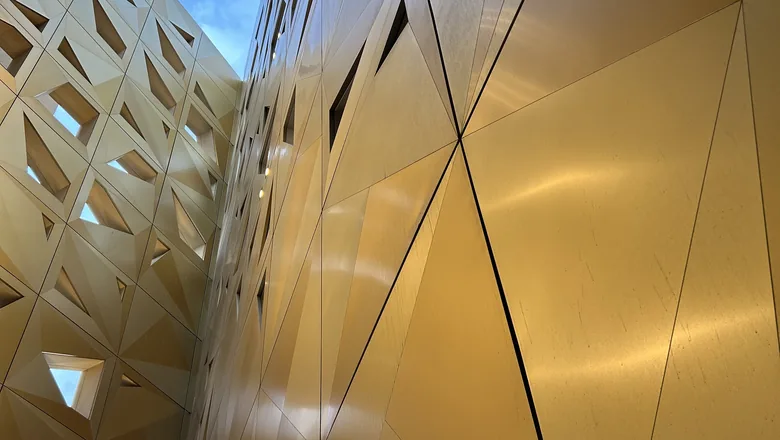
Anodized aluminum cladding is solid aluminum sheet whose surface has been converted into a hard, integral oxide layer by electrolysis. The finish is not a coating sitting on top of the metal — it is the metal, transformed. That single difference is what makes anodized panels the specification of choice for elevations that face salt spray, wind-blown sand and twenty-five years of cleaning cycles, and for interiors where a genuine metal surface has to survive daily contact. On INDECO’s wall systems it sits alongside kinetic louver facades and unitised glazing as the solid, no-nonsense option: see the Aluminum Cladding product page for the full panel range.
Most of what is written about anodized aluminum stays at the level of adjectives. This guide is about the numbers you actually have to put in a specification: film thickness and its AA class, neutral salt-spray hours, color tolerance expressed as ΔE, fire class, and the forming sequence that decides whether the folded edge of your panel is protected or bare.
What anodizing actually does to the aluminum
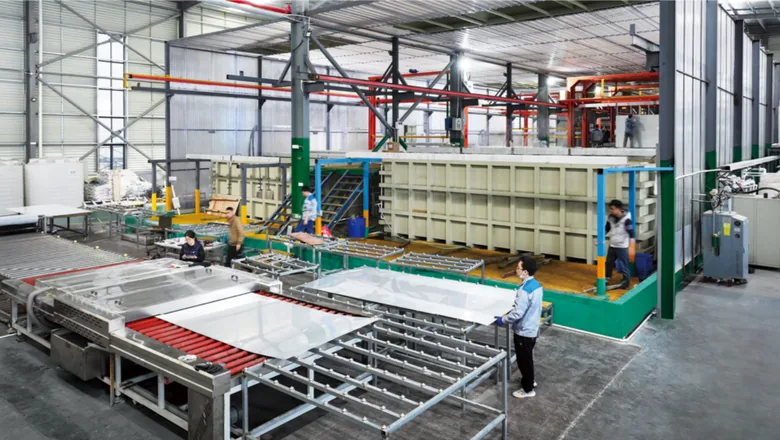
In a sulphuric-acid anodizing line, the aluminum sheet becomes the anode in an electrolyte bath and a direct current is passed through it. Oxygen liberated at the surface reacts with the aluminum immediately, building an oxide layer that grows outward and inward from the original surface. Unlike a paint film, that layer is chemically continuous with the substrate: there is no interface to delaminate, because there is no second material.
The oxide as formed is porous — millions of hexagonal cells with fine channels running through them. That porosity is what makes color possible: pigment can be drawn into the channels by organic dye, or metal salts can be driven into them by a second electrolytic step. The pores are then closed in a sealing stage, and the color ends up locked inside the oxide rather than lying on top of it. The full sequence our sheet passes through is: degrease → etch → neutralize → anodize → color → seal.
Film thickness, mechanical data and salt spray
The oxide layer on architectural sheet normally runs from 5 to 25 microns, expressed as the CLASS designation AA5 through AA25 — AA15 means a nominal 15 µm film. Thicker is not automatically better: a heavier film is harder and more corrosion-resistant but less tolerant of tight bends, so the class has to be matched to the forming and to the exposure.
The table below is the data we work from when specifying anodized sheet. The salt-spray column is the one worth reading twice.
| Surface series | Alloy & temper | Film class | Neutral salt spray | Yield strength | Elongation |
|---|---|---|---|---|---|
| Satin | 5052-T32 | AA5–AA25 | 168–500 h | 110–160 MPa | ≥4–6% |
| Brushed | 5052-T32 / 5005-H14 | AA5–AA20 | 500 h | 110–150 MPa | ≥4% |
| Embossed | 5052-T32 / 5005-H14 | AA5–AA20 | 500 h | 110–150 MPa | ≥4% |
| Sandblasted | 5052-T32 / 5005-H14 | AA5–AA20 | 4,000 h | 110–150 MPa | ≥4% |
| Electrolytic color (D-series) | 5052-T32 / 5005-H14 | AA5–AA20 | 500 h | 110–150 MPa | ≥4% |
Two numbers deserve comment. First, the 4,000-hour sandblasted class is roughly eight times the standard 500-hour result, and it is the specification we reach for on coastal and marine elevations in the Gulf, East Africa and West Africa. Second, the satin series carrying a 168–500 h range is a reminder that anodizing is a process, not a product: the same series can be run at different film classes, and the corrosion result moves with it. Ask for the class, not just the series.
Five anodized surfaces — and where each belongs
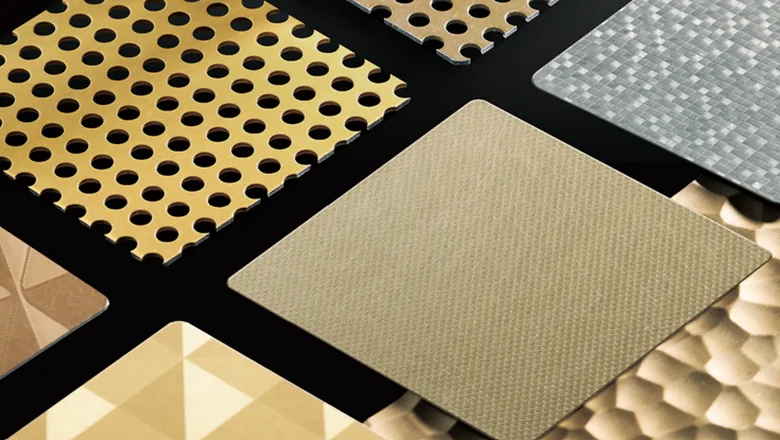
The surface texture is set before anodizing: rolled, brushed, embossed or blasted into the sheet, then locked in by the oxide. Because the texture is in the metal, it cannot wear off.
- Satin — a fine matte grain with low reflectivity. Fingerprint-resistant and anti-static, so it does not hold a charge and attracts noticeably less dust. The default for large wall areas and ceilings in sandy climates.
- Brushed — a directional grain, available long or short. Reads unmistakably as metal and hides minor panel waviness under raking light. The premium choice for retail interiors, lift lobbies and entrance walls.
- Embossed — a pattern rolled into the sheet before anodizing. Used as a feature surface where the design wants depth rather than color.
- Sandblasted — high-pressure abrasive produces an even, multi-angle matte that is softer than brushed to the eye. This is the 4,000-hour corrosion class.
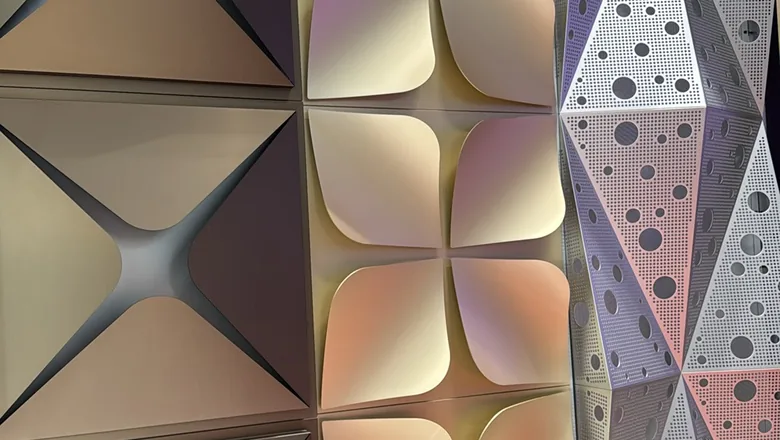
- Electrolytic color (D-series) — metal salts driven into the pores produce champagne, bronze, black, blue and green tones. Because the color sits inside the oxide, it is inherently UV-stable: the usual range also includes brushed black and brushed titanium-silver.
Color consistency: the real specification problem
Anodized color is a chemical result, not a paint recipe. Alloy chemistry, electrolyte temperature and concentration, current density and immersion time all shift the tone, and a drift in any one of them shows up on the wall. This is why anodizing has a reputation for color variance — and why the variance has to be controlled by contract rather than by hope.
Realistic tolerances for production anodizing are ΔE ≤1.0–2.0 within a single batch and ΔE ≤2.0–2.5 across different batches. For reference, around ΔE 1 a trained eye can just detect the difference side by side; above ΔE 2.5 it becomes visible on a large flat elevation.
Four rules keep an anodized elevation visually coherent:
- Fix the alloy and temper. 5052-T32 and 5005-H14 anodize to slightly different tones from the same bath. Mixing them on one elevation is the most common cause of “patchy” anodizing.
- Order one batch per elevation. Not per project — per elevation. Repaint nothing, rematch nothing; the cheapest insurance in the specification.
- Approve a physical sample and keep it. A screen or a print is not a color reference for a metal surface, because anodized tone changes with viewing angle.
- Write the ΔE tolerance into the purchase order, with the measuring method and the reference sample identified.
“Anodized color should be released on a spectrophotometer reading, not on a photograph. If your supplier cannot tell you the ΔE against your approved sample, the color is not specified — it is hoped for.”
Anodized vs PVDF-coated aluminum: an honest comparison
Both finishes belong on a facade. They solve different problems, and specifying the wrong one is expensive in both directions.
| Attribute | Anodized aluminum | PVDF / fluorocarbon coated |
|---|---|---|
| How the finish is bonded | Integral oxide grown from the aluminum itself | Factory-applied paint film over a pre-treated surface |
| Film build | 5–25 µm oxide (AA5–AA25) | Typically 23–35 µm total paint system |
| Color range | Metallic tones, bronzes, blacks, champagne; texture-driven | Effectively unlimited, including exact RAL and bright solids |
| Corrosion data | 500 h neutral salt spray typical; 4,000 h on the sandblasted class | AAMA 2605-grade systems are tested to 4,000 h |
| Abrasion & scratch | High surface hardness; no film to chip or peel | Softer than the oxide; film can chip at cut edges and folds |
| Cut and folded edges | No film to flake; coil-anodized edges read slightly differently in raking light | Cut edges expose bare substrate and are the usual start point for corrosion |
| UV / fade behavior | Color is inside the oxide; no chalking | Quality PVDF resists chalking well; some pigments drift over decades |
| Repairability | Difficult to spot-repair with a color match | Easier to touch up on site |
| Best for | Exposed edges, high-touch interiors, coastal abrasion, genuine metal appearance | Bright custom colors, very large elevations requiring exact cross-batch matching |
Specify PVDF when the design depends on a color anodizing cannot produce, or when several thousand square meters must match precisely across multiple production runs. Specify anodizing when the panel has exposed folds or returns, when the surface will be touched, cleaned or abraded, when the project is coastal, or when the brief calls for a real metal surface rather than a painted one. For a wider look at surface options, see our aluminum cladding finishes guide.
Anodize-then-form, or form-then-anodize?
This is the decision that most often gets left out of a specification, and it is the one that shows up on site.
Coil-to-coil anodizing runs the sheet continuously through the line before fabrication. It is the most economical and the most uniform route, and it is how our standard anodized sheet is produced. The limitation is geometric: only the flat faces are anodized, so a cut edge or a folded return is bare aluminum — still naturally corrosion-resistant, but visibly different from the anodized face under raking light.
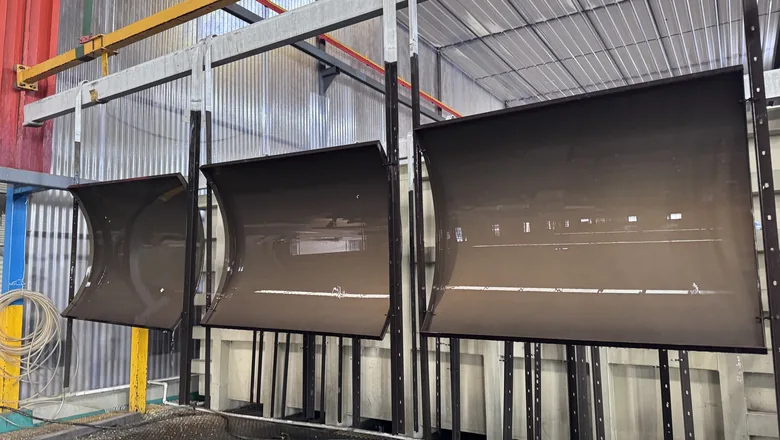
Form-then-anodize forms the panel first and anodizes the finished component, so the oxide covers all six faces, including returns, hems and visible folds. Specify it wherever the edge of the panel is part of the design: ceiling trays, folded fascia, column casings, feature walls with exposed returns. The trade-offs are real — racking contact points can leave marks, and unit cost is higher. Newer hanger-free horizontal anodizing lines reduce contact marking considerably; our anodizing partner commissioned one in 2025 specifically to lift material utilisation on post-formed work.
Whatever the sequence, three forming rules apply:
- Agree a minimum bend radius with the fabricator and check it against the film class. Bending an already-anodized panel past its limit crazes the oxide along the fold.
- Deburr laser-cut edges before anodizing. Burrs hold electrolyte and produce staining that no amount of cleaning removes.
- Handle with film on, but not forever. Protective film should be UV-stable and removed within the supplier’s stated window; a film left on a sun-facing elevation can bake adhesive into the surface.
Fire performance, life span and end of life
Anodized solid aluminum reaches A2-s1,d0 under GB 8624-2012. At 600 °C the panel does not combust and does not release toxic smoke, because both the alloy and the oxide are inorganic — there is no polymer core and no organic film to burn. This is the same argument that makes solid panels the safer choice over composite panels, set out in full in our aluminum cladding fire safety comparison.
Service life for a correctly sealed, correctly specified anodized panel is 25 years and beyond, with the anti-fingerprint and anti-static surface keeping maintenance to periodic washing. At end of life, aluminum is 100% recyclable with recovery rates around 96%, and the oxide layer does not need to be stripped or separated — unlike a composite panel, which has to be split back into metal and core. On projects where the client is tracking embodied carbon or green-building credits, that single fact is often worth more than the panel price difference.
What to write in the specification
Paste this into the material schedule and most of the arguments disappear before they start:
- Alloy and temper: 5052-T32 or 5005-H14, single source per elevation.
- Film class: AA15 minimum for exposed exterior work; AA20–AA25 for high exposure; AA10 acceptable for interior and protected soffits.
- Color: approved physical sample held as reference, with ΔE ≤2.0 within batch and ≤2.5 across batches.
- Corrosion: ≥500 h neutral salt spray as standard; ≥4,000 h for coastal and marine elevations.
- Fire: A2-s1,d0 to GB 8624-2012 (or the local equivalent), stated on the panel, not just in the brochure.
- Process sequence: state explicitly whether the anodizing is coil-to-coil or after forming — and specify form-then-anodize wherever the panel edge is exposed.
- Sealing: oxide must be sealed; unsealed anodizing stains and loses color.
- Fixings: stainless steel or aluminum only; isolate where the fixing meets steel or other metals to avoid galvanic attack.
- Rainscreen cavity: drained and ventilated, with a minimum cavity depth set by the wind load calculation.
- Format: our standard sheet is 1,800 mm wide and 2,440 mm long in 0.15–6.0 mm thickness, with custom lengths available — confirm panel size against the wind-pressure span before fixing the joint layout.
Where anodized cladding goes on a building
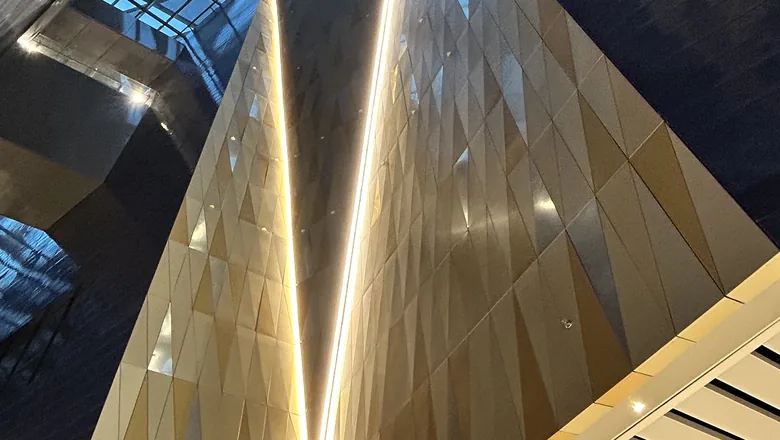
Externally, the material suits rainscreen panels, soffits, canopies, column casings, parapet cappings and any elevation where salt, sand or cleaning equipment will be doing the damage. Internally, it appears as reception and feature walls, lift lobbies, perforated screens and clip-in or hook-on ceilings — hybrid wall systems that use the same anodized surface across wall and ceiling, so the interior reads as one continuous material.
Frequently asked
Can anodized aluminum be repaired on site? Minor scratches in the oxide can be dressed out, but a color-matched spot repair is not realistic. The practical answer is to order spare panels from the same batch at the time of manufacture — and to detail the facade so damaged panels can be replaced individually.
Does anodizing fade? The color is inside the oxide, so it does not chalk or peel the way a paint film can. What it can do is change with exposure if the film is thin or unsealed. Specifying the class and demanding sealing covers both risks.
Is anodized aluminum suitable for coastal projects? Yes — and it is one of the few finishes that is. Use the sandblasted or appropriately thickened class to target the 4,000-hour salt-spray result, specify stainless fixings, and keep the rainscreen cavity drained and ventilated.
How does anodized cladding compare on cost? It normally sits above standard powder coating and at or above a good PVDF system, because the process is slower and the reject rate on color is real. The life-cycle case is the argument: no repainting cycle, no film to fail, full recyclability at end of life.
Key takeaways
- Anodizing grows an integral oxide layer (5–25 µm, CLASS AA5–AA25) out of the aluminum — there is no film to peel, chip or delaminate.
- Process sequence: degrease, etch, neutralize, anodize, color, seal. Color sits inside the pores, which is why it does not chalk.
- Corrosion data ranges from 168–500 h neutral salt spray on standard satin to 4,000 h on the sandblasted class.
- Color consistency is the real risk: ΔE ≤1.0–2.0 within a batch, ≤2.0–2.5 across batches, fixed alloy per elevation, one batch per elevation.
- Form-then-anodize wherever panel returns are visible; coil-to-coil is more economical but leaves cut edges un-anodized.
- A2-s1,d0 fire class, 25-year-plus service life and around 96% recovery at end of life.
Specifying anodized cladding?
Send us the elevation and the exposure. We return a panel schedule with the alloy, film class, ΔE tolerance, salt-spray target and joint layout — and a sample set you can hold against the wall. See the Aluminum Cladding range, read the complete aluminum cladding guide and the finishes and colors guide, or talk to our team.