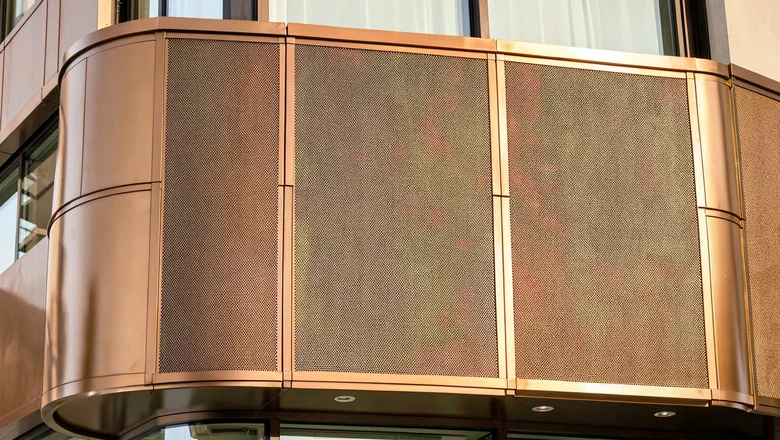
One of the strongest reasons architects specify aluminum cladding is the freedom it gives them over appearance. A single material can be finished to look like stone, timber or brushed metal; it can be perforated into a screen or formed into complex curves. For INDECO, the finish is not an afterthought — it is part of the engineering specification that determines durability, color stability and maintenance. The same PVDF, metallic and wood-effect finishes also appear on INDECO's kinetic facades and frame the views through unitised glazing.
Stone & Wood Texture Imitation
INDECO offers two popular ways to bring natural textures to aluminum without the weight, cost or maintenance of real stone or timber:
- Stone texture imitation — a coating process that reproduces the grain, color variation and tactile feel of natural stone such as granite, marble or limestone. The advantage is a lightweight panel with the look of stone, suitable for large elevations where real stone would be impractical.
- Thermal transfer printed wood texture — a film-transfer process that applies realistic wood grain to the aluminum surface. It gives the warmth of timber with the durability of metal, making it ideal for soffits, feature walls, canopies and interior ceilings.
Both finishes rely on stable coatings that resist fading, cracking and peeling under long-term UV exposure — an important consideration for projects in the Middle East and Africa.
Solid Colors & Metallic Coatings
For a clean, contemporary look, solid color aluminum cladding is the standard choice. INDECO's color range covers neutral greys, whites, blacks, bronze, champagne, gold and project-specific custom colors. The two dominant coating technologies are:
- PVDF / fluorocarbon coating — a two-coat or three-coat system that gives excellent UV resistance, color retention and self-cleaning properties. PVDF is the default for exterior aluminum cladding in harsh climates.
- Powder coating — an electrostatically applied finish that is heat-cured. It offers a wide color range, good durability and environmental benefits (no solvents).
Metallic and anodised finishes are also available, including mirror-polished (No.8) and brushed (No.4) stainless-alike effects, giving designers a premium architectural palette that matches the kinetic facade and glazing finishes on the same building.
Perforated Aluminum Panels & Screens
Perforation turns a solid panel into a perforated aluminum screen that controls light, air, visibility and solar gain. INDECO can produce panels with standard pattern libraries or custom perforations based on the architect's design.
Common applications include:
- External façade screens — solar shading and privacy layers.
- Air-conditioner covers — hiding mechanical equipment while allowing airflow.
- Balustrades and partitions — decorative and functional screening.
- Interior feature walls and ceilings — acoustic and visual interest.
Perforation patterns can be geometric, organic, branded or even image-based, giving projects a unique identity.
Hyperbolic, Curved & Shaped Panels
Flat panels are only the beginning. INDECO's hyperbolic aluminum cladding uses specialized forming equipment and 3D modeling to produce double-curved, twisted and free-form panels. These are used for:
- Sculptural building envelopes and entrance canopies.
- Circular and elliptical columns.
- Curved soffits and ceiling features.
- Iconic façades that would be impossible with flat sheet.
Because aluminum is ductile and lightweight, it can be stretched and formed into complex shapes while retaining its structural properties and finish quality.
Matching Interior Ceilings
Aluminum cladding is not limited to walls. INDECO also supplies clip-in tile ceiling systems, linear baffles and open-cell ceilings in matching finishes. Standard clip-in tile sizes include 300×300, 300×600, 400×400, 500×500, 600×600, 600×1200 and 800×800 mm, with bevel or right-angle edge options. This allows a seamless transition from exterior façade to interior lobby.
How to Choose the Right Finish
When selecting a finish, consider these factors in order:
- Exposure — exterior façades should use PVDF or anodised finishes; interior applications can use powder coating.
- Color stability — dark colors absorb more heat; light colors stay cooler and reduce thermal movement.
- Maintenance — smooth PVDF surfaces are easier to clean than heavily textured finishes.
- Pattern scale — large perforations give openness; small perforations give a more solid appearance.
- Budget — imitation stone/wood and hyperbolic panels add cost but create distinctive architecture.
Customisation Summary
| Feature | Options |
|---|---|
| Finish type | PVDF, powder coat, anodise, wood effect, stone effect, mirror, brushed |
| Color | Standard palette + custom color matching |
| Panel shape | Flat, curved, hyperbolic, folded, column cover |
| Perforation | Standard patterns or custom design |
| Thickness | Selected to suit size, wind load and impact resistance |
| Interior systems | Clip-in tiles, linear baffles, open-cell ceilings |
Key takeaways
- Finishes span PVDF/powder coatings, anodising, wood/stone effects, mirror and brushed.
- Perforation turns panels into screens for shading, privacy, AC covers and feature walls.
- Hyperbolic forming makes double-curved and free-form façade possible.
- Clip-in ceilings (300×300 to 800×800 mm) carry the finish from façade into the lobby.
Design your next façade finish with INDECO
Visit the Aluminum Cladding product page, review the aluminum cladding FAQ, or contact INDECO for samples, color charts and custom perforation design support.