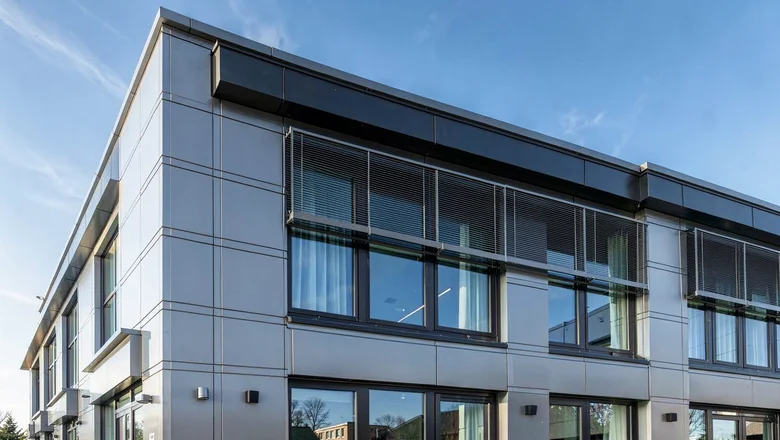
Aluminum cladding is a decorative and protective covering made from solid aluminum alloy sheets, formed into panels and fixed to the exterior or interior surfaces of a building. It is lightweight, durable, recyclable and available in a wide range of finishes — which is why it has become one of the most specified façade materials for commercial, civic and high-rise projects across the Middle East and Africa. On INDECO envelopes it often wraps a kinetic louver facade or backs a unitised glazing system.
Unlike heavy masonry or brittle composite boards, aluminum wall cladding adds an architectural skin that can be shaped, perforated, curved and colored to almost any design intent. INDECO fabricates aluminum cladding from high-quality aluminum alloy sheet, using CNC bending and forming technology to create panels that are both precise and repeatable.
What Is Aluminum Cladding Made From?
INDECO's aluminum cladding starts with a high-quality aluminum alloy sheet as the base material. The sheet is cut, bent and formed through numerical control (CNC) technology, then finished with a protective and decorative coating. The result is a solid metal panel with consistent thickness, uniform color and excellent dimensional stability.
Common aluminum alloys for cladding include 1100, 3003 and 5052, selected for their formability, corrosion resistance and weldability. Thicknesses are typically chosen to suit panel size, wind load and span — solid panels can be produced from thin architectural gauges up to heavier structural gauges where impact resistance matters.
Solid Aluminum Cladding vs Aluminum Composite Panels
There are two main categories of aluminum façade panels, and the difference matters for performance, safety and longevity:
| Attribute | Solid Aluminum Cladding | Aluminum Composite Panel (ACP) |
|---|---|---|
| Core | Solid aluminum throughout | Thin aluminum skins bonded to a plastic core |
| Fire behaviour | Non-combustible; aluminum does not burn | Core material can be combustible depending on type |
| Impact resistance | High; dents can often be repaired | Lower; core can delaminate |
| Recyclability | Fully recyclable as metal | Requires separation of materials |
| Longevity | 20–40+ years with quality coating | Shorter life, core can degrade |
| Best for | High-rise, public, coastal and long-life buildings | Low-rise signage and temporary applications |
For safety-critical and long-life buildings, solid aluminum cladding is the specification most engineers and insurers prefer.
Where Is Aluminum Cladding Used?
INDECO supplies aluminum cladding for both outdoor and indoor applications. The same material can create a unified architectural language across the whole building, tying together kinetic facades, glazing and solid wall areas.
- Building exterior walls — rainscreens, façade panels and feature walls.
- Reception and entrance appearances — striking first impressions at building entries.
- Awnings and canopies — lightweight overhead panels with long spans.
- Column decoration and cladding — circular, square and custom column covers.
- Elevated corridors and pedestrian bridges — durable soffits and side panels.
- Balconies, elevator trimming and advertising signs — architectural details that need weather resistance.
- Interior ceilings and feature walls — clip-in tiles, linear baffles and profiled ceiling systems.
Key Advantages of Aluminum Cladding
INDECO's solid aluminum cladding offers a combination of practical and aesthetic benefits:
- Lightweight — much lighter than stone, concrete or steel, reducing structural load.
- Corrosion resistant — aluminum forms a natural oxide layer; fluorocarbon (PVDF) coatings add decades of protection.
- Anti-ultraviolet — quality coatings resist fading and chalking under intense sun.
- Impact and strong-wind resistant — solid metal panels withstand site impacts and high wind pressures.
- Customisable — size, shape, color, perforation and texture can be tailored to design requirements.
- Easy installation and maintenance — simple fixing systems reduce construction time and lifecycle cost.
- Recyclable — aluminum can be fully recovered and reused, supporting green building targets.
Why Architects Specify It
Aluminum cladding gives designers freedom. It can be flat, curved, hyperbolic, perforated or embossed. It can imitate stone or timber, carry a metallic finish, or be coated in almost any solid color. At the same time, it is a proven engineering material with predictable structural behaviour, so it works for both design-led and structurally demanding projects.
Key takeaways
- Aluminum cladding is solid alloy sheet (1100/3003/5052) formed by CNC and coated for weather resistance.
- Solid aluminum beats ACP on fire, impact, recyclability and lifespan (20—40+ years).
- Used on exterior walls, entrances, canopies, columns, bridges, balconies and interiors.
- It is light, corrosion-resistant, UV-stable, customizable and fully recyclable.
Explore INDECO's aluminum cladding range
See the full Aluminum Cladding product page, browse global projects, or read the aluminum cladding FAQ. Ready to discuss a project? Talk to our team.