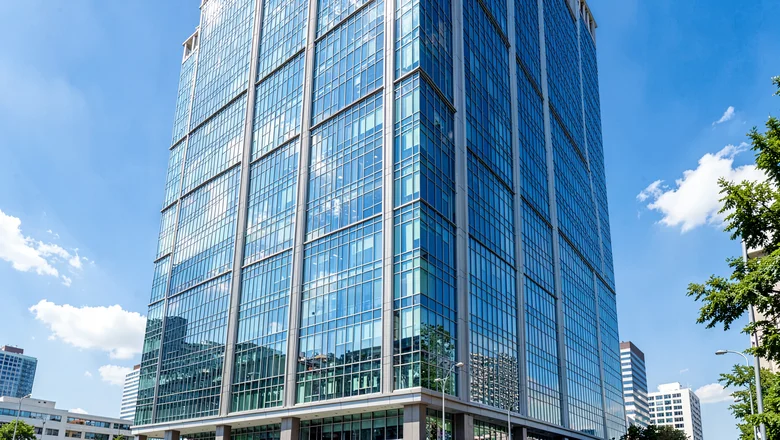
A unitised curtain wall — also spelled unitized curtain wall — is a façade system built from large, factory-finished glazing units that are lifted into place and locked together on site. Unlike traditional stick-built curtain walls, where millions of components are assembled piece by piece in the open air, a unitised glazing system arrives as pre-assembled, weather-tight modules. On many INDECO towers it works alongside a kinetic louver facade for dynamic shading and aluminum cladding for feature elements.
For tall buildings in hot, windy and coastal markets such as the Gulf, East Africa and South Asia, unitisation solves three problems at once: it shortens the construction schedule, raises quality control and reduces the weather risk that comes from sealing joints on a high-rise scaffold.
What Is a Unitised Curtain Wall?
At its simplest, a unitised curtain wall is a prefabricated glazing and framing unit. Each unit contains:
- Aluminum mullions and transoms (vertical and horizontal framing members).
- An insulated glass unit (IGU) — typically laminated or tempered outer lite, argon cavity and inner lite.
- Gaskets, pressure plates, covers and drainage details installed in factory conditions.
- Interlocking male/female stack joints that connect to adjacent units on site.
Because the unit is assembled, glazed and sealed under roof, the critical weather seals are applied in a controlled environment rather than on a tower in direct sun, dust or rain.
Unitised vs Stick-Built Curtain Wall
The split between unitised and stick-built is essentially a split between factory and field labour. Stick-built systems carry long aluminium extrusions to site, erect the frame floor by floor, and glaze afterwards. Unitised systems reverse the ratio: most labour happens in the factory, and site work becomes an installation operation.
| Attribute | Stick-Built | Unitised |
|---|---|---|
| Where it is assembled | On site, piece by piece | In the factory as complete units |
| Glazing sequence | Frame first, glass later | Pre-glazed before delivery |
| Weather protection | Dependent on site sealing | Factory seals + stack joints |
| Speed on high floors | Slower, more trades | Faster, crane-assisted |
| Quality control | Varies with site conditions | Consistent, factory-tested |
| Best for | Low-rise, complex geometry | High-rise, repetitive grids |
For towers with large, regular grids, unitised is usually faster and more reliable — which is why specifiers weighing it against stick-built systems tend to reach the same answer.
How INDECO Delivers a Unitised Curtain Wall
INDECO's project lifecycle follows a disciplined path from concept to handover:
- Business & Design. We turn the client's brief into a feasible, engineered concept, working closely with the design team and following international standards so the idea is buildable from the start.
- Prototyping & Testing. A physical façade mock-up is built and tested against real-world conditions before full-scale production begins. This is the quality checkpoint for durability and safety.
- Material Selection & Mock-up. Aluminum alloy, glass type, coatings and gaskets are selected and assembled into a representative sample.
- Performance Testing & Reporting. Air leakage, water penetration, structural performance and cyclic movement are verified under simulated environmental conditions.
- Manufacturing & Just-in-Time Delivery. Units are produced, inspected and shipped to match the site installation sequence.
- Installation of the Primary Support Structure. Anchors, brackets and floor-by-floor support frames are fixed.
- Glazing, Sealing & Integrated Systems. Pre-glazed units are craned into position and interlocked.
- Final Closure & Wiring. Perimeter seals, flashings and any integrated screens or louvers are completed.
- Inspection, Testing & Commissioning. Field tests and documentation close out the project before handover.
Where Architects Specify Unitised Glazing
Unitised systems are not limited to one building type. They are specified wherever speed, scale and weather-tightness matter:
- Commercial towers — repetitive floor plates where factory production pays off.
- Hospitality & hotels — guest comfort depends on airtight, watertight seals.
- Airports & transport hubs — large elevations, high wind loads and public safety priorities.
- Healthcare & institutions — controlled internal environments and long service life.
- Retail & mixed-use — fast enclosure so interior trades can start earlier.
Key Benefits of Unitised Glazing
Beyond schedule, unitisation offers measurable performance advantages, and pairs naturally with a kinetic facade shading layer and aluminum cladding accents.
- Tighter quality control — seals, glass and gaskets are installed in factory conditions.
- Reduced site labour — fewer workers on high floors and less exposure to weather.
- Better water management — dual-stage gaskets and drained/stacked joints handle wind-driven rain.
- High structural capacity — mullion and transom sections can be sized for project wind loads.
- Design flexibility — exposed frame, hidden frame, corner units, sloped glazing and integrated openings are all possible.
Key takeaways
- A unitised curtain wall arrives as factory-glazed, weather-tight modules — versus stick-built systems assembled on site.
- INDECO's delivery runs nine stages from business & design through inspection, testing and commissioning.
- Best for high-rise and repetitive grids: faster, more consistent sealing, less weather risk.
- Use it where schedule, scale and weather-tightness matter — towers, hotels, airports, hospitals.
Explore INDECO's unitised glazing solutions
See the full Unitised Glazing product page, review our Dubai Waterfront Tower case study, or read the unitised glazing FAQ. Ready for a project conversation? Talk to our engineering team.