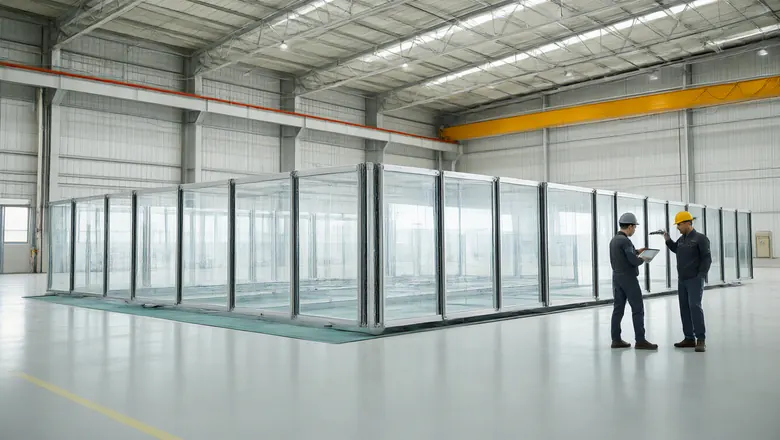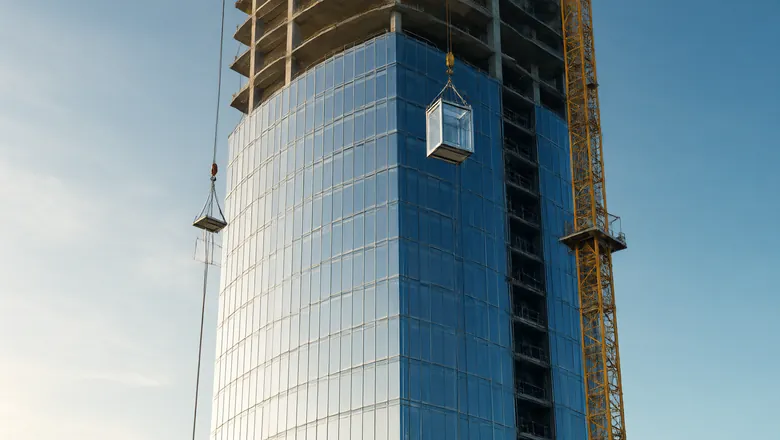
Structural glazing — structural silicone glazing (SSG), bonded glazing or frameless glazing — holds glass to a curtain wall frame with a load-bearing silicone bond rather than pressure plates and cover caps. In a unitised curtain wall (unitised glazing, modular glazing, factory-assembled facade, also spelled unitized) that bond is made inside the factory: a 1.5 × 4.0 m INDECO unit with a 6 + 12A + 6 or 8 + 16A + 12 insulating glass unit is bonded, cured to a 10–25 mm silicone bite, inspected and only then shipped. The delivered wall is a flush glass plane with system U ≈ 1.4 W/m²·K, SHGC ≤ 0.22, visible transmittance ≥ 40%, STC 42, designed for 4.5 kPa wind and verified at 750 Pa water penetration.
The distinction matters at tender stage. A captured system holds glass in a mechanical rebate; two-sided SSG bonds one pair of opposite edges and captures the other pair; four-sided SSG bonds all four edges and removes the external caps entirely. Four-sided SSG is the default on our unitised glazed curtain wall range for Gulf towers because it removes the external cap that collects dust at 45 °C and eliminates roughly 660 field-sealed joints per 1,000 m². The engineering behind it is set out in factory quality control, IGU selection and the unitised curtain wall guide.
Large European system houses sell structural glazing as a catalogue system. INDECO supplies it as a China-fabricated, project-engineered package: 6063-T5 extrusions, an anodic film of 5–20 µm to AA15–AA25 with 200–500 HV hardness and ΔE ≤ 2.5 from our anodizing partner in Guangdong, A2 reaction to fire, and a 25-year design life under ISO 9223 C4–C5 exposure — adapted to 45 °C and to SBC and Mostadam documentation rather than a temperate European baseline.
What is structural glazing in a unitised curtain wall?
Structural glazing is a load path, not a finish. Wind pressure acts on the pane, the pane transfers that load through the cured silicone bead into the aluminium frame, and the frame carries it into the slab-edge brackets. The silicone is therefore a structural component with a design strength, a minimum bite (bond width), a joint thickness and a cure record — all four must be specified and traceable. In a unitised system this happens on a jig at 20 °C and 40% relative humidity, not 200 m up a tower in wind and dust.

| System family | How the glass is held | Typical silicone bite | Where it is used |
|---|---|---|---|
| Captured / pressure plate | Mechanical rebate, gaskets, screw-fixed cap | None (weather seal only) | Stick-built walls, spandrel zones, low-rise |
| Two-sided SSG | Two bonded edges, two captured edges | 10–20 mm | Vision bands where a vertical or horizontal cap is wanted |
| Four-sided SSG | All four edges bonded to the unit frame | 15–25 mm | Flush glass towers, Gulf and East African high-rise |
| Semi-unitised / ladder | Factory-glazed panel on stick mullions | 10–20 mm | 8–20 storeys, mixed geometry, fast programme |
The factory route changes four things at once, and each one is measurable:
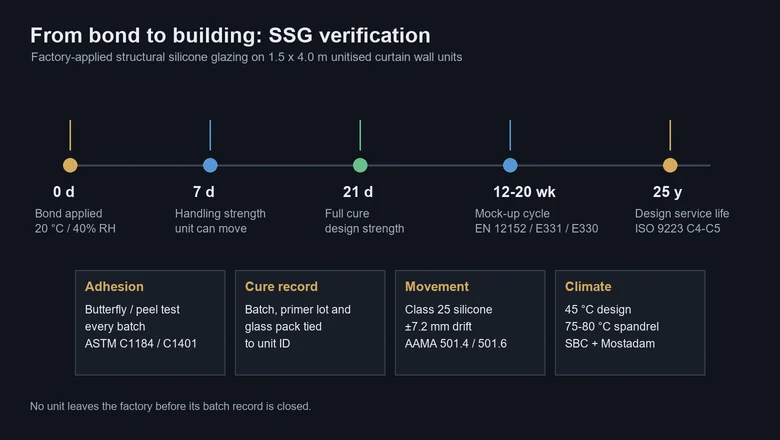
- Cure environment. Structural silicone needs 7 days to handling and 21 days to full cure at 20 °C / 40% RH. Only a factory can hold that window for every unit.
- Dimensional control. Bonded on a jig, the module holds ±1.0 mm width and ≤1.5 mm diagonal difference, so the glass edge clearance of 3–5 mm is uniform around the pane.
- Traceability. Silicone batch, primer lot, glass pack and cure date are tied to the unit ID; a recalled batch can be traced to a floor and a facade zone.
- Zero field sealant. The 660-odd field-sealed junctions per 1,000 m² of a stick-built wall disappear; the remaining site joints are dry interlocking gaskets.
How is the silicone bite sized for wind and thermal movement?
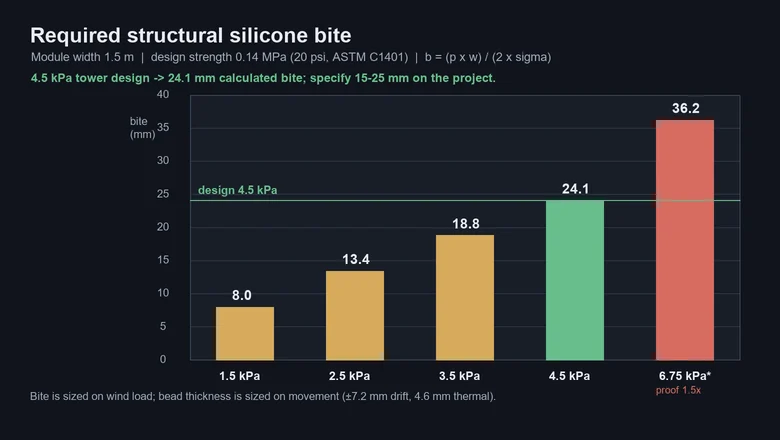
Start with the wind. Dynamic pressure is q = 0.613 V², so a 45 m/s service wind gives about 1,241 Pa; a corner zone at 1.7–2.0× amplification reaches 2.1–2.5 kPa. INDECO designs the unitised glazed facade to 4.5 kPa and proves it at 1.5× — 6.75 kPa — on the mock-up. The tributary load on a 1.5 m wide pane is p × w, shared by two bonded edges, so the required bite is b = (p × w) / (2 × σ), with σ = 0.14 MPa (20 psi, ASTM C1401) as the silicone design strength.
| Design wind pressure | Equivalent wind speed | Required bite on 1.5 m module | Design note |
|---|---|---|---|
| 1.5 kPa | 49 m/s | 8.0 mm | Low-rise, sheltered inland |
| 2.5 kPa | 64 m/s | 13.4 mm | Typical mid-rise field zone |
| 3.5 kPa | 76 m/s | 18.8 mm | Upper field zone, exposed sites |
| 4.5 kPa | 86 m/s | 24.1 mm | INDECO tower design — specify 15–25 mm bite |
| 6.75 kPa (1.5× proof) | — | 36.2 mm | Proof load only; not the sizing case |
Bite is only half the joint design. The bead must also absorb movement without tearing, which sets its thickness. Aluminium grows 4.6 mm over a 4.0 m module at ΔT 50 K (α = 23 µm/m·K) while glass grows about 1.8 mm; inter-storey drift adds ±7.2 mm at H/500 and slab-edge brackets absorb ±15 mm. A class 25 silicone at 25% allowable strain needs a bead thickness of at least the movement divided by twice the strain, so 7.2 mm of drift calls for roughly 14 mm of free bead. That is why a 2:1 width-to-depth rule and a bond-breaker backing rod — never three-sided adhesion — are written into the detail.
- Size the bite on wind, the thickness on movement. A wide, thin bead resists pressure but tears under drift; a thick, narrow bead moves but shears under load.
- Keep the 2:1 geometry. Bite 15–25 mm against a 6–12 mm bead depth, with a closed-cell PE backing rod at 25–30% compression.
- Break the third side. Silicone bonded to glass, frame and the back of the rebate cannot extend; adhesive or cohesive failure follows within a season.
- Widen at corners. Corner pressure coefficients of 1.7–2.0× are handled by reducing the module width or adding bite, not by raising the silicone strength.
- Verify at 1.5×. ASTM E330 structural proof at 6.75 kPa, followed by ASTM E331 at 750 Pa and EN 12152 A4 air testing on the same specimen.
Why does SSG durability depend on adhesion, UV and 45 °C heat?
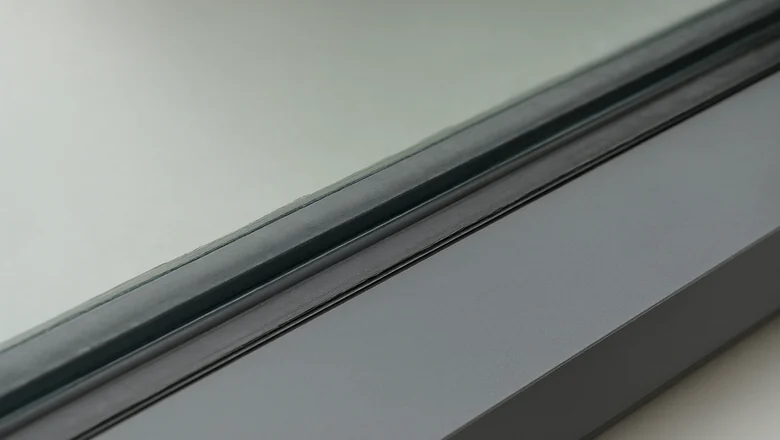
Silicone is the only glazing elastomer with a credible 25-year UV and thermal record; polysulphide and polyurethane IGU secondary seals are not structural adhesives and must never be the bond substrate. Durability is therefore an adhesion problem first. The bond line sees 45 °C ambient, 75–80 °C on a dark spandrel surface, chloride-bearing C4–C5 atmospheres (ISO 9223), and continuous UV reflected off the glass edge. If the primer, the anodized surface or the IGU secondary seal is wrong, the joint does not age — it debonds.
| Durability factor | Requirement | How it is verified |
|---|---|---|
| Adhesion to frame | 100% cohesive failure on test coupons | Butterfly / peel test every batch, ASTM C1184 / C1401 |
| Cure schedule | 7 days to handling, 21 days to full cure | Factory log at 20 °C / 40% RH, tied to unit ID |
| IGU compatibility | Silicone secondary seal, no polysulphide | Compatibility and adhesion report per IGU supplier lot |
| Heat and UV | 45 °C design, 75–80 °C spandrel surface | Heat-soaked / heat-strengthened glass, EN 14179-1; accelerated ageing |
| Corrosive atmosphere | ISO 9223 C4–C5; A2 backing; A4 stainless | 500–4,000 h neutral salt spray on the anodic film |
| Movement capability | Class 25 minimum, class 50 at drift joints | ISO 11600 / ASTM C920; AAMA 501.4 and 501.6 racking |
| Finish under the bond | 5–20 µm anodic film, AA15–AA25, 200–500 HV | EN 10204 3.1 certificates, ΔE ≤ 2.5 per facade |
The 21-day cure is the schedule item most often squeezed. A unit shipped at seven days can be handled, but its bond has not reached design strength; in a 45 °C Gulf summer the packaging temperature can exceed 60 °C, which is no substitute for controlled curing. We keep the full cure inside the factory programme and link it to the five-stage inspection matrix and to drift compatibility testing, so no unit leaves before its batch record is closed.
- Specify the sealant, not a brand. ASTM C1184 / EN 15434 structural silicone, 0.14 MPa design strength, class 25 movement minimum.
- Require a project-specific adhesion report. Test coupons must use the actual anodized extrusion and the actual IGU edge seal, not generic laboratory substrates.
- Batch-clean and prime the frame. Degrease, light abrasion, primer within the stated window; record lot numbers against the unit ID.
- Forbid three-sided adhesion. Use a bond breaker so the bead can extend in shear rather than peel.
- Plan for replacement. A bonded pane is cut out and re-bonded from access equipment, not unscrewed; keep a 0.5–1% spare-glass allowance and a documented cut-out procedure.
What standards and specification clauses apply to structural glazing?
There is no single global code for SSG, so the specification names the family it follows and then states the performance in numbers. North American practice uses ASTM C1184 for the sealant and ASTM C1401 for the design; European practice uses EN 15434 with EOTA ETAG 002 guidance; Chinese fabrication follows GB 16776. The wall itself is proven to EN 12152 class A4 air, EN 12154 class RE 1200 water, ASTM E331 at 750 Pa and ASTM E330 at 1.5× design pressure, with AAMA 501.1 dynamic water where the project has a cyclone or hurricane exposure.
| Clause | What to write into the specification |
|---|---|
| System definition | Four-sided structural silicone glazing on factory-assembled 1.5 × 4.0 m units; state the SSG family and the retained mechanical restraint. |
| Sealant | ASTM C1184 / EN 15434 structural silicone, 0.14 MPa design strength, class 25 movement, project adhesion report required. |
| Joint geometry | Bite 15–25 mm (calculated), bead depth 6–12 mm, 2:1 ratio, closed-cell backing rod, no three-sided adhesion. |
| Cure and traceability | 21 days at 20 °C / 40% RH before dispatch; silicone batch, primer lot, glass pack and cure date tied to unit ID. |
| Performance | 4.5 kPa design / 6.75 kPa proof (ASTM E330), 750 Pa water (ASTM E331), EN 12152 A4, EN 12154 RE 1200. |
| Movement | ±7.2 mm inter-storey drift at H/500, 4.6 mm thermal at ΔT 50 K, ±15 mm three-way bracket adjustment. |
| Finish and fire | 6063-T5, 5–20 µm AA15–AA25 anodic film, 200–500 HV, ΔE ≤ 2.5, A2 reaction to fire per EN 13501-1. |
| Regional compliance | 45 °C design condition, SBC and Mostadam documentation, ISO 9223 C4–C5 exposure with A4 stainless fixings. |
For Gulf submissions the same clause set supports SBC and Mostadam documentation; for East African coastal work the ISO 9223 C4–C5 line drives the A4 stainless fixings and the 500–4,000 h salt-spray requirement on the anodic film. Nowhere does the certificate number of an upstream supplier appear on an INDECO document — the finish is described by its measured parameters and its 25-year service life.
Key takeaways
- Structural glazing replaces mechanical caps with a load-bearing silicone bond; in a unitised wall that bond is made and cured in the factory, not at height.
- Bite is sized on wind: b = (p × w) / (2 × σ), with σ = 0.14 MPa (20 psi) — a 4.5 kPa tower on a 1.5 m module needs about 24 mm.
- Bead thickness is sized on movement: ±7.2 mm drift, 4.6 mm thermal growth and 2:1 width-to-depth geometry with a bond breaker.
- Durability is an adhesion problem: 7-day handling, 21-day full cure, project-specific adhesion coupons, silicone IGU secondary seals, and batch-to-unit traceability.
- At 45 °C with 75–80 °C spandrel surfaces, an AA15–AA25 anodic film with 200–500 HV and ΔE ≤ 2.5 under the bond is part of the system, not a cosmetic choice.
Frequently asked questions
How does unitised glazing improve building airtightness?
A unitised wall moves the air barrier into the factory. Every glass edge is bonded with structural silicone under controlled conditions, and neighbouring units interlock with factory-fitted gaskets at the stack joint. INDECO systems target EN 12152 class A4 at 600 Pa; a continuous bonded line avoids the hundreds of field-sealed junctions where a stick-built wall leaks.
How are unitised facade joints sealed against water?
Two lines, not one. The outer silicone and gasket line sheds most rain, while a drained, pressure-equalised cavity behind it carries any water that gets through to a weep at each module. The structural bond is not the weather seal. We verify the assembly to ASTM E331 at 750 Pa and EN 12154 class RE 1200.
What standards apply to unitised glazed facades globally?
For the bonded glass, ASTM C1184 and C1401 in North America, EN 15434 with EOTA ETAG 002 in Europe, and GB 16776 in China. For the wall, EN 12152 A4 air, EN 12154 RE 1200 water and ASTM E330 proof at 1.5 times design pressure. Gulf projects add SBC and Mostadam documentation, plus EN 13501-1 A2 for backing materials.
What IGU options are available for unitised curtain walls?
Double and triple insulating glass units, typically 6 + 12A + 6 up to 8 + 16A + 12 on a 1.5 by 4.0 m module. Low-E coatings give U about 1.4 W/m2K, SHGC at or below 0.22 and STC 42. For SSG the secondary seal must be silicone, not polysulphide, so the bond has a compatible substrate.
Who supplies unitised glazed facades for international towers?
A small number of system houses dominate Europe, but INDECO supplies factory-glazed unitised packages from China for developers, architects and contractors across Africa and the Gulf. We engineer the module grid, structural silicone bite and finish in-house, anodize with a partner in Guangdong to AA15–AA25, and align the package to 45 °C, SBC and Mostadam requirements.
Specifying structural glazing for a 45 °C tower?
Send us the design wind pressure, module grid and IGU build-up. We return a package with the calculated silicone bite, the movement budget, the adhesion and cure schedule, the mock-up test matrix and the finish specification — aligned to SBC and Mostadam documentation for Gulf projects. See the Unitised Glazing product page, the specification guide and the performance testing guide, or talk to our engineering team.