Short answer: An A2 aluminium cladding manufacturer must certify the full panel system to EN 13501-1 as A2-s1,d0 — limited combustibility, lowest smoke and no burning droplets — coat or anodize to AAMA 2605 or QUALANOD class AA15–AA25, and prove it with third-party test reports, ISO 9001 control and full batch traceability. Specifying on the certificate, not the price, is what keeps a tower compliant in Gulf and East African markets.
Selecting a cladding supplier is where most specification risk is created or removed. A rainscreen is a system — the visible aluminium panel (solid plate, aluminium composite or anodised sheet) is only one line of it — and the fire, corrosion and finish performance of that system is decided long before it reaches the site. This guide sets out what an A2 aluminium cladding manufacturer must actually hold, how to read the certificates, and a shortlist scorecard you can send to a tender. It follows on from the aluminum cladding guide, the specification article and the fire-safety article, and it applies the 45°C design day used across our aluminum cladding pages.
What Fire Rating Is Required for Cladding on High-Rise Buildings?
Reaction-to-fire classification follows EN 13501-1, the same ladder referenced by the Saudi Building Code (SBC 901) and the Mostadam green-building scheme. The classes run from A1 (non-combustible) down through A2, B, C and D. For a high-rise facade the practical minimum is A2-s1,d0: the panel system is of limited combustibility, produces the lowest smoke class (s1) and sheds no burning droplets (d0).
| Class | Combustibility | Smoke | Burning droplets | Typical use |
|---|---|---|---|---|
| A1 | Non-combustible | — | — | Aluminium base metal, stone, steel |
| A2-s1,d0 | Limited combustibility | s1 (lowest) | d0 (none) | High-rise & tall facade minimum |
| B-s3,d0 | Low | s3 | d0 | Low-rise, non-critical |
| C / D | Combustible | s2–s3 | d1–d2 | Not for tall facades |
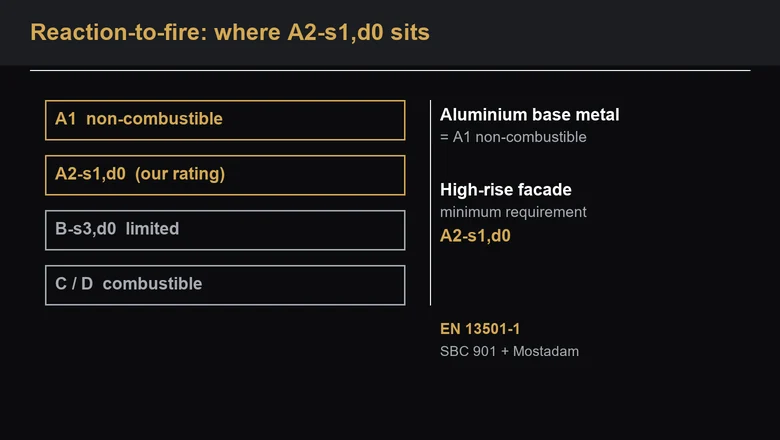
The key point that catches specifiers: the base aluminium is A1, but the cladding system rating is what the authority checks. An organic coating or a combustible core can pull a panel down to B or C even though the metal is non-combustible, which is why an anodized (inorganic) finish is the safest route to holding A2-s1,d0 on a tower.
What Does A2-s1,d0 Actually Mean for Aluminum Cladding?
Read the three suffixes separately. A2 means limited combustibility — the panel contributes almost no fuel. s1 is the lowest smoke-production class, which matters more than flame in a real evacuation because smoke, not heat, causes most casualties. d0 means no burning droplets are produced, removing the secondary ignition risk below the facade. For aluminium, anodizing is the natural route to A2: it grows an inorganic oxide film (AA15–AA25, 5–20 µm, 200–500 HV) with no organic coating to burn, so the panel keeps the A2 non-combustible classification of the base metal. Our anodizing partner in Guangdong works to QUALANOD class AA15–AA25 with ΔE ≤ 2.5 batch-to-batch, 500–4,000 h salt spray and 96% recyclability.
| Suffix | Meaning | Why it matters on a tower |
|---|---|---|
| A2 | Limited combustibility | Panel adds almost no fuel to a fire |
| s1 | Lowest smoke production | Smoke, not heat, drives most casualties |
| d0 | No burning droplets | No secondary ignition below the facade |
| Anodized route | Inorganic oxide film | Holds A2 of base metal; no coating to renew |
Polyester or PVDF coatings can also reach A2 when formulated as non-combustible-rated systems, but they remain organic films; an anodized panel never needs recoating, which is the comparison set out in the anodized cladding article and the finishes article.
Which Standards Should an A2 Cladding Manufacturer Meet?
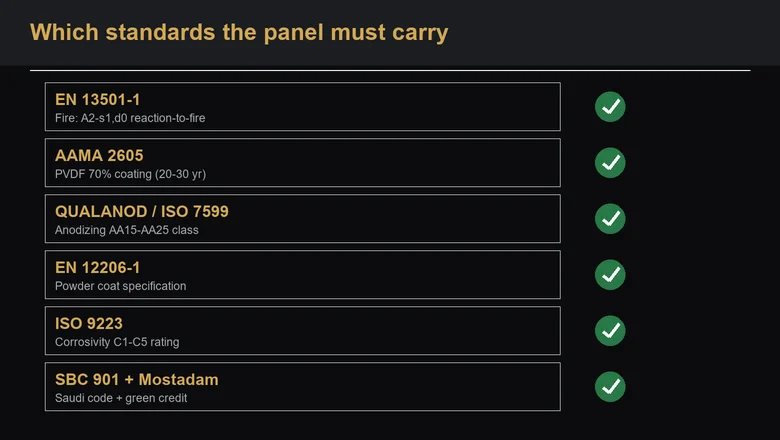
A certificate for one standard is not enough. The panel has to be documented across fire, finish, corrosion and local code. The table below is the minimum document set we expect from any manufacturer we specify.
| Standard | Scope | What it proves |
|---|---|---|
| EN 13501-1 | Reaction to fire | Panel system is A2-s1,d0, not just the metal |
| AAMA 2605 | PVDF 70% coating | 20–30 year colour and gloss retention |
| QUALANOD / ISO 7599 | Anodizing | AA15–AA25 class, ΔE ≤ 2.5, 200–500 HV |
| EN 12206-1 | Powder coating | Coil or batch powder specification |
| ISO 9223 | Corrosivity | Site class C1–C5 sets the finish and alloy |
| SBC 901 + Mostadam | Saudi code | Local compliance and green credit |
ISO 9223 matters because it sets the corrosivity class: a Gulf or East African coastal site is typically C4–C5, which drives the alloy, the anodizing class and the stainless grade of the fixings — the same logic used in our coastal cladding article and the joints and sealants article.
How Do You Verify a Cladding Supplier's Fire Test Reports?
A certificate letter is not a test report. Before you shortlist, ask for the actual EN 13501-1 document issued by a notified body, then check that the product scope matches the exact panel build-up you intend to buy — thickness, core, coating — because a report for a 4 mm A2 composite does not cover a 3 mm solid plate. The checklist below is what we run on every supplier we approve.
| Document | What to check |
|---|---|
| EN 13501-1 report | Issued by a notified body; product scope matches your panel build-up |
| Reaction vs resistance | Reaction-to-fire (A2) is not fire-resistance (EI); do not confuse them |
| Anodize / coat batch tests | Salt spray 500–4,000 h, HV 200–500, ΔE ≤ 2.5, per QUALANOD / AAMA 2605 |
| ISO 9001 / CE marking | Factory quality system and declared performance |
| Traceability | Alloy, temper, batch and anodizing bath recorded per panel |
Then verify the production line, not just the paper: a factory audit (or a recorded one) confirms the anodizing class, the coating line and the batch testing are real. Anodized panels in particular cannot be colour-matched on site later, so the batch-to-batch ΔE control is the item that protects you years after handover. The maintenance regime that keeps these finishes performing is set out in the maintenance article.
How to Shortlist Aluminum Cladding Manufacturers for a Tower?
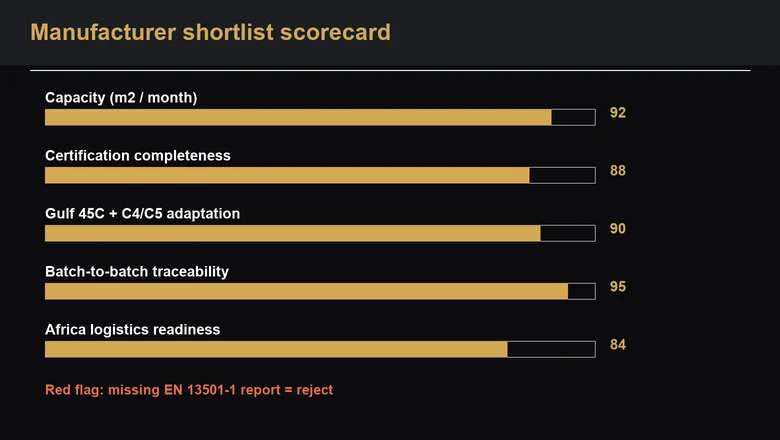
Turn the document check into a scorecard. Weight capacity, certification completeness, regional adaptation, traceability and logistics, and reject any supplier with a missing EN 13501-1 report regardless of price. The red line is simple: no A2-s1,d0 report, no tender.
| Criterion | What good looks like | Red flag |
|---|---|---|
| Capacity | ≥ 12,000 m² / month, single source | No spare line for your programme |
| Certification | EN 13501-1 A2-s1,d0 + AAMA 2605 / QUALANOD | Letter only, no notified-body report |
| Regional adaptation | Tested for 45°C, C4/C5, dust | Only temperate-climate data |
| Traceability | Alloy, temper, bath per panel | No batch record |
| Logistics | Container plan to Africa, spare panels | Undefined freight and lead time |
For a Gulf or East African tower the regional adaptation line is the one most suppliers fail: a panel proven in a temperate climate is not automatically safe at a 45°C design day with C4/C5 chlorides and wind-borne dust. A manufacturer who already runs a full facade line — kinetic, unitised glazing and aluminium cladding — can also carry the interface details that a single-product shop cannot, which is the comparison in our guide.
Key takeaways
- A2-s1,d0 (EN 13501-1) is the high-rise facade minimum: limited combustibility, lowest smoke, no burning droplets.
- Aluminium base metal is A1; the cladding system rating is what the authority checks, so an anodized finish holds A2 most reliably.
- Anodizing to QUALANOD class AA15–AA25 (5–20 µm, 200–500 HV, ΔE ≤ 2.5) is inorganic and never needs recoating.
- Ask for the actual EN 13501-1 report from a notified body; match the product scope to your exact panel build-up.
- Shortlist with a scorecard: capacity, certification, 45°C + C4/C5 adaptation, traceability and Africa logistics — no A2 report means no tender.
Frequently asked questions
What fire rating is required for facade cladding in high-rise buildings?
High-rise facades typically require a minimum of A2-s1,d0 under EN 13501-1, referenced by SBC 901 and Mostadam in the Gulf. A2 means limited combustibility, s1 is the lowest smoke class and d0 means no burning droplets. The aluminium base metal is A1 non-combustible, but the full panel system must carry the A2-s1,d0 rating.
What is A2-s1,d0 classification for aluminum cladding?
A2-s1,d0 is a reaction-to-fire class: A2 is limited combustibility, s1 is the lowest smoke production, and d0 means no burning droplets are shed. For aluminium, an anodized inorganic finish keeps the A2 rating of the base metal, while organic coatings must be formulated as non-combustible-rated systems to reach A2.
What standards should an A2 aluminum cladding manufacturer meet?
At minimum: EN 13501-1 for fire (A2-s1,d0), AAMA 2605 or QUALANOD / ISO 7599 for finish, EN 12206-1 for powder, ISO 9223 for corrosivity class, and SBC 901 with Mostadam for the Saudi market. Each standard covers a different failure mode, so a single certificate is not enough.
How do you verify a cladding supplier's fire test reports?
Request the actual EN 13501-1 report from a notified body and confirm the product scope matches your exact panel thickness, core and coating. Check anodizing or coating batch tests (salt spray, hardness, ΔE), ISO 9001 and per-panel traceability, then verify the production line with an audit rather than trusting a certificate letter.
How do you shortlist aluminum cladding manufacturers for a tower?
Use a scorecard weighting capacity (≥ 12,000 m² per month), certification completeness, regional adaptation to 45°C and C4/C5, batch traceability and Africa logistics. Reject any supplier without a valid EN 13501-1 A2-s1,d0 report regardless of price, because that is the non-negotiable line for a tower.
References
Need a defensible cladding supplier shortlist?
Send us the elevations, panel build-up, finish intent and design temperature. We return an A2-s1,d0 document checklist, the EN 13501-1 scope match for your exact panel, the anodizing or coating specification with batch testing, and a manufacturer scorecard with the red flags written down — checked against a 45°C design day and SBC / Mostadam requirements. Talk to the engineering team.