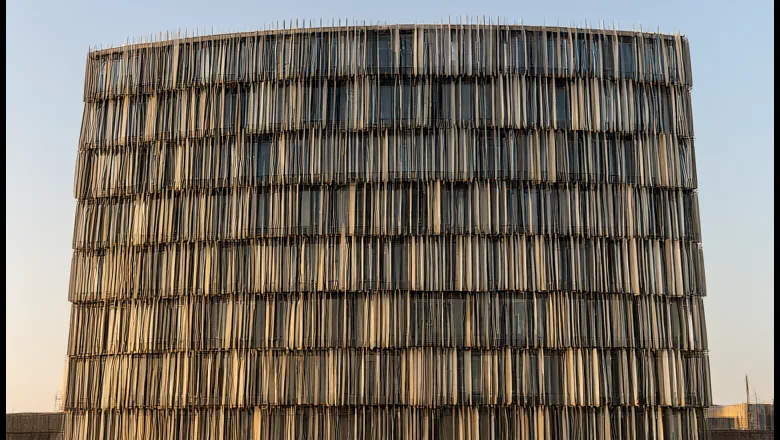
A kinetic facade is priced like a mechanical assembly, not like a sheet of cladding. The unit of cost is the blade: an extruded 6063-T5 profile, a stainless pivot, a wind-return spring and two brackets, repeated four to eight times per square metre. Two elevations with identical areas can therefore differ by 40% in price, because they do not contain the same number of parts. That single fact explains most of the variation buyers see between tenders.
What does a kinetic facade cost per square metre?
For budget-stage estimating in 2026, a Gulf or East African project should allow roughly USD 380–750/m² for a passive kinetic screen and USD 620–1,150/m² for a motorised one, supply and install, excluding the main building structure, access scaffolding and land. Those bands are order-of-magnitude allowances for feasibility work, not a quotation: blade width, module height, finish, wind regime and access method each move the number by 5–15%.
A more portable way to compare schemes is an index with a fixed aluminium louvre of the same area set at 100. It survives currency and market movements, and it makes the premium for movement visible in one line.
| System | Installed cost index | Operating energy | 25-year cost index | Where it fits |
|---|---|---|---|---|
| Fixed aluminium louvre | 100 | 0 | 100 | The shading angle is known and does not change |
| Passive kinetic louvre | 130–160 | 0 | 118–140 | Animation and shading with zero power and no controls |
| Motorised kinetic louvre | 175–240 | Below 1 kWh/m²·yr | 165–225 | Scheduled tracking, scenes and BMS integration |
The index also shows where the premium stops being visible to a client. A 30–60% uplift buys a moving elevation; a 75–140% uplift buys controllability. If the brief only asks for a living facade and the site has reliable breeze, the passive system delivers the architectural effect at the lower band, and it keeps working during a power cut — the point covered in detail in passive versus motorised actuation.
Where does the money go?
The screen dominates every kinetic budget. In a passive system it is 62–70% of the installed package, because every blade carries its own pivot, spring and brackets. Motorisation does not reduce that absolute cost; it dilutes the screen's share by adding actuators, sensors, a control cabinet and commissioning on top.
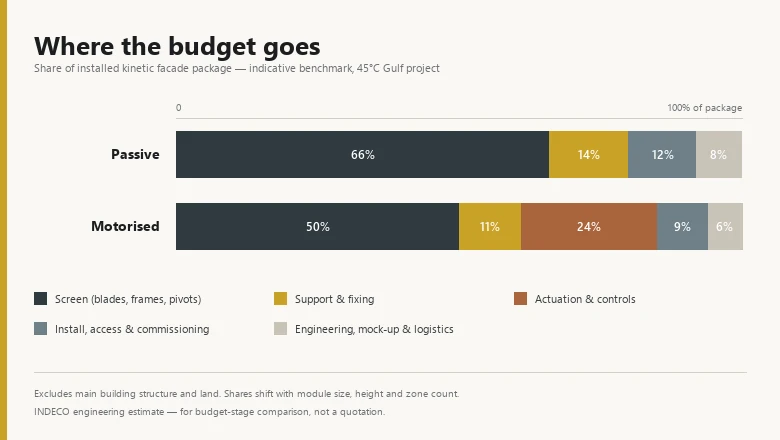
| Package element | Passive | Motorised | What moves it |
|---|---|---|---|
| Screen: blades, frames, pivots, springs | 62–70% | 46–55% | Blade count per m², module height, alloy temper, pivot grade |
| Support and sub-frame | 12–16% | 9–13% | Bracket density, slab tolerance, embed condition, thermal isolation |
| Actuation, sensors and controls | 0–2% | 18–26% | Zone count, actuator torque, anemometer and BMS points |
| Installation, access and commissioning | 9–13% | 9–14% | Height, hoist type, night or weekend working windows |
| Engineering, mock-up, testing and logistics | 5–8% | 5–9% | Wind study, daylight modelling, sample, sea freight |
Two lines cause most budget surprises. The first is support and fixing: a facade that looks identical on the drawing can need 30% more brackets because the slab edge is out of tolerance or the embed plates were cast in the wrong place. The second is commissioning, which is small in percentage but expensive in programme when a motorised system is handed over before the BMS is ready. Both belong in the budget from day one, not in a variation later.
How does blade geometry change the price?
Blade width sets the pitch, and the pitch sets the part count. INDECO blades run at 100, 150 and 200 mm on pitches of roughly 125, 190 and 250 mm, which gives 8.0, 5.3 and 4.0 blades per square metre. Every blade carries a pivot, a bearing and two brackets, so the wider profile removes a third of the hardware without changing the elevation area.
| Blade width / pitch | Blades per m² | Pivot points per m² | Rest open area | Screen cost index |
|---|---|---|---|---|
| 100 mm / 125 mm | 8.0 | 8.0 | 26% | 100 |
| 150 mm / 190 mm | 5.3 | 5.3 | 24% | 88–95 |
| 200 mm / 250 mm | 4.0 | 4.0 | 23% | 82–90 |
The saving is real but not free. A 200 mm blade catches roughly twice the wind load of a 100 mm blade of the same length: at the 45 m/s service wind, a 4.0 m blade carries about 1.2 kN against 0.6 kN, so the pivot, bearing and return spring are upgraded and part of the saving disappears. Wide blades also coarsen the visual grain of the facade and deepen the reveal between blades. The full structural arithmetic is in kinetic facade wind load.
Is passive or motorised cheaper over 25 years?
On first cost, no contest: passive is 20–35% cheaper than motorised for the same elevation. On whole-life cost the gap widens, because a motorised system adds actuators with a 10–15 year service life, a control cabinet to maintain, sensor calibration, and a commissioning cycle every time a zone is re-configured.
| Cost line over 25 years | Passive | Motorised |
|---|---|---|
| First cost index | 130–160 | 175–240 |
| Actuator replacement | None | One to two full sets |
| Annual inspection and cleaning | 0.8–1.5% of first cost | 1.5–2.5% of first cost |
| Controls upkeep | None | 0.3–0.8% of first cost per year |
| Operating energy | Zero | Below 1 kWh/m²·yr |
| Failure mode | Blades rest; shading continues | Drives or controls fault; zone locks |
For a 2,000 m² elevation, the difference is typically a five-figure sum in year one and a similar sum again at the first actuator replacement. The maintenance schedule and inspection intervals behind these percentages are set out in kinetic facade maintenance.
What do support, access and programme add?
These are the lines most often left out of a first estimate, and they are the ones that turn a compliant tender into a difficult project.
- Sub-frame and brackets: 12–16% of the package on a passive screen. Brackets at 1.2–1.5 m centres and four supports per module are normal; a slab edge outside ±20 mm pushes that up.
- Access: 8–12% of installation cost on a high-rise, whether by monorail, cradle or scaffold. A cradle that cannot reach a recessed elevation changes the method, not just the price.
- Working windows: night or weekend installation in an occupied building adds 5–10% to labour and needs a lighting plan for alignment checks.
- Phasing: handing over the facade in two stages adds 3–6% for remobilisation, temporary protection and a second set of access equipment.
- Storage and double handling: blades are long, light and easily bent. On-site storage in a 45 °C yard needs shade and dunnage; re-handling a bent blade costs more than the bracket that should have protected it.
Which value-engineering levers actually work?
Value engineering has a bad name because it usually arrives late and targets the visible finish. The levers below are the ones that remove real cost without removing performance, listed with the trade-off each one carries.
| Lever | Typical saving | What you give up |
|---|---|---|
| Move from 100 mm to 150 mm blades | 5–12% of screen | Coarser visual grain and a deeper reveal |
| Standardise the module at 3.6 or 4.0 m | 4–9% of screen | The facade grid must follow the module |
| Reduce control zones (motorised) | 6–14% of controls | Coarser response to orientation and height |
| Anodised AA25 instead of PVDF | 3–7% of finish | Narrower colour range; batch colour control needed |
| Delete actuation and go passive | 18–26% of package | No scheduled tracking, scenes or BMS points |
| Pre-assemble modules in the factory | 3–6% of installation | 15–25% more shipping volume |
| Single source for extrusion and finishing | 2–5% of screen | Die ownership and minimum order quantities |
The three levers worth testing first are geometry, standardisation and actuation, in that order. The ones to resist are the ones that cut verification: deleting the wind study, skipping the mock-up, or reducing the finish specification to a thin powder coat on a coastal site. Those save 1–3% now and return as corrosion, noise or a failed water test within five years. Finish durability is covered in anodized aluminium cladding, and the shading performance that justifies the premium in glare and daylight control.
What should a kinetic facade budget include?
A complete budget line for a kinetic elevation has eight components. If a tender is missing two or three of them, the missing cost will reappear as a variation or as a lower-grade component that is invisible until year five.
- Blade schedule priced per piece: profile, width, length, alloy temper, pivot and spring, not just square metres of elevation.
- Sub-frame, brackets, anchors and a structural check of the embed condition.
- Finish: anodised AA25 at 5–20 µm and 200–500 HV, or 25 µm PVDF two-coat, with ΔE tolerance stated.
- Actuation package where specified: actuators, anemometer, irradiance sensor, control cabinet, BMS points and uninterruptible supply.
- Verification: wind-load calculation and FEA across the project’s design cases, daylight or glare modelling, and a physical mock-up.
- Installation and access method, including the alignment survey and the tolerance budget between structure and blade line.
- Logistics: packing for sea freight, container count, site buffer stock and protection during storage.
- Commissioning, training, spares and documents: 2% spare blades, 1% pivots, one spare actuator per zone, and an inspection schedule for handover.
Key takeaways
- Kinetic facades are priced per part, not per square metre: blade count and pivot hardware drive 46–70% of the package.
- A passive system sits at 130–160 on an index where a fixed louvre is 100; a motorised one at 175–240.
- Wider blades cut hardware by a third and save 5–12%, but double the blade load at 45 m/s and coarsen the visual grain.
- Over 25 years, motorisation adds actuator replacement and controls upkeep on top of a 35–60% first-cost premium.
- The levers that work are geometry, standardisation and actuation. The ones that backfire are cuts to wind study, mock-up and finish.
Frequently asked questions
How much does a kinetic facade cost per square metre?
As a 2026 budget allowance, USD 380–750/m² for a passive kinetic screen and USD 620–1,150/m² for a motorised one, supply and install, excluding main structure and access. Treat these as feasibility bands rather than quotations: blade width, module height, finish and wind regime move the figure by 5–15% each.
What is the biggest cost driver in a kinetic facade?
The number of blades and pivots per square metre. A 100 mm blade at a 125 mm pitch needs eight blades and eight pivot points per square metre; a 200 mm blade at 250 mm needs four. That single geometric choice moves the screen — 46–70% of the package — by 10–18%.
Is a passive kinetic facade cheaper than a motorised one?
Yes, by 20–35% on first cost and more over 25 years. Passive blades need no actuators, sensors, cables, control cabinet or commissioning, and they keep shading during a power failure. Motorised systems earn their premium only where scheduled tracking, scenes or BMS integration are genuinely required by the brief.
Does a wider blade really reduce cost?
It reduces part count, not performance. Moving from 100 mm to 150 mm blades cuts blades per square metre from 8.0 to 5.3 and typically saves 5–12% of the screen. Part of that is returned in stronger pivots and springs, because a wider blade carries roughly twice the wind load at the same length.
How do I compare kinetic and fixed louvres on whole-life cost?
Put both on the same index with the fixed louvre at 100. A passive kinetic screen lands at 118–140 over 25 years and a motorised one at 165–225, including inspection, cleaning, actuator replacement and controls upkeep. Then credit the shading energy saving and the rental or branding value of a moving elevation.
Need a costed kinetic facade for a live project?
Send us the elevation areas, the module grid, the wind regime and whether the brief needs movement only or scheduled control. We return a budget split by package element, a blade schedule priced per piece, and the value-engineering options ranked by saving and risk. See the Kinetic Louver Facade range, read what a kinetic facade is, or talk to our engineering team.