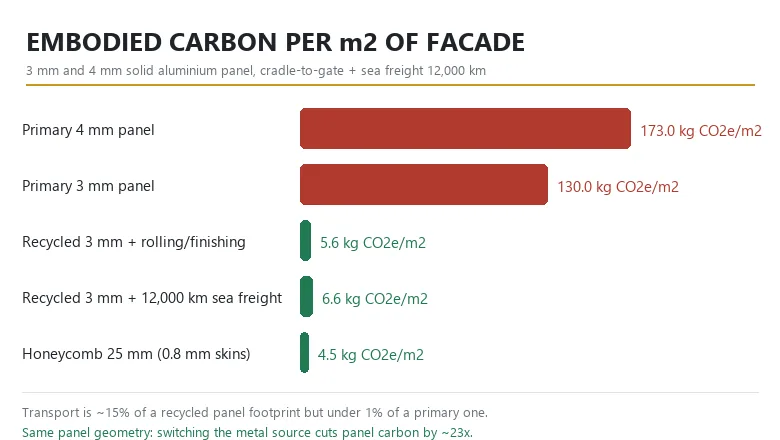
Short answer: Aluminium cladding is one of the few facade materials that can genuinely close the loop. A 3 mm solid panel carries 8.1 kg/m² of metal: made from primary aluminium that is about 130 kg CO2e/m², from recycled metal about 5.6 — a 23× reduction. Our panels are 100% recyclable with 96% recovery at end of life.

Aluminium is the most recycled metal in construction, and it is also one of the most carbon-intensive to make from scratch. That tension is the entire subject. A cladding package can be genuinely low-carbon or a green-washed claim, and the difference sits in three places: where the metal came from, how the panel was finished, and whether it can be taken apart again in 30 years. This article gives the figures INDECO uses on Gulf and East African cladding packages at 45°C design conditions, the comparison tables behind them, and the clause wording that makes the numbers verifiable. For the material basics, start with the complete aluminum cladding guide.
What Makes Aluminum Cladding a Low-Carbon Facade Material?
Three properties do the work. Aluminium is infinitely recyclable without any loss of mechanical properties — it is re-melted, not downcycled. Remelting takes roughly 5% of the energy needed to smelt primary metal from bauxite, which is why the carbon gap between the two routes is so large. And an estimated three-quarters of all the aluminium ever produced is still in productive use, which is what a genuinely circular material looks like over decades.
Our panels are dimensionally stable, non-combustible to A2-s1,d0, and fully recoverable: the end-of-life figure we work to is 100% recyclable with 96% recovery, and our D-colour outdoor range is rated for a service life of 25 years or more. That combination — long life, no water absorption, no rot or delamination, and a remelt route at the end — is what makes a metal skin defensible in a sustainability submission.
The caveat matters as much as the claim. “Recyclable” is a property, not an outcome. It only becomes low carbon when recycled metal is actually fed into the coil, when the finish does not obstruct the remelt, and when the panel is fixed so that it can be removed as one piece. The rest of this article is about turning the property into the outcome.
How Much Embodied Carbon Does an Aluminum Panel Carry?
Carbon per square metre scales with metal mass first and source second. A solid aluminium panel at 2.70 g/cm³ weighs 8.1 kg/m² at 3 mm and 10.8 kg/m² at 4 mm. Published cradle-to-gate ranges put primary aluminium at roughly 11–17 t CO2e per tonne and recycled (secondary) aluminium at 0.4–0.6 t CO2e per tonne, with smelting dominating the primary figure at around 13–15 kWh per kilogram of metal.
| Route | Panel mass | Embodied carbon (kg CO2e/m²) | Note |
|---|---|---|---|
| 3 mm solid panel, primary metal | 8.1 kg/m² | ≈ 130 | Smelting dominates; grid-intensive |
| 4 mm solid panel, primary metal | 10.8 kg/m² | ≈ 173 | Scales linearly with mass |
| 3 mm solid panel, recycled metal | 8.1 kg/m² | ≈ 5.6 | Includes rolling, anodising, packing |
| 25 mm honeycomb, 2 × 0.8 mm skins | ≈ 6.0 kg/m² | ≈ 4.5 | Stiffness from geometry, not mass |
| 4 mm composite, 2 × 0.5 mm skins + PE core | ≈ 5.5 kg/m² | ≈ 45 | Metal fraction only; PE core blocks remelt |
Treat these as design-stage figures and let the project EPD govern at tender. Two conclusions survive any reasonable error bar: the metal source is worth roughly 20× more than any panel dimension, and the lightest panel is not automatically the lowest-carbon one — a composite with a polymer core forfeits the 96% recovery route, which no thinner skin can buy back.
How Do You Calculate Embodied Carbon Per Square Metre of Facade?
Take a 10,000 m² cladding package in 3 mm solid panel. Using the figures above:
- Primary route: 10,000 × 130 = 1,300 t CO2e for the panels alone.
- Recycled route: 10,000 × 5.6 = 56 t CO2e, plus roughly 1.0 kg/m² for 12,000 km of sea freight = 66 t CO2e.
- Difference: about 1,234 t CO2e avoided on the same geometry, same finish, same performance.
- Add 2–4 kg CO2e/m² for the aluminium sub-frame, insulation and stainless fixings — real, but an order of magnitude smaller than the panel.
- Amortised over a 30-year service life, the recycled panel sits at about 0.22 kg CO2e/m²·year against 4.4 for the primary one.
Note what the freight line does and does not do. Shipping finished or coil material 12,000 km adds roughly 1 kg CO2e/m² — about 15% of a recycled panel’s footprint but well under 1% of a primary one. Transport is a rounding error next to smelting, which is why material sourcing outranks logistics in every cladding carbon study worth reading.
What Recycled Content Should the Specification Demand?
“Recycled” covers two very different things, and vague tenders get the weaker one:
| Term | Definition | Evidence to request |
|---|---|---|
| Pre-consumer recycled content | Process scrap returned to the melt inside the manufacturing chain | Mill certificate or mass-balance statement |
| Post-consumer recycled content | Metal recovered from demolished facades, vehicles, packaging and other end products | Chain-of-custody plus third-party verified EPD, defined to ISO 14021 |
| Declared unit | Panel performance per m² or per tonne to EN 15804+A2, modules A1–A3 | EPD verified to ISO 14025 by an approved programme operator |
| End-of-life credit | Recovery and remelt, module C plus module D benefit | Take-back commitment and diversion records |
The trap is treating recycled content as a carbon number. It is not. A panel declaring 50% recycled content, cast from a coal-fired remelt, can carry a higher footprint than a 100% primary panel from a smelter running on hydro or nuclear power. Specify the recycled share and the embodied carbon in kg CO2e per m², and require both on the EPD so they cannot be traded against each other after award. On coastal and desert projects, the same document set is what makes the corrosion strategy auditable too.
Is Anodised or PVDF-Coated Aluminum the Lower-Impact Finish?
Both finishes are recyclable, so the comparison is about process emissions and longevity, not disposal.
| Aspect | Architectural anodising (AA15–AA25) | 70% PVDF coil coating (AAMA 2605) |
|---|---|---|
| Layer type | Integral oxide grown from the metal itself, 5–20 µm | Applied organic film, 25–40 µm |
| Hardness | 200–500 HV | Pencil hardness in the HB–2H band |
| Solvent / VOC | None applied; acid bath with on-site neutralisation | Solvent-borne; abatement by thermal oxidiser |
| Finishing-step carbon | ≈ 0.4–1.0 kg CO2e/m², electricity-dominated | ≈ 0.8–1.8 kg CO2e/m², coating plus gas-fired curing |
| Colour permanence | Integral to the oxide; ΔE 1.0–2.0 within batch, 2.0–2.5 across batches | Controlled by AAMA 2605 ΔE limits |
| Service life | 25+ years, no repaint | 20–30 years in C3–C4 exposure |
| At end of life | Oxide disappears in the remelt; no stripping step | Coating burns off in the remelt and reports as dross |
The gap is real but secondary: finish choice moves the panel footprint by 0.5–1.5 kg CO2e/m², while metal source moves it by 120. Our architectural anodising comes from our anodizing partner in Guangdong, a QUALANOD-licensed line running 5–20 µm oxide at 200–500 HV with neutral salt-spray endurance from 500 to 4,000 hours. The finish options are compared side by side in our finishes and colours guide, and the oxide itself in the anodized cladding article.
Which Green Building Credits Can Aluminum Cladding Earn?
Cladding earns credits through documentation, not through product category:
| Scheme | Route | What to submit |
|---|---|---|
| LEED v4.1 BD+C | Materials & Resources — Building Product Disclosure and Optimization: EPD option, and the Sourcing of Raw Materials option with its recycled-content thresholds | Third-party verified EPD to EN 15804 / ISO 14025; recycled content declaration by material cost or by mass |
| LEED — construction and demolition waste | Waste management plan with staged diversion targets | Offcut remelt and panel take-back records |
| Mostadam (Saudi Arabia) | Materials and waste category: recycled content, recyclable and locally available materials, EPD documentation beyond the SBC 901 baseline | EPD plus recycled content declaration plus SBC 901 energy calculations |
| EDGE / IFC | Materials measure, targeting at least a 20% embodied-energy saving against the base case | EPD or manufacturer embodied-carbon data for the base-case comparison |
Two practical warnings. First, thresholds and credit names change between rating versions — confirm the current manual for your project, and do not let a supplier quote a credit that was retired three versions ago. Second, EPDs are the bottleneck, not panels: they take weeks to issue, and a facade package with several finishes and panel types may need more than one. Commission them at design stage. The evidence mindset is the same one we apply to facade performance testing.
How Do You Design Aluminum Cladding for Disassembly and Recovery?
- Fix mechanically, never bond. Cassette and hook-on systems come off with hand tools, which is the whole basis of the 96% recovery figure. Foam-tape or structural-adhesive fixed panels turn a recyclable panel into demolition waste.
- Keep the panel mono-material. A solid aluminium panel returns to the melt as one material. A polymer-cored composite has to be delaminated first, and in practice most of it never is.
- Isolate mixed metals. A2 or A4 stainless fixings with EPDM or nylon washers solve the galvanic-corrosion problem and keep steel out of the remelt charge — the same discipline covered in our rainscreen fixing guide.
- Plan the cut. Cutting waste of 10–15% is normal; optimised nesting with a return-to-melt agreement typically brings it under 8%.
- Secure a take-back route before you sign. A documented module D recovery path is worth more than a verbal recycling promise.
- Issue a material passport. Alloy, temper, finish and fixing type recorded per elevation lets the next owner recover the panels instead of guessing.
What Should a Sustainability Clause in the Cladding Specification Say?
- Panel: alloy 3003 / 5005 / 5052, thickness 2.5–4.0 mm, reaction to fire A2-s1,d0 to GB 8624-2012.
- Recycled content: minimum share by mass, split explicitly into pre-consumer and post-consumer, with a third-party verified EPD to EN 15804+A2 / ISO 14025.
- Carbon: embodied carbon declared in kg CO2e per m² of installed panel for modules A1–A3, with modules C and D declared where available.
- Finish: AA15–AA25 architectural anodising from a QUALANOD-licensed line, or 70% PVDF to AAMA 2605, both with declared ΔE limits.
- Service life: minimum 25 years with a published cleaning and inspection schedule — see the maintenance schedule.
- Fixing: fully demountable, no adhesive bonding of the primary panel, stainless fixings isolated from the aluminium.
- Offcuts and end of life: return-to-melt route and take-back commitment with diversion records.
- Documentation set: EPD, mill certificates, and a cut plan showing nesting efficiency.
These clauses slot into the wider tender checklist in our aluminum cladding specification guide, which covers alloy, thickness, tolerance and deflection limits. Where a project carries a wall U-value target as well, the thermal performance article covers the calculation route and the SBC 901 / Mostadam evidence.
Key takeaways
- Metal source dominates: primary aluminium at 11–17 t CO2e/t versus recycled at 0.4–0.6 t CO2e/t — about a 23× reduction on the same 3 mm panel.
- A 3 mm solid panel is 8.1 kg/m²: ≈ 130 kg CO2e/m² from primary metal, ≈ 5.6 from recycled, ≈ 6.6 including 12,000 km of sea freight.
- On a 10,000 m² package the recycled route avoids roughly 1,234 t CO2e with identical geometry and performance.
- Recycled content percentage and embodied carbon are different numbers — specify both on one EPD per EN 15804+A2 / ISO 14025.
- Anodising adds ≈ 0.4–1.0 kg CO2e/m² and PVDF ≈ 0.8–1.8; useful, but secondary to the metal decision.
- 96% end-of-life recovery only survives if panels are mechanically fixed, mono-material and documented with a take-back route.
- Design at 45°C, document to SBC 901 + Mostadam, and commission the EPDs at design stage — not after award.
Frequently asked questions
Is aluminum cladding an environmentally friendly facade material?
It can be one of the most circular facade options available. Aluminium is infinitely recyclable without any loss of quality, and our panels are 100% recyclable with 96% recovery at end of life. The carbon result depends entirely on the metal source: a 3 mm panel carries roughly 130 kg CO2e/m² from primary aluminium and about 5.6 from recycled metal.
How much recycled content can aluminum cladding have?
Technically up to 100%, and 96% of the metal is recovered whenever a facade is replaced. In practice, specify a floor rather than a ceiling — for example 50% post-consumer recycled content by mass, documented by a third-party verified EPD — and ask for the embodied carbon figure in kg CO2e per m² alongside it.
Does anodised aluminium have a lower carbon footprint than PVDF?
Both finishes are fully recyclable, so the difference is process emissions. Architectural anodising grows an integral oxide with no applied organic film and typically adds about 0.4–1.0 kg CO2e/m². A 70% PVDF coil coating adds roughly 0.8–1.8 kg CO2e/m² including gas-fired curing, and anodising needs no repainting over a 25-year life.
Can aluminum cladding earn LEED or Mostadam credits?
Yes, through documentation rather than product type. A third-party verified EPD to EN 15804 and a declared recycled content figure feed the LEED materials disclosure credits, while construction-waste diversion records support the waste credits. Mostadam rewards the same evidence on top of the SBC 901 energy baseline. Confirm current thresholds in the rating manual for your project version.
How is aluminum cladding recycled at end of life?
Panels are unbolted, sorted by alloy and returned to a remelt furnace. The anodic oxide or coating layer burns off or floats out as dross with a small metal loss, and the recovered aluminium is recast without loss of properties. Remelting uses about 5% of the energy of primary smelting, and recovery reaches 96% where fixings are mechanical.
Need the carbon numbers for a cladding package?
Send us the elevations and the target rating. We return the panel build-up, alloy and finish, declared recycled content and embodied carbon in kg CO2e/m², with EPD documentation and the SBC 901 / Mostadam evidence pack. See the Aluminum Cladding product page, the specification checklist, or talk to our engineering team.