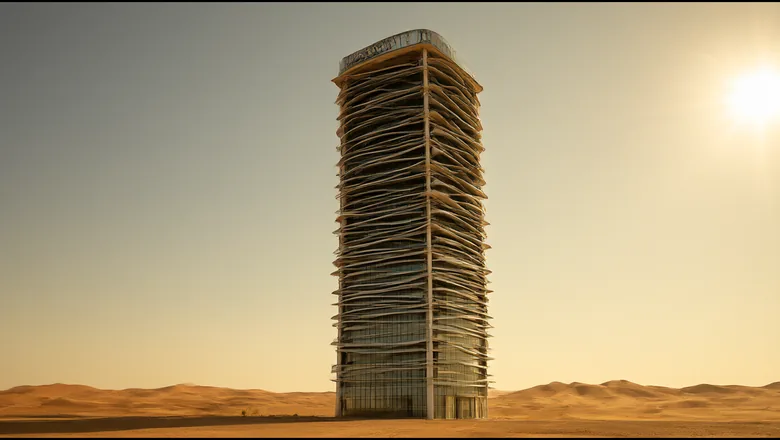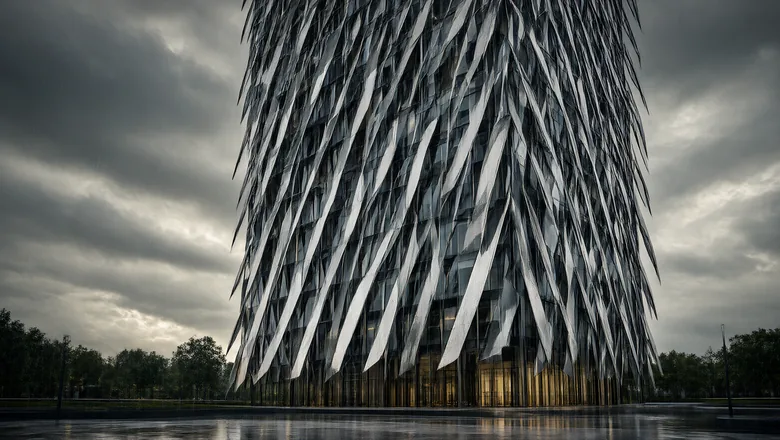
Rain is the load a kinetic facade is most often asked about and least often specified for. Shading, wind and movement are all written into the tender; water is usually left to the sentence “the screen is not the weather line”, which is true but not sufficient. A dynamic louvre screen changes how much rain reaches the wall behind it, adds a cavity that did not exist before, and introduces a drainage path that has to work for 25 years in a climate that alternates between dust and downpours.
This article sets out what actually happens to water on a kinetic facade: how much driving rain a 76% solid screen intercepts, how much passes through and in what state of the blades, how the cavity behind is drained and ventilated, why the backing wall still has to be a tested weather barrier in its own right, and how the detailing differs between the Gulf and East Africa. It follows on from the wind-load design range, the installation sequence and the maintenance regime, and it uses the same 45 °C, SBC and Mostadam context as our Gulf climate guidance.
What does a kinetic facade actually do in the rain?
It intercepts, deflects and sheds — and it does all three without being sealed. A kinetic facade, also written as a dynamic facade or moving louver screen, is an outer layer of aluminium blades standing 100 to 300 mm in front of the real building envelope. Rain arrives with a horizontal velocity component, strikes the blades, runs down their faces and drips off the lower edge into the cavity, where a tray and a weep slot take it back outside at every floor.
The distinction that matters in specification is between a screen and a barrier. A sealed barrier — the glazed or panel wall behind — is designed to be watertight under a test pressure. A screen is designed to shed the bulk of the water and to accept that some gets through, which is exactly the principle of a rainscreen. Treating a kinetic screen as a weather line is the single most common specification error we see, and it fails in the first serious storm.
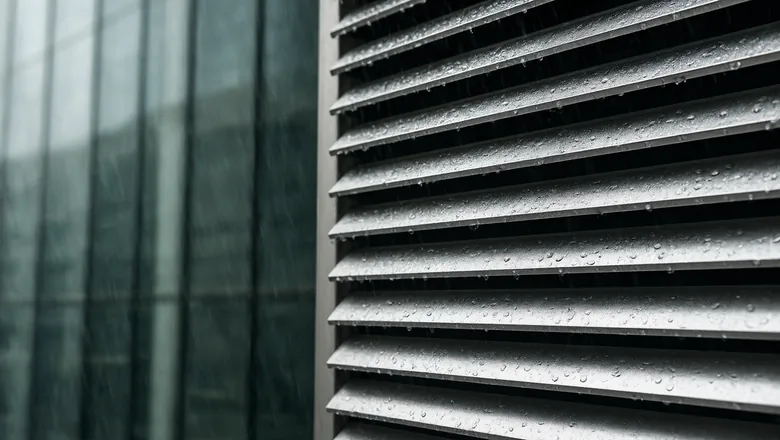
Two properties of the blade array do the work. The first is solidity: with 150 mm blades on a 190 mm pitch the screen is 76% solid at rest, so three quarters of the projected area is metal rather than hole. The second is droplet inertia. Rain driven at 10 to 20 m/s does not turn the corner through a 24% open gap nearly as easily as air does; a significant fraction of the water that would geometrically fit through the opening instead impinges on the blade behind and is shed downwards. That is why the measured penetration is lower than the open-area figure alone would suggest.
How much wind-driven rain does a louvre screen stop?
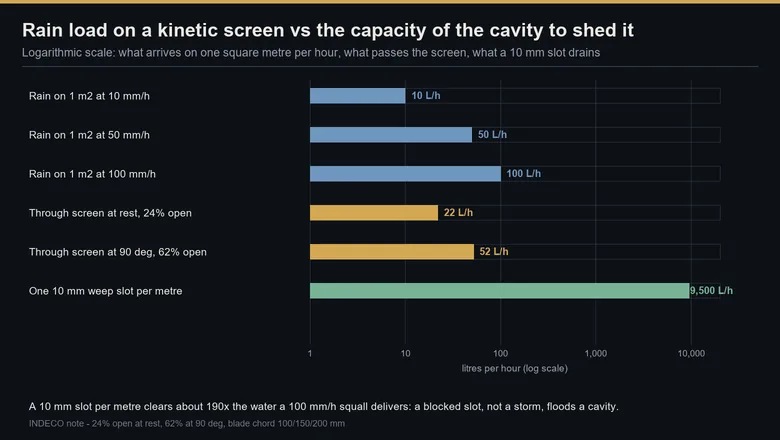
Start with the water arriving. Rainfall intensity is quoted as millimetres per hour on a horizontal surface, and 1 mm/h is simply 1 litre per square metre per hour — a convenient identity that makes the sums immediate. On the upper third of a tall building, wind-driven rain on the facade typically reaches 0.8 to 1.5 times the horizontal intensity at ground level, and at an exposed corner it can approach 2 times it, because the flow accelerates around the arris. So a 100 mm/h squall can present a west corner with the equivalent of 150 to 200 L/m² per hour.
| Screen state | Open area | Wind | Rain reaching the backing wall |
|---|---|---|---|
| At rest, passive blades closed | 24% | Below 0.9 m/s — light, near-vertical rain | 15–25% of what arrives |
| Partly open, around 45° | ~45% | 5–10 m/s | 35–45% of what arrives |
| Fully open, 90° | 62% | Storm wind, 15 m/s and above | 45–60% of what arrives |
| No screen at all | 100% | Any | 100% of what arrives |
Read that table honestly and one thing stands out: a passive kinetic screen protects least precisely when the rain is worst, because the same wind that drives the rain also opens the blades. The screen at rest is a genuine shield; the screen at 90° is closer to a coarse filter. This is not a defect — it is the physics of a wind-driven mechanism, and it is set out in the actuation article. It is, however, the reason the wall behind must be detailed as a real weather line rather than relying on the screen.
Now the drainage sum, which is reassuring. Take a 1.0 m wide module in a 100 mm/h squall, with the screen at rest: roughly 100 L/h arrives, and 15 to 25 L/h reaches the cavity. A continuous 10 mm drainage slot across that metre, discharging under a modest 10 mm head, passes about 9,500 L/h — on the order of 400 times the load. Blockage, not storm intensity, is what floods a cavity. Design the slot so it cannot be blocked by a blade, a fixing or a piece of site debris, and the hydraulic problem disappears.
How must the cavity behind a kinetic facade be drained?
With four rules: give it depth, give it a tray at every floor, let it breathe, and keep the fire barrier out of the water path. The cavity between a kinetic screen and the wall behind is 100 to 300 mm deep by default, which is enough to install brackets, absorb as-built deviation and allow air to move. It is the same cavity a conventional rainscreen uses, and it has the same three jobs — drain, ventilate, and not become a flue.
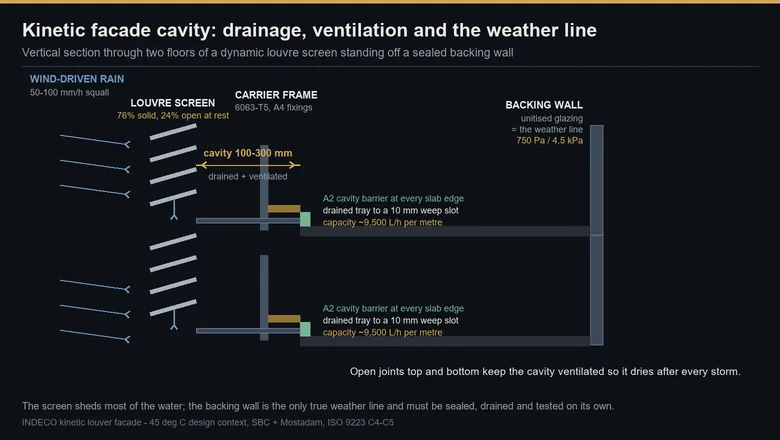
- Tray and weep at every floor: a formed aluminium or stainless tray collects what runs down the cavity and discharges it through a 10 mm slot; never let one floor's water fall onto the next.
- Slot protection: fit a perforated insect and debris screen that will not trap dust — in the Gulf, dust turned to mud is the usual cause of a blocked weep.
- Ventilation: keep open joints at the top and bottom of each compartment so the cavity dries after a storm; a cavity that cannot dry will keep its spandrel insulation wet.
- Fire barrier that still drains: an A2 barrier 100 to 200 mm deep, compressed 25 to 50%, at every slab edge to EN 13501-1 — detailed so it closes the cavity against fire without damming the water.
- No capillary paths: break any continuous gap narrower than about 6 mm across the cavity; a blade tip that nearly touches a bracket will hold water by surface tension.
- Access for cleaning: every weep position must be reachable from a cradle or rope, because a cavity is only as good as its dirtiest slot.
| Element | What it does | Typical value |
|---|---|---|
| Cavity depth | Room for brackets, drainage and drying airflow | 100–300 mm |
| Floor tray | Intercepts water running down the cavity | Formed 1.5–2.0 mm aluminium or stainless, sloped |
| Weep slot | Discharges the tray to the outside | 10 mm continuous per metre; ~9,500 L/h capacity at 10 mm head |
| Cavity barrier | Stops vertical fire and smoke spread | A2 to EN 13501-1, 100–200 mm deep, compressed 25–50% |
| Ventilation openings | Let the cavity dry after rain | Open joint top and bottom of each compartment |
| Inspection | Confirms slots are clear | Every 12 months; every 6 months in C5 exposure |
Why does the backing wall still need its own weather line?
Because for part of the year the screen is 62% open, and because a shield that sheds 70 to 80% of the water is still delivering 20 to 30% of it — at 45 m/s wind pressure — onto whatever stands behind. The backing wall on most kinetic projects is a unitised glazed curtain wall, and it has to be specified, detailed and tested exactly as it would be without a screen in front of it. Its joints, drainage and pressure equalisation are described in the unitised drainage article; the numbers below are the ones that should appear in the tender regardless of the screen.
| Performance | Target | Standard reference |
|---|---|---|
| Static water tightness | 750 Pa with no leakage | ASTM E331, spray 3.4 L/m² per minute |
| Dynamic water tightness (wind-driven rain) | No leakage under combined pressure and spray | EN 13050 — the test that represents driving rain |
| Air permeability | Class A4 at 600 Pa | EN 12152 |
| Water tightness classification | RE 1200 or project-specific | EN 12154 |
| Structural wind | 4.5 kPa design, proven at 1.5× | ASTM E330 / EN 13116 |
| Hose test of the assembled screen and wall | 19 L/min at 240 kPa, no penetration | AAMA 501.1 |
One practical interaction is worth calling out. A screen reduces the rain load on the backing wall, but it also reduces the wind pressure acting on it in the field while increasing shelter and suction patterns locally. Do not use the screen as an excuse to downgrade the backing wall's tested performance class; use it to extend service life and to keep the glass cleaner, which in a dusty climate is a maintenance saving in its own right.
How do Gulf and East African rain regimes change the detailing?
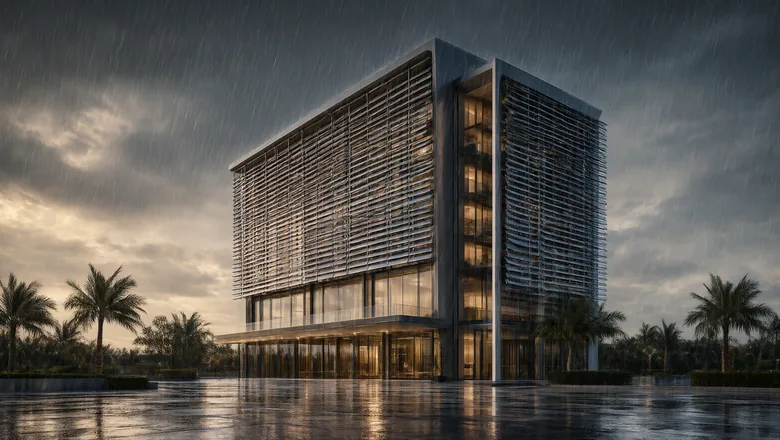
Because the two markets we build in get their water in opposite ways. The Gulf is a dry region that rains violently: well under 150 mm a year in total, but delivered in short convective bursts of 50 to 100 mm/h, often with dust in the air first. East Africa gets roughly 800 to 1,500 mm a year spread over two rainy seasons, with long periods of 10 to 30 mm/h and high ambient humidity. The screen sees the same mechanism in both; what changes is what blocks it and what grows in it.
| Driver | Gulf (45 °C design) | East Africa (highland and coastal) |
|---|---|---|
| Annual rainfall | Under 150 mm, concentrated | 800–1,500 mm, two seasons |
| Peak intensity | 50–100 mm/h bursts | 10–30 mm/h sustained |
| What blocks drainage | Dust turned to mud, then baked hard | Organic debris, seed pods, insect nests |
| Biological risk | Low — surfaces reach 75–80 °C | Moderate — mould and algae on shaded north faces |
| Condensation driver | Coastal dew point around 35–38 °C at 45 °C and high humidity | Cool highland nights against warm humid days |
| Inspection emphasis | Clear weeps before the summer squalls | Clear weeps at the start and end of each rainy season |
The Gulf case has a sting in it that catches projects out: the dust arrives dry, the rain arrives after it, and the mixture dries into a hard crust on the blade edges and in the weep slots. The fix is not a bigger slot but a cleaning cycle — rinse the screen and clear the weeps before the squall season, then again after the first storm. In East Africa the equivalent is a slot size that tolerates organic debris and a cavity that can dry within a day, because a cavity that stays damp through a long rainy season will show it on the spandrel panels and, eventually, on the indoor air.
Which moisture and corrosion details decide service life?
The water itself is not the enemy; standing water plus chlorides plus a dissimilar metal is. Aluminium with an intact anodic oxide is durable in both regions, but only where the detailing keeps water moving and keeps metals apart. The selection below is the one used across the kinetic range, and it follows the exposure classification in the coastal exposure guidance.
| Exposure (ISO 9223) | Typical location | Fixing and isolation | Inspection |
|---|---|---|---|
| C3 | Inland East Africa, low pollution | A2 stainless, EPDM isolators | 12 months |
| C4 | Coastal East Africa, industrial Gulf | A4 stainless at blade pivots, EPDM isolators | 12 months |
| C5 | Gulf waterfront, splash and dune zones | A4 stainless throughout, EPDM isolators, drained trays in stainless | 6 months |
- Blade: 6063-T5 extrusion, 100 / 150 / 200 mm chord, 24% open at rest and 62% at 90°, carried on sealed stainless pivots with return springs.
- Finish: AA25 anodising, 5–20 µm oxide, 200–500 HV, ΔE ≤ 2.5 — an integral oxide that cannot peel and is not damaged by rinsing, delivered through our anodizing partner in Guangdong.
- Isolation: EPDM or equivalent between aluminium and every stainless fixing; never allow aluminium-to-aluminium bearing in a wet, chloride-bearing cavity.
- Drainage hardware: trays and weep guards in the same family as the fixings — A2 in C3/C4, A4 in C5.
- Sealants: neutral-cure silicone where the cavity meets the backing wall, with the joint geometry and movement rules set out in the joints and sealants article.
- Service life: 25 years and beyond on the blade and pivot system, with drainage components as the only items on a shorter replacement cycle.
How is rain performance tested before the screen goes on site?
With a mock-up that includes the screen, the cavity and the backing wall together, because the interfaces are where water finds a way. A screen tested alone proves only that the blades shed water; a screen tested with its cavity, tray, barrier and backing wall proves the assembly. The programme and cost are the same ones described in the testing article — a 3.0 × 8.0 m mock-up with a 1.5 m return, 12 to 20 weeks, and 0.5 to 1.5% of package value.
| Stage | What is proven | Acceptance |
|---|---|---|
| Static water, backing wall alone | The weather line is watertight without the screen | No leakage at 750 Pa, ASTM E331 |
| Dynamic water, backing wall | Behaviour under wind-driven rain | No leakage to EN 13050 |
| Hose test, screen installed | The screen does not channel water into the cavity | 19 L/min at 240 kPa, AAMA 501.1 |
| Cavity drainage check | Tray and weep discharge without backing up | Discharge visible at every slot; no retention in the tray |
| Post-cycling repeat | Water performance after mechanical cycling | Repeat static and hose tests after cycling; no degradation |
| Site sweep and handover | Every blade moves and every slot is clear | 100% of blades swept; weeps photographed and logged |
Two site checks finish the job and cost almost nothing. After the first real storm on the completed elevation, open an inspection panel and look at the tray: it should be stained, not full. And photograph every weep position at handover so that the 12-month inspection has a baseline to compare against — the comparison is what tells you whether the cleaning cycle you set is the right one.
Key takeaways
- A kinetic louvre screen is a shield, not a weather barrier: 76% solid at rest, 62% open at 90°.
- Wind-driven rain on the upper third of a tall facade runs at 0.8–1.5× the horizontal intensity, and close to 2× at an exposed corner.
- Rain reaching the wall behind: 15–25% with the blades at rest, 45–60% once they open to 90° in storm wind.
- Drainage is never the constraint — one 10 mm slot per metre clears about 9,500 L/h against a 100 L/h squall. Blockage is the risk.
- Give the cavity a tray and weep at every floor, ventilation top and bottom, and an A2 barrier that closes the cavity without damming the water.
- Specify the backing wall as a tested weather line in its own right: 750 Pa static, EN 13050 dynamic, A4 air, 4.5 kPa structural.
- Clear weeps before the Gulf squall season and at the start and end of each East African rainy season; inspect at 12 months, or 6 in C5.
Frequently asked questions
Does a kinetic facade keep the rain out?
Not on its own. A kinetic louvre screen is a shield that sheds most of the water; it is not a sealed weather barrier. At rest it is 76 percent solid, so it intercepts the bulk of driving rain, but the wall behind still has to be watertight and tested in its own right.
How much rain gets through a kinetic louvre screen?
About 15 to 25 percent of what arrives while the blades are at rest, rising to 45 to 60 percent once they swing fully open in storm wind. Droplet inertia helps: much of the water that would fit through a gap strikes the next blade instead and is shed downwards.
Where does the water behind a kinetic facade go?
It runs down the cavity and is caught on a formed tray at every floor, then discharges to the outside through a continuous 10 millimetre weep slot. One slot per metre clears roughly 9,500 litres an hour, so a blocked slot, not a heavy storm, is what floods a cavity.
Does the cavity behind a kinetic facade need a fire barrier?
Yes. An A2 barrier 100 to 200 millimetres deep, compressed 25 to 50 percent, is fitted at every slab edge to EN 13501-1 so the new cavity cannot act as a flue. It must be detailed to stop fire and smoke without damming the drainage path.
How often should kinetic facade drainage be cleaned?
Inspect every 12 months, or every 6 months in C5 coastal exposure. In the Gulf clear the weeps before the squall season because dust wets and bakes hard; in East Africa clear them at the start and end of each rainy season.
Kinetic Facade Wind Load: From 0.9 m/s Activation to 45 m/s Design
Kinetic Facade Maintenance: Inspection & Lifecycle Cost
Unitised Glazing Drainage: Pressure Equalisation & Weep Paths