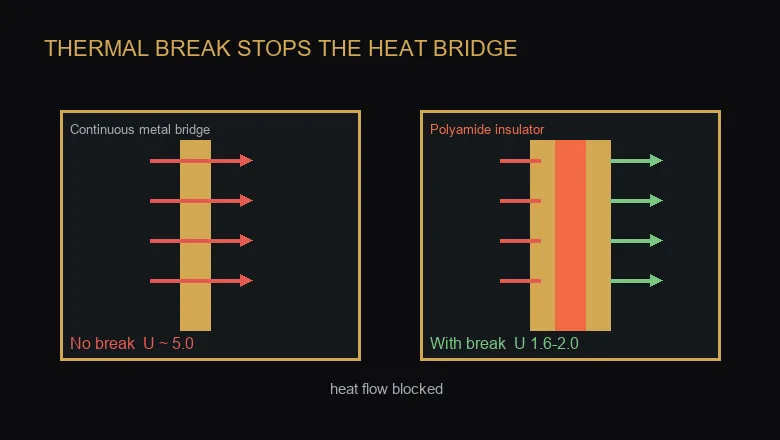
Short answer: A thermal break is an insulating barrier cast or inserted into the aluminium frame of a unitised glazing unit. It interrupts conduction through the metal and typically cuts the frame U-value from about 5.0 to 1.6–2.0 W/m²K — the step that lets a façade meet SBC and Mostadam targets for a modest material premium.
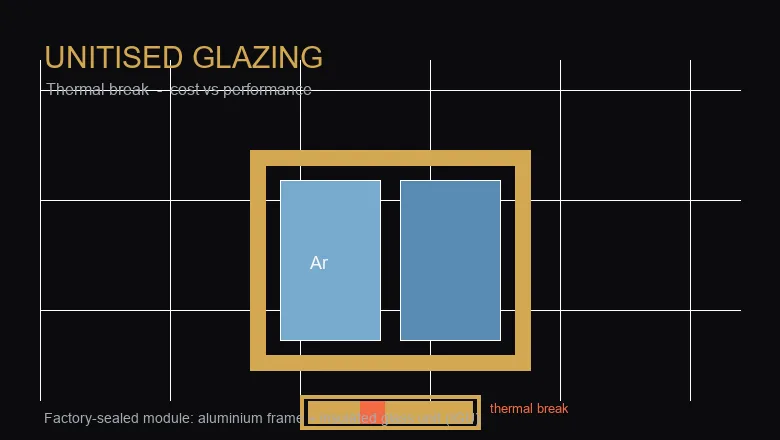
A unitised curtain wall — also called a unitised glazing or modular glazing system — arrives on site as factory-sealed aluminium-and-glass modules. The glass, an insulated glass unit (IGU), is only half the thermal story; the aluminium mullions and transoms are the other half. Without an insulating break, those extruded sections form a continuous metal bridge that leaks heat straight through the wall.
INDECO frames are finished with architectural anodized aluminium from our anodizing partner in Guangdong, licensed under the QUALANOD architectural-anodizing scheme. The oxide film is grown from the metal itself (5–20 µm, 200–500 HV, A2 fire rating), so there is no organic coating to chalk or peel under Gulf UV. Read more about the finish in our anodized aluminium cladding guide.
What Is a Thermal Break in Unitised Glazing?
A thermal break is a low-conductivity section inserted between the inner and outer faces of the aluminium frame of a curtain-wall module. It turns one continuous metal profile into two separated profiles, joined only by the insulator. In a unitised system this break is built into every vertical mullion and horizontal transom before the IGU is glazed, so the thermal upgrade is part of the factory-sealed module rather than a field fix.
- Polyamide strip system (PA66GF25) — two extruded aluminium halves are rolled together with a glass-reinforced nylon strip. Strip widths of 14–34 mm are common, and the joint can be cut and assembled in a factory line.
- Pour-and-debridge system — liquid polyurethane is poured into a cavity in the profile and the metal bridge is removed after curing. It suits complex profiles and lower-volume lines.
INDECO uses polyamide strip systems for most repetitive unitised grids because the width, strength and thermal movement are well understood, and the components integrate cleanly with factory assembly jigs.
How Does a Thermal Break Work?
Aluminium conducts heat at roughly 160 W/mK; a typical polyamide thermal break conducts at roughly 0.3 W/mK. Inserting the break between the outer and inner profiles forces heat to travel through the insulator instead of across the metal. The result is a lower frame U-value, a warmer interior frame surface and far less risk of condensation at the glazing perimeter.
The improvement is not just about conductivity. A broken frame also raises the interior surface temperature under winter or high-AC-load conditions, which means occupants do not feel a cold strip of metal at the window edge — an important comfort factor in towers conditioned to 22°C while the Gulf exterior is 45°C.
Thermal-Broken vs Non-Broken: A Performance Comparison
Numbers vary with profile geometry, glass specification and cavity width, but the table below shows the order-of-magnitude difference INDECO engineers use when comparing options at concept stage.
| Attribute | No thermal break | Polyamide thermal break |
|---|---|---|
| Frame U-value | ~5.0 W/m²K | 1.6–2.0 W/m²K |
| Typical whole-façade U-value | 3.0–3.5 W/m²K | 1.4–1.8 W/m²K |
| Interior surface temperature at perimeter | 10–14°C risk of condensation | Near room air temperature |
| Condensation risk | High | Low |
| Comfort at glass edge | Cold downdraught | Stable |
| SBC / Mostadam-ready envelope | Unlikely without oversized glass | Achievable |
The table explains why thermal breaks are treated as standard, not optional, on projects governed by modern envelope codes. They are a small fraction of façade cost but often the single biggest lever on frame-dominated U-value.
Which Thermal-Break Material Should You Specify?
Both polyamide strips and pour-and-debridge systems are proven. The choice depends on production volume, profile complexity and structural load path.
| Attribute | Polyamide strip (PA66GF25) | Pour-and-debridge polyurethane |
|---|---|---|
| Typical width | 14–34 mm | Profile-specific |
| Best suited to | Repetitive unitised grids | Complex or low-volume profiles |
| Factory handling | Roll-form, easy to assemble in jigs | Cure time, dedicated cell |
| Thermal movement | Designed into the strip geometry | Limited by foam depth |
| Structural capacity | High; tested shear and tension | Good; verify with supplier data |
| Finish compatibility | Excellent with anodizing | Check masking before anodizing |
For high-rise unitised façades with regular modules, the strip system is usually the faster and more repeatable factory choice. The thermal and structural data are also more widely published, which helps code submission.
Cost vs Performance: When the Upgrade Pays
The polyamide strip and the second extrusion add roughly 8–15% to frame material cost. Spread across the whole façade — glass, gaskets, seals, installation, support steel — the premium is typically 2–4% of envelope cost. The return comes from three places:
- Smaller HVAC plant — lowering the glazing U-value reduces the peak cooling load, which can trim chiller capacity in 45°C Gulf climates.
- Energy savings — lower year-round transmission through the envelope, especially on east and west elevations.
- Compliance value — meeting SBC envelope limits and Mostadam energy credits without upgrading the entire glass package to a far more expensive specification.
In INDECO's experience on high-rise towers in the Gulf and East Africa, the payback period is usually under five years, and the avoided compliance risk is worth more than the material premium itself.
Specifying for Gulf and East African Projects
Thermal performance cannot be separated from durability. At 45°C design heat, with ISO 9223 C4/C5 coastal exposure, the aluminium finish must survive UV, dust and chloride. Architectural anodizing at 5–20 µm, with A4/316 stainless fixings and careful isolation of dissimilar metals, is the INDECO baseline for unitised glazing in these markets.
Recent INDECO reference applications include the Gulf Waterfront Commercial Tower (Dubai), the Gulf Cultural Landmark Pavilion (Doha) and the East Africa CBD Tower (Nairobi). In each case the thermal-broken unitised frame allowed the façade to hit the target U-value while keeping the visible aluminium profile depth within the architectural grid. For more detail see our unitised curtain wall guide and unitised glazing specifications.
Key takeaways
- A thermal break is an insulating barrier inside the aluminium frame of a unitised glazing unit; it interrupts the metal heat bridge.
- It typically cuts the frame U-value from ~5.0 to 1.6–2.0 W/m²K, which often decides whether the façade meets SBC and Mostadam.
- Polyamide strip systems (PA66GF25) are the standard choice for repetitive unitised grids; pour-and-debridge suits complex profiles.
- The material premium is about 8–15% on frames, 2–4% on the whole façade, with a payback usually under five years in hot climates.
- Anodized aluminium (5–20 µm, A2, ΔE 1.0–2.0) and A4/316 fixings complete the package for C4/C5 Gulf and East African exposure.
Frequently asked questions
What is a thermal break in unitised glazing?
It is an insulating section — usually a polyamide strip or a polyurethane pour — inserted between the inner and outer aluminium profiles of a unitised curtain-wall frame. It blocks the direct heat path through the metal and improves the frame U-value.
How much does a thermal break improve the U-value?
Typically the frame U-value falls from about 5.0 W/m²K without a break to 1.6–2.0 W/m²K with a polyamide break. That step can move the whole façade U-value from 3.0–3.5 down to 1.4–1.8 W/m²K.
Polyamide strip or pour-and-debridge — which is better?
For repetitive unitised grids, polyamide strips are usually better: they are factory-friendly, well-tested and easier to integrate with anodized finishes. Pour-and-debridge works for complex or low-volume profiles but needs more care in anodizing.
Does a thermal break add significant cost?
About 8–15% on the aluminium frame material and roughly 2–4% on the whole façade. The payback in reduced cooling load is usually under five years in 45°C Gulf and East African climates, and it often makes SBC/Mostadam compliance possible.
Is a thermal break required under SBC and Mostadam?
Codes do not always name the component, but the envelope U-value limits in the Saudi Building Code and the energy intent in Mostadam make thermal breaks effectively necessary on metal-framed unitised façades in hot climates.
Specifying unitised glazing for a Gulf or East Africa project?
Send us the elevation grids, the governing code and the target U-value. We return a thermal-broken unitised glazing concept, profile and IGU selection, anodized finish specification for the exposure class, and SBC/Mostadam documentation. See the Unitised Glazing product page, read the unitised curtain wall guide and the unitised glazing specifications, or talk to our engineering team.