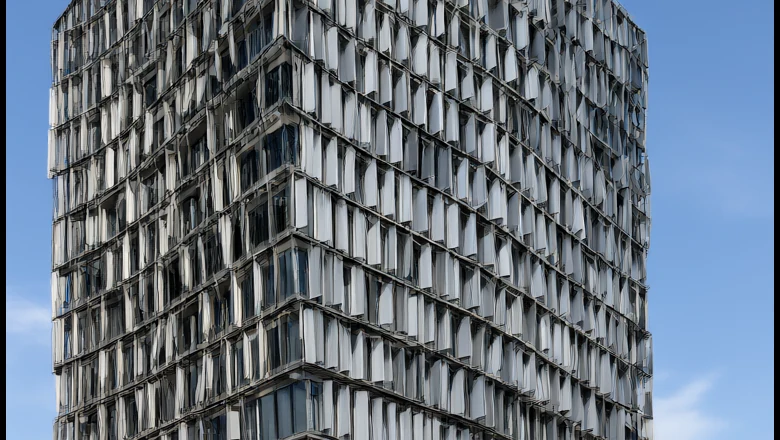
Every moving facade is a machine before it is a wall, and the machine has a name: its movement type. Choose the wrong one and you inherit a maintenance liability that no coating or control system can fix. Choose well and the same elevation shades itself, survives a 45 m/s gust and keeps moving for 25 years without a service call. Kinetic architecture — also described as dynamic or responsive architecture — is defined by parts of the building envelope moving without loss of structural integrity; the engineering question is which kinematics deliver that reliably at scale.
This article compares the four families used in practice, quantifies what each one delivers in free area, wind demand, speed and joint count, and gives the specification clauses that keep the choice honest. It uses the blade family in our kinetic louver facade range — 6063-T5 blades in 100, 150 and 200 mm widths on 4.0 m modules, activating below 0.9 m/s and designed for 45 m/s service wind.
What is a kinetic facade movement type?
A movement type is the kinematic family of the mechanism: how many degrees of freedom the panel has, what path it travels, and how load reaches the structure in every position along that path. Four families cover almost everything built: rotation (a blade pivots about a fixed axis), folding (hinged leaves stack back on themselves), sliding (a panel translates along a track) and scissor or deployable (a pantograph linkage extends and retracts).
The distinction matters because each family converts wind into a different structural problem. A rotating blade presents less and less solidity as it opens; a sliding panel presents the same full area at every position. That single difference decides bracket sizes, anchor loads and, on a tall tower, whether the mechanism is affordable at all. It also decides how many wearing parts the facade owns: each additional hinge or roller is another item on the maintenance schedule.
How does rotation work, and why does it dominate towers?
A rotating louver is a single-degree-of-freedom machine: an extruded 6063-T5 blade carried on stainless pivot bearings at each end, balanced by a return spring, sweeping 0–90°. In its passive form there is no motor, no sensor and no cable; wind pressure itself provides the torque, and the spring provides the restoring force. Activation is below 0.9 m/s — roughly 2 mph, a breeze you can feel on your cheek — and the blade then floats at an angle set by the balance between wind torque and spring preload.
Three geometric facts explain why this family wins on tall buildings. First, the blade is narrow: 100, 150 or 200 mm chord on a 4.0 m module, so wind load per element stays at the order of 0.6–1.2 kN even at 45 m/s. Second, the load path never leaves the module frame: pivots, brackets, then the slab edge. Third, open area is achieved by turning rather than by removing material, so the screen keeps its rain-screening function at every angle — the same geometry that produces 24% open area at rest and about 60% at 90°.
| Blade chord | Typical pitch | Open area at rest | Open area at 90° | Blades per 4.0 m module band |
|---|---|---|---|---|
| 100 mm | 130 mm | 26% | 62% | 11–12 |
| 150 mm | 190 mm | 24% | 61% | 8 |
| 200 mm | 250 mm | 23% | 60% | 6 |
Wider blades buy shadow depth and a calmer visual grain rather than more open area: the table shows open area is almost constant at 23–26%, which is why glare and daylight control is driven by blade angle and pitch, not by chord alone.
When does folding make sense?
Folding leaves — the bi-fold vocabulary borrowed from doors — stack back to one side of a bay and can clear up to 90% of the opening. That makes them attractive where the brief is occasional full opening rather than continuous modulation: podium restaurants, terrace edges, double-height lobbies that open to the street on mild evenings.
The trade is mechanical. A folding bay carries four hinges, two carriers and a top track for every two leaves, all of which must stay aligned while the building drifts and the leaves swing. Carrier wheels and hinges expose far more wearing area to dust than a sealed pivot, and the closed leaf is a solid sail: at 45 m/s it carries the full stagnation pressure with no relief. Folding is a good answer for low, sheltered, occasionally-opened elevations, and a poor one for a 40-storey windward face.
What do sliding panels offer?
Sliding is the simplest kinematics of all — translation along a track — and it is what most people picture when they hear “moving facade”. Panels are large, flat and legible; they can carry perforation, pattern or glazing; and they read as architecture rather than as shading hardware.
But sliding has three hard limits. Free area is capped near 50%, because a panel has to park somewhere and that parking space is still facade. Tracks are horizontal ledges in a dusty, saline climate, which means grit and salt collect exactly where the rollers run; in C4 and C5 air that becomes a cleaning item, not a design detail. And the panel keeps full solidity at every position, so wind load does not drop when the facade “opens”. Sliding suits mid-rise elevations with sheltered aspects and an owner prepared to fund track maintenance.
Where do scissor and deployable mechanisms fit?
A scissor mechanism is a pantograph: a parallelogram linkage that extends and retracts, converting a short actuator stroke into a large movement. It delivers the most dramatic geometry in the entire family — canopies that unfurl, screens that bloom — and it is the right choice for landmark canopies, atrium roofs and cultural pavilions where the movement itself is the architecture.
It is also the joint-heaviest option. A pantograph multiplies pivots: six nodes and eight bushings per bay is typical, each one a wear point and each one adding free play that accumulates across the span. On a repetitive tower elevation that accumulation is unacceptable; at a single feature canopy it is manageable because access and inspection are easy. Pantograph linkages are excellent at one-off features and rare, for good reason, on 20,000 m² of cladding.
How much free area does each movement type deliver?
| Movement type | Free area closed | Free area open | Rain screening while open | Typical application |
|---|---|---|---|---|
| Rotating louver | 0% (blades overlap) | 60–62% | Yes — blades shed water at any angle | Tower shading screens |
| Folding leaves | 0% | 85–90% | No — opening is a weather opening | Podium, terrace, lobby |
| Sliding panel | 0% | 45–50% | Partial — depends on overlap | Mid-rise screens |
| Scissor / deployable | 0% | 90–100% | No | Canopies, pavilions |
Note that free area is not the same as useful ventilation. A rotating screen at 24% open area still rejects driven rain and still shades, so it can stay in that position through a squall; a folding set at 90% is an open wall and has to be closed the moment weather arrives. On a tower, the position you can hold all day is worth more than the position you can reach occasionally.
How does movement type change the 45 m/s wind case?
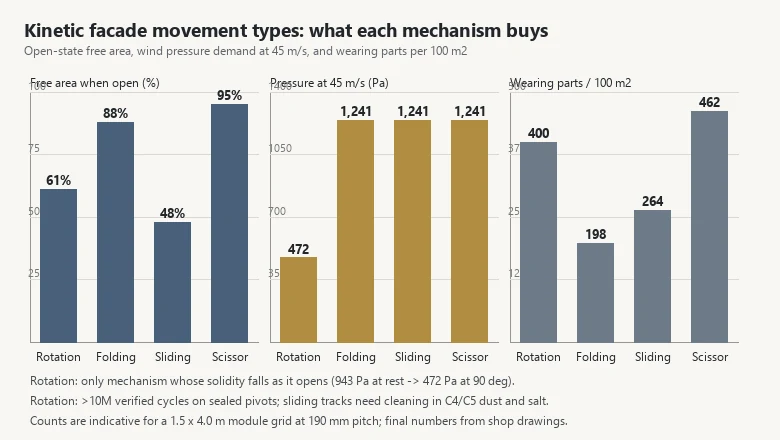
At 45 m/s the stagnation pressure is q = 0.613 V² ≈ 1,241 Pa. What the facade actually feels is that pressure multiplied by its solidity — the fraction of the elevation that blocks the flow — and by the shape factor of the zone. Rotation is the only family whose solidity falls as it opens.
| Movement type and state | Solidity | Pressure at 45 m/s | Corner zone (1.7–2.0×) |
|---|---|---|---|
| Rotating louver, 90° open | 0.38 | 472 Pa | 0.80–0.94 kPa |
| Rotating louver, at rest (24% open) | 0.76 | 943 Pa | 1.60–1.89 kPa |
| Sliding panel, any position | 1.00 | 1,241 Pa | 2.11–2.48 kPa |
| Folding leaf, closed | 1.00 | 1,241 Pa | 2.11–2.48 kPa |
| Scissor screen, deployed | 1.00 | 1,241 Pa | 2.11–2.48 kPa |
That is a factor of 2.6 in demand between an open louver and a solid panel on the same corner, and it propagates straight into bracket sections, anchor spacing and slab-edge checks. The full derivation sits in the 45 m/s wind load guide, where the 150+ load cases behind our 99.8% reliability figure are set out.
How fast does a kinetic facade actually move?
Slower than intuition suggests, and that is deliberate. A motorised line sweeps 0–90° in 10–30 s; a passive blade follows the breeze continuously, with a full stroke over minutes. Expressing the same stroke as angular velocity and blade-tip speed shows how little kinetic energy is in the system — the reason moving aluminium can be made safe and quiet.
| Stroke time for 0–90° | Angular velocity | Tip speed, 100 mm blade | Tip speed, 200 mm blade |
|---|---|---|---|
| 10 s (fast motorised) | 9.0 °/s | 7.9 mm/s | 15.7 mm/s |
| 15 s | 6.0 °/s | 5.2 mm/s | 10.5 mm/s |
| 20 s | 4.5 °/s | 3.9 mm/s | 7.9 mm/s |
| 30 s (standard motorised) | 3.0 °/s | 2.6 mm/s | 5.2 mm/s |
Tip speeds of 3–16 mm/s are walking pace and below, which is why blade-to-blade clearances of 10 mm and simple edge geometry are enough to manage entrapment and noise. The audible problems reported on kinetic screens come from flutter and vortex shedding, not from the drive — see the failure modes in the testing and verification article.
What does each mechanism cost to keep moving?
Cost of ownership follows joint count and cycle budget, not the purchase price of the mechanism. Using a 1.5 × 4.0 m module grid at 190 mm pitch — eight blades and sixteen pivots per module — the indicative counts per 100 m² of elevation are:
| Movement type | Wearing parts per 100 m² | Track or guide length | Verified cycle life | Dust sensitivity |
|---|---|---|---|---|
| Rotating louver (passive) | 267 pivots, 133 springs | None | >10 million cycles | Low — sealed bearing |
| Rotating louver (motorised) | 267 pivots, 8–12 actuators | None | Bearings >10M; actuators 10–15 yr | Low |
| Folding leaves | 132 hinges, 66 carriers | 66 m | 100,000–250,000 cycles | Moderate |
| Sliding panels | 264 rollers | 132 m | 100,000–200,000 cycles | High — open track |
| Scissor linkage | 198 nodes, 264 bushes | 66 m | 50,000–150,000 cycles | High |
Indicative counts for design comparison; final numbers come from the shop drawings. Against a 25-year budget of 182,500 to 365,000 strokes, only the rotating family is comfortably inside its verified envelope. The capital picture is set out in the cost and value engineering article, where a fixed louvre is indexed at 100, passive kinetic at 130–160 and motorised kinetic at 175–240.
Which movement type suits Gulf and East African projects?
| Project condition | Recommended movement | Why |
|---|---|---|
| Gulf tower, 45°C, 45 m/s, corner zones | Passive rotation | Lowest solidity when open, no motor to derate at 45°C |
| Coastal C4/C5: Gulf waterfront, Mombasa, Lagos | Passive rotation, AA25 anodised | Sealed pivots resist salt; no track to foul |
| Dusty inland: Riyadh, Khartoum, Nairobi dry season | Passive rotation | No open tracks; wipe-clean blade surfaces |
| Podium restaurant or terrace edge | Folding | Occasional full opening, easy access for service |
| Landmark canopy or pavilion | Scissor / deployable | Feature geometry, inspectable at ground level |
| Boardroom or atrium requiring scheduled scenes | Motorised rotation | Deterministic angle set by BMS |
For the Gulf case specifically, passive rotation removes the single most fragile item in a 45°C environment: the actuator and its control cabinet. The full climate argument, including Gulf-specific design at 45°C under SBC and Mostadam, is covered separately.
What belongs in the movement clause?
- Name the movement type and the degrees of freedom; do not leave “kinetic” undefined.
- State travel (0–90° or mm), stroke time, angular velocity and tip speed limits.
- State free area at rest, at mid-travel and fully open, with the pitch and chord used.
- Give the solidity used for the wind case, and the pressure at each zone including the 1.7–2.0× corner factor.
- Specify the cycle budget for 25 years and the verified cycle life of every wearing part.
- Require sealed bearings, and state the dust and salt category from ISO 9223.
- Require blade-to-blade clearance of at least 10 mm and rounded trailing edges.
- Finish: AA25 anodising, 5–20 µm film, 200–500 HV, ΔE ≤ 2.5, ISO 9227 salt spray by category; A2 reaction to fire.
Key takeaways
- Four movement families exist — rotation, folding, sliding and scissor — and they differ in solidity, free area and joint count, not just appearance.
- Rotation drops solidity from 0.76 at rest to 0.38 when open, cutting 45 m/s pressure from 943 Pa to 472 Pa before zone factors.
- Rotating blades are verified past 10 million cycles; sliding and folding mechanisms typically sit in the 100,000–250,000 band.
- Tip speeds are 3–16 mm/s, so clearance and edge geometry, not drive power, govern safety and noise.
- Passive rotation needs no motor, sensor or cable, which removes the 45°C derating problem entirely.
Frequently asked questions
What are the main types of kinetic facade movement?
Four: rotation, where blades pivot 0–90° on bearings; folding, where hinged leaves stack to one side; sliding, where panels translate along a track; and scissor or deployable linkages that extend and retract. Rotation is used on most towers; the other three appear on podiums, canopies and feature areas.
Which kinetic facade movement type lasts longest?
Rotation. A 6063-T5 blade on sealed stainless pivots is verified beyond 10 million cycles, against a real budget of 180,000 to 365,000 strokes in 25 years. Sliding rollers and folding carriers typically carry 100,000 to 250,000 cycles and need earlier replacement intervals.
Do kinetic louvers move without motors?
Yes. A passive blade is driven by wind torque and returned by a spring: no motor, no sensor, no cabling and zero energy use. Activation begins below 0.9 m/s, about 2 mph, and the blade then floats at the angle where wind torque and spring preload balance.
How much open area does a rotating louver give?
About 23–26% at rest, depending on chord and pitch, rising to 60–62% at 90°. Wider blades do not add much open area — 100 mm and 200 mm blades differ by only three points — but they do add shadow depth and a coarser visual grain.
Which movement type suits a 45 m/s Gulf tower?
Passive rotation. It has the lowest solidity when open, so corner pressure stays near 0.8–0.9 kPa instead of 2.1–2.5 kPa for a solid panel, and it has no actuator to derate in 45°C air or no cable route to maintain.
Choosing movement for a live tower?
Send the elevation, the wind study and the shading brief. We return a movement-type recommendation with free area and wind numbers, a blade schedule in 100–200 mm chords, and a budget range. See the kinetic louver facade range, read passive vs motorised drive, or talk to our engineering team.