Short answer: A kinetic facade for hot, arid Gulf climates is a wind-responsive skin of moving aluminium louvers that shades a glass tower in 45°C design heat. It cuts solar gain and cooling load with zero electricity, and pairs with unitised glazing and anodized aluminium (5–20 µm oxide, A2 fire rating).
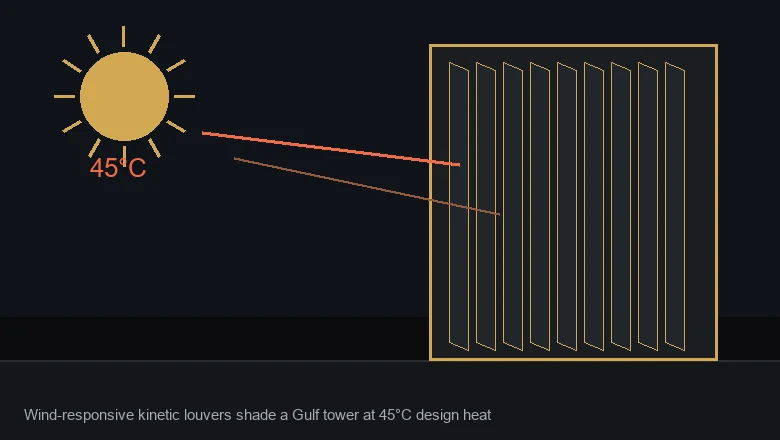
Cooling is the single largest operating cost of a glass tower in Riyadh, Doha, Dubai or Jeddah. A kinetic facade — also called a dynamic facade, or a wall of moving louvers — attacks that cost at the envelope: it shades the glass in 45°C design heat and ventilates the cavity, with motion driven by wind rather than motors. This guide covers how a kinetic facade performs in hot, arid Gulf conditions and how it lines up with the Saudi Building Code (SBC) and the Mostadam rating.
Why the Gulf climate is the hardest test for a facade
Three loads act on a Gulf envelope at once. First, intense solar gain: high sun angles through most of the year pour radiation onto large glazed areas, and a design air temperature of 45°C sets the cooling peak. Second, airborne dust: fine desert particles settle on and between panels, dulling reflectivity and trapping moisture. Third, chloride carried off the coast, which pushes exposure toward ISO 9223 categories C4 and C5 and demands a corrosion-resistant finish with non-corroding fixings.
A fixed overhang or a single fixed screen cannot answer all three. As the sun angle and the wind shift through the day, a static facade is either over-shaded — dark and wasteful on lighting — or under-shaded, and hot. A kinetic skin adapts to both.
How does a kinetic facade shade a building at 45°C?
INDECO kinetic louvers are passive: the wind is the actuator, and motion begins at very low speeds — under 2 mph (about 0.9 m/s) — with no motors, sensors or power supply. As the breeze moves the blades, the elevation continuously re-opens and re-closes its shading pattern. Compared with a fixed screen, the same skin shades more at high sun angles while keeping daylight and views when the sun is low.
| Attribute | Fixed shading screen | Kinetic facade |
|---|---|---|
| Response to sun & wind | None — one fixed position | Continuous, adaptive |
| Energy to move | n/a | Zero (wind-driven) |
| Daylight / views | Compromised year-round | Optimised hour to hour |
| Cooling-load strategy | Fixed reduction | Variable, peak-shaving |
| Visual identity | Static | Ever-changing landmark |
| Maintenance | Standard | Low, engineered for decades |
Because the shading layer sits in front of the glazing, the single biggest win is reduced direct solar gain — the driver of the Gulf cooling peak. Paired with a sealed unitised glazing envelope, the kinetic layer handles the sun while the glazing handles airtightness, water and thermal performance.
Which aluminium finish survives 45°C heat, dust and salt?
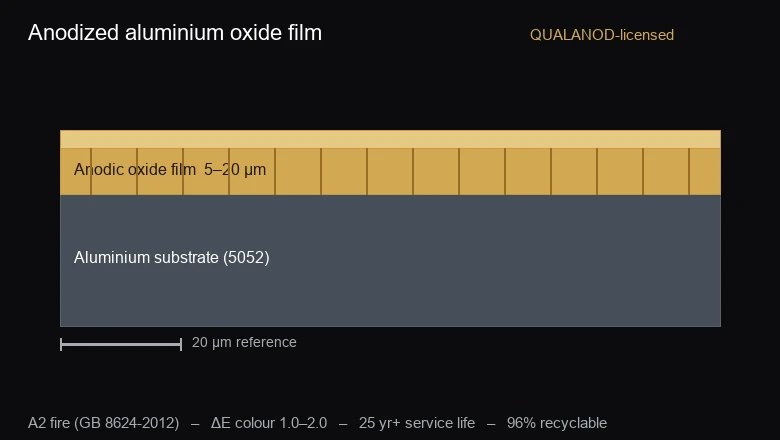
In C4/C5 Gulf conditions the finish, not the alloy, decides service life. INDECO kinetic blades are produced with anodized aluminium from our anodizing partner in Guangdong, an architectural anodizing line licensed under the QUALANOD quality scheme. Anodizing grows the oxide out of the metal itself, so there is no coating to peel, chip or chalk under UV — a decisive advantage where the same surfaces also face abrasive dust.
| Property | Anodized architectural aluminium |
|---|---|
| Oxide film thickness | 5–20 µm |
| Surface hardness | 200–500 HV |
| Fire reaction | A2 (GB 8624-2012); no combustion, no toxic gas at 600°C |
| Colour consistency | ΔE 1.0–2.0 within a batch; 2.0–2.5 across batches |
| Service life | 25 years+ |
| End of life | 100% recyclable; ~96% recovery |
For the blade material itself, lightweight corrosion-resistant alloys such as 5052 are the default for kinetic panels — the same family INDECO forms into aluminum cladding at podium and feature levels.
Wind, corrosion and structural ratings
- Wind-load capability — INDECO kinetic systems are rated for 150+ wind-load conditions, so the same blade logic scales from low-rise screens to tower elevations.
- Design wind speed — the Gulf Cultural Landmark Pavilion in Doha uses a wind-driven kinetic installation rated for 45 m/s design winds.
- Corrosion strategy — anodized aluminium blades with A4/316-grade stainless fixings and pivots in coastal C4/C5 zones, isolating dissimilar metals to stop galvanic couple.
- Dust and maintenance — a smooth, non-charging anodized surface releases dust and cleans with pH-neutral water, keeping reflectivity stable where a chalking coating would not.
How does a kinetic facade support SBC and Mostadam?
Saudi projects are governed by the Saudi Building Code (SBC) for envelope energy performance and are increasingly specified to the Mostadam green-building rating. A kinetic facade contributes on two fronts:
- Envelope energy — adaptive shading lowers the solar heat gain reaching the glass, reducing the cooling demand that SBC envelope limits are written to control.
- Rating credits — a passive, zero-energy shading system supports Mostadam's energy and innovation intent without adding a powered, maintained sub-system.
Gulf sustainability frameworks are not interchangeable: Saudi schemes follow SBC and Mostadam, while GSAS and Estidama belong to other jurisdictions. Naming the right framework in the facade documentation avoids a compliance mismatch at submittal.
Where this is already specified
- Gulf Waterfront Commercial Tower (Dubai) — unitised glazing with a shading strategy built for extreme solar gain.
- Gulf Cultural Landmark Pavilion (Doha) — a wind-driven kinetic installation rated for 45 m/s design winds.
- East Africa CBD Tower (Nairobi) — a wind-responsive kinetic skin tuned to East African wind profiles.
Read the technical detail in our kinetic curtain wall specification guide, the energy-saving analysis and the East Africa zero-energy case study.
Key takeaways
- The Gulf combines three loads at once — solar gain at a 45°C design temperature, desert dust and coastal chloride (ISO 9223 C4/C5).
- A kinetic facade shades adaptively with wind alone, starting below 0.9 m/s, with no motors, sensors or power.
- Anodized aluminium (5–20 µm, 200–500 HV, A2 fire, ΔE 1.0–2.0) is the finish that survives UV, dust and salt with no coating to peel.
- Systems are rated for 150+ wind-load conditions; the Doha pavilion runs a 45 m/s design wind.
- Kinetic shading supports SBC envelope limits and Mostadam credits; do not mix in GSAS or Estidama.
Frequently asked questions
What is a kinetic facade and how does it help in hot climates?
A kinetic facade is a building skin of wind-driven movable louvers that shade and ventilate as the wind and sun change. In hot climates the shading cuts direct solar gain during peak hours, which lowers the cooling load. It needs no electricity to move, so the shading benefit carries no operating-energy penalty of its own.
Do kinetic facades use electricity?
INDECO kinetic facades do not. The blades are actuated by wind alone — motion begins under 2 mph (about 0.9 m/s) and the fins return to rest when the breeze drops. There are no motors, sensors or wiring, which removes a powered sub-system to power, monitor and maintain.
Which finish withstands 45°C heat, dust and salt?
Architectural anodized aluminium. The oxide film is grown from the metal (5–20 µm, 200–500 HV), so there is no coating to chalk or peel under UV, and it resists abrasion from desert dust. Our anodizing partner in Guangdong is licensed under the QUALANOD scheme for architectural anodizing.
Are kinetic facades allowed under the Saudi Building Code and Mostadam?
Yes — they help rather than hinder compliance. Adaptive shading lowers the solar heat gain reaching the glazing, which supports SBC envelope energy limits, and a passive zero-energy system supports Mostadam's energy and innovation intent. Document the shading strategy in the facade submittal for review.
How windy must it be for the louvers to move?
Very little. Activation begins at very low wind speeds — under 2 mph, about 0.9 m/s — which is common at height and along Gulf waterfronts. On a still day the blades rest quietly; the Gulf Cultural Landmark Pavilion in Doha is rated for 45 m/s design winds.
Specifying a kinetic facade for a Gulf project?
Send us the location, the elevation areas and the governing code (SBC / Mostadam). We return a kinetic shading concept, blade geometry matched to the site sun path, an anodized finish specification for the exposure class, and wind-load documentation. See the Kinetic Louver Facade range, read the specification guide, or talk to our engineering team.