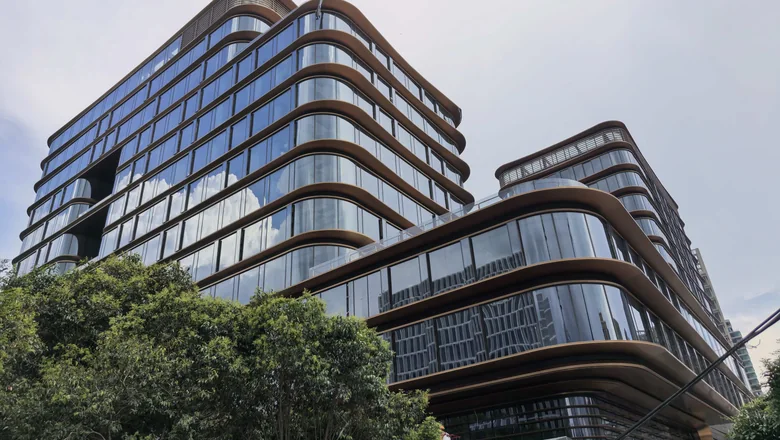
The African coast is one of the most demanding places to put a metal facade, and one of the best places to put an aluminium one. From Lagos and Accra through Abidjan and Dakar, and from Mombasa and Dar es Salaam down to Maputo, a building faces the same combination: airborne chloride, humidity that rarely drops, a wet season that alternates with a dry one, intense ultraviolet, and surface temperatures that reach 45 °C.
Aluminium does not rust, which is why it is the default cladding material on that coast. But “does not rust” is not the same as “will not corrode”, and the difference between a facade that looks new at twenty years and one that is streaked and pitted at eight is almost never the metal. It is the finish, the fixings and the drainage. This guide sets out the exposure, the material and finish decision, the details that decide service life, and the maintenance cycle that keeps the warranty honest. It sits alongside our complete aluminum cladding guide and the anodized cladding guide, and it links to the regional pages for Kenya, Tanzania, Nigeria and the wider African market.
What the coastal environment actually does to a facade
Corrosion on the coast is not caused by salt in the air alone. It is caused by salt that lands on a surface, dries, and concentrates. Five mechanisms do most of the damage.
- Chloride deposition. Sea spray carries chloride inland on the prevailing wind. Deposited on aluminium it breaks down the passive oxide film locally, and where moisture sits, that point pits. The distance that matters is not to the sea in general but to the surf line: a site behind a headland and a site on an open beach 300 m from the water are in different exposure classes.
- Wet–dry cycling. Constant rain would be comparatively kind, because it dilutes and washes. It is the alternation — wet at night from dew and humidity, dry and concentrated by mid-morning — that repeatedly attacks the same spots.
- Harmattan dust. On the West African coast, the December–February harmattan brings fine, abrasive, slightly alkaline dust that settles into joints and on horizontal surfaces. Left in place it holds moisture against the finish and dulls a metallic surface within a season.
- Ultraviolet and heat. UV degrades organic coatings, and at 45 °C a dark panel is hotter than the air. That drives thermal cycling, which is what opens joints and works fixings loose over years.
- Rainfall intensity and run-off. Heavy convective rain in the Gulf of Guinea and the East African long rains produce run-off that carries dust and chloride down the facade. The result is not corrosion but staining, and staining is what building owners see and complain about.
Which exposure class is the site?
The first specification decision is not the alloy or the colour, it is the corrosion category. ISO 9223 sorts atmospheres from C1 to C5, with CX for extreme offshore conditions, and the category drives the finish, the fixing grade and the cleaning frequency.
| Category | Typical coastal situation | What it demands of the cladding | Cleaning cycle |
|---|---|---|---|
| C3 | Inland urban, or a coastal city more than a few kilometres from the surf line | Standard anodized or PVDF finish; A2 stainless fixings | Annually |
| C4 | Coastal with moderate salinity: built-up coastal districts, sheltered bays, a few hundred metres inland | Class 15–20 µm anodizing or a high-performance PVDF system; A2/A4 stainless fixings with isolation | Every 6–12 months |
| C5 | Coastal with high salinity: exposed shoreline, onshore wind, within a few hundred metres of breaking surf | Class 20–25 µm anodizing or a three-coat PVDF system; A4 stainless fixings throughout; closed edges and a drained cavity are mandatory | Quarterly, plus a fresh-water rinse after storms |
| CX | Offshore platforms and similar extreme exposure | Specialist systems and cathodic protection; not a normal cladding brief | Continuous |
The category is a function of the site, not the country. A project in central Accra is not in the same class as a beachfront hotel at Ada, and two buildings in Mombasa can differ by a full category depending on orientation to the monsoon. Get the class right, then everything downstream follows.
Material choice under chloride
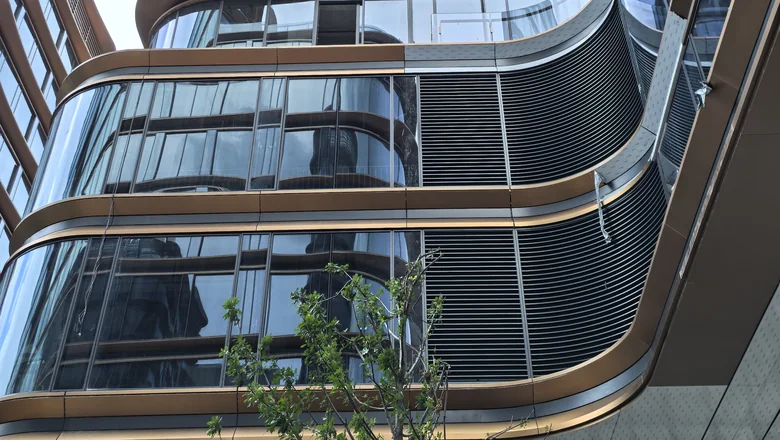
On a coastal facade the real comparison is not aluminium against nothing; it is aluminium against the alternatives that clients and contractors propose instead.
| Material | Behaviour in chloride | Verdict for a coastal facade |
|---|---|---|
| Aluminium, anodized | Oxide film is integral to the metal; no coating to chip off; acid-free cleaning; appearance is metallic and stable | Preferred where the surface will be handled, abraded or perforated; cut edges stay metallic |
| Aluminium, high-performance coated | 70% PVDF systems give the widest colour range and the longest salt-spray performance | Preferred where a saturated colour or an exact match to a painted element is required |
| Galvanized steel | Zinc is consumed noticeably faster in chloride than in rural atmospheres; rust staining appears at cut edges and in the splash zone | Acceptable only with a duplex coating and a shorter inspection cycle |
| Painted mild steel | Every scratch and cut edge is a corrosion site; maintenance never ends | Avoid on exposed coastal facades |
| Stainless steel | Excellent in chloride — A4 or duplex grades; A2 is not suitable within reach of salt | Preferred for fixings and brackets, not usually for large panel areas |
| Composite panel with a PE core | The core is combustible and the open edge absorbs water | Not acceptable where a facade fire class applies |
The practical conclusion is short: an aluminium facade with an anodized or high-performance coated surface, A4 stainless fixings that are isolated from the panel, and closed, drained edges is the combination that performs. The guide to panel build-ups explains why the core type and edge treatment belong in the same conversation as the finish.
The finish decision: anodized or coated
Both families work on the African coast. They fail in different ways, and they are sold on different promises, so the choice is usually made on project priorities rather than on performance.
- Anodizing converts the surface of the aluminium itself into a hard oxide layer. Because the film is part of the metal, it cannot flake or peel, and it keeps a metallic appearance at cut edges and inside perforations. Architectural film classes are written in micrometres — commonly 15, 20 and 25 µm — and the exterior classes are the ones that matter on a coast. Anodized aluminium produced under the QUALANOD quality-mark scheme for architectural anodizing is classed and tested to a published specification, which is the reason to ask for it by name rather than shipping an unspecified finish.
- PVDF coating is an applied film, normally a 70% PVDF resin system applied in two or three coats over a primer, at a total dry film thickness of roughly 23–30 µm for two-coat work and 35–45 µm for three-coat. It delivers colour ranges that anodizing cannot match and is qualified at salt-spray durations well beyond a thousand hours — high-performance PVDF systems are typically tested in the 3,000–4,000 hour range to ASTM B117. Its weaknesses are mechanical: a coating can be scratched, and a scratch through to metal is a corrosion site until it is repaired.
Three rules cut through the debate. Choose the lighter end of the colour range unless there is a reason not to, because a lighter surface runs cooler, moves less and shows dust less. Never accept an acid-cure sealant against aluminium, because the acetic acid released as it cures attacks the metal and the finish. And ask for the film class or the coating system in writing on the panel, not only in the proposal, because it is the number that decides how the facade looks at year fifteen.
Detailing that decides service life
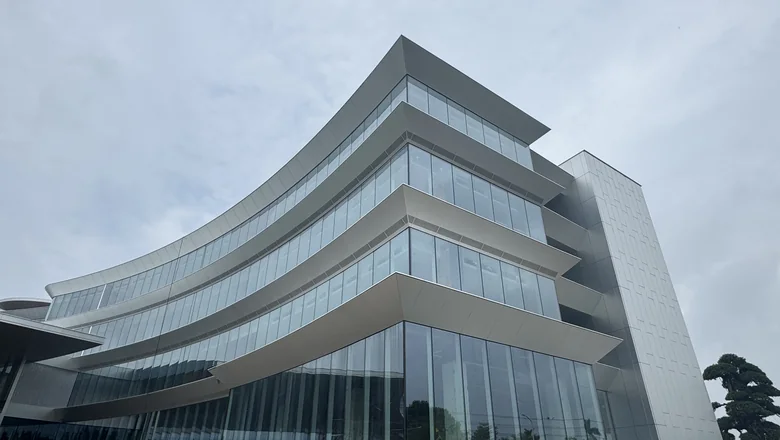
Two facades in the same town, with the same alloy and the same finish, can differ by a decade of appearance. The difference is in seven details.
- Drain and ventilate, do not seal. A rainscreen is designed to get wet behind the outer skin and to dry again. Give the cavity a drained horizontal joint, a drip edge at the bottom, and ventilation openings at top and bottom. A cavity sealed at both ends holds water indefinitely.
- Take the run-off off the face. Water should leave the facade, not run down it. A drip or a projection at the top of each band breaks the film of water that otherwise carries dust from the top of the building to the bottom of the wall.
- Isolate every fixing. Stainless steel in aluminium forms a galvanic couple, and in a chloride atmosphere that couple has an electrolyte most days. Use A4 stainless in C5 exposure with an isolating washer under every head, and keep aluminium clear of galvanized and bare carbon steel entirely.
- Hold the cladding above the splash zone. The most aggressive exposure on any coastal building is the bottom metre, where salt spray lands, sand accumulates and rain splashes back. A common rule is to hold the bottom of the cladding 150–300 mm above finished ground; a plinth in a more tolerant material does the same job more robustly.
- Detail movement, and mean it. Aluminium moves about 23 × 10-6 per °C. Against a design temperature of 45 °C, the swing from a 15 °C coastal night is 30 °C, which is roughly 4 mm on a 6 m panel run. One fixed point per panel, slotted fixings elsewhere, and movement joints at the spacing the module requires.
- Never leave a bare cut edge. Every cut, notch and site-drilled hole exposes aluminium. On anodized work the edge cannot be colour-matched later, so it must be designed out: put it behind a return, a cover strip or a gasket.
- Protect the sealant from the sun and the salt. Use a neutral-cure, low-modulus silicone on a backer rod, tooled to shed water away from the joint rather than into it. Acid-cure silicone and aluminium are incompatible.
Maintenance: the part everyone forgets to price
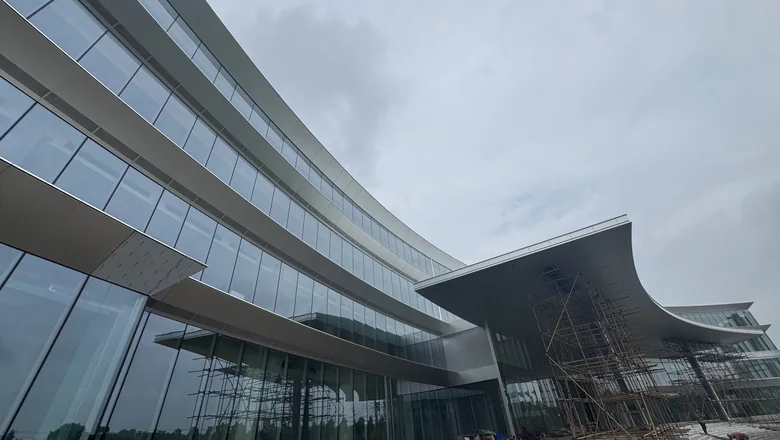
A coastal facade is a maintained asset, not a finished one. The schedule below is what a C4/C5 site needs to keep a twenty-year appearance expectation realistic.
| Task | Frequency (C4) | Frequency (C5) | Method |
|---|---|---|---|
| Fresh-water rinse of the whole facade | 6 months | 3 months | Low-pressure clean water, top down |
| Wash with a neutral-pH cleaner | 12 months | 6 months | Soft brush, then full rinse; never acid or alkaline cleaners |
| Rinse after a storm or a harmattan season | As required | As required | Water only; do not let dust sit through a wet season |
| Inspect joints, sealant and fixings | 12 months | 6 months | Look for open joints, hardened or cracked sealant, and loose or stained fixings |
| Clear drainage paths and base | 12 months | 6 months | Remove sand and dust from drained joints and the base detail |
| Touch-up of coated surfaces | As required | As required | Same coating system, applied to a prepared edge; anodized surfaces cannot be repaired and are replaced instead |
Two practical warnings. Never wash a facade in the middle of the day when the surface is hot, because the water evaporates before it rinses and leaves the deposits behind. And never clean with a pressure washer at close range on a coated surface, because the fastest way to destroy a finish is to drive water under its edge.
Specification checklist for a coastal project
- Corrosion category of the site per ISO 9223, stated as C3, C4 or C5, and confirmed by distance and orientation to the surf line, not by city name.
- Alloy and temper for each panel type, and the panel build-up with its core.
- Finish system — anodized film class in micrometres, or coating system, number of coats and dry film thickness — with a physical colour sample, and with the salt-spray test evidence quoted for the system supplied.
- Fixing grade and isolation: A4 stainless and isolating washers in C5, and no contact with galvanized or bare carbon steel.
- Edge treatment for every panel type, including perforations and site-drilled holes.
- Drainage and ventilation of the cavity, drawn, with the base and head conditions resolved.
- Movement provision: one fixed point per panel, slotted fixings, and movement joints at the required spacing.
- Cleaning and inspection regime matched to the category, with the materials permitted and prohibited listed.
- Fire class for the panel as supplied, where a facade fire class applies.
Frequently asked
Does aluminium corrode in coastal air? The metal itself does not rust. It behaves differently: chloride deposits break down the protective oxide film locally and can cause pitting where moisture then sits. In practice the finish and the detailing govern service life, which is why an anodized or high-performance coated surface, closed edges, isolated A4 stainless fixings and a drained cavity are the specification that lasts.
Anodized or PVDF for a coastal facade? Anodized where the surface will be handled, abraded or perforated, where a metallic appearance is wanted, and where an integral finish that cannot peel is the priority. PVDF where the project needs a saturated colour or an exact match to a painted element. Both are used on the same building when the design calls for it.
Can galvanized steel be used instead? It can, with a duplex coating and a shorter inspection cycle, but zinc is consumed markedly faster in chloride than inland and rust staining will appear at cut edges and in the splash zone. On an exposed coastal facade aluminium removes that failure mode rather than managing it.
How often should coastal cladding be cleaned? A C5 site close to breaking surf typically needs a fresh-water rinse every three months and a neutral-pH wash every six; a C4 site roughly half as often. Add a rinse after the harmattan season on the West African coast and after the long rains in East Africa.
Is a composite panel with a PE core acceptable on the coast? No, for the same reason it is unacceptable anywhere else: the core is combustible and contributes fuel to a facade fire. Where a facade fire class applies — which is most high-rise and public projects — the correct build-up is an A2 or better panel with closed edges. See the fire safety comparison.
Key takeaways
- Chloride damage is caused by salt that lands, dries and concentrates — not by salt in the air. Distance and orientation to the surf line set the exposure class.
- Fix the corrosion category first: C3, C4 or C5 per ISO 9223. Finish, fixing grade and cleaning frequency all follow from it.
- Anodizing keeps metal at the cut edge and cannot peel; PVDF gives the widest colour range and the longest salt-spray performance. Both work on the coast.
- A4 stainless fixings with isolating washers, and a drained, ventilated cavity, matter more than the alloy on a coastal wall.
- Hold the cladding clear of the splash zone and never leave a bare cut edge, especially on anodized work where it cannot be repaired.
- Budget the maintenance: a rinse every three to six months on a C5 site, a neutral-pH wash twice a year, and never clean a hot surface in direct sun.
Building on the African coast?
Send us the location, the orientation to the sea and the elevations. We return an exposure assessment with the corrosion category, a panel and finish schedule, the fixing specification with isolation details, the drainage and movement details, and a maintenance regime for the site — plus a sample panel in the specified finish. See the Aluminum Cladding range, read the panel build-up guide and the anodized cladding guide, or talk to our team.