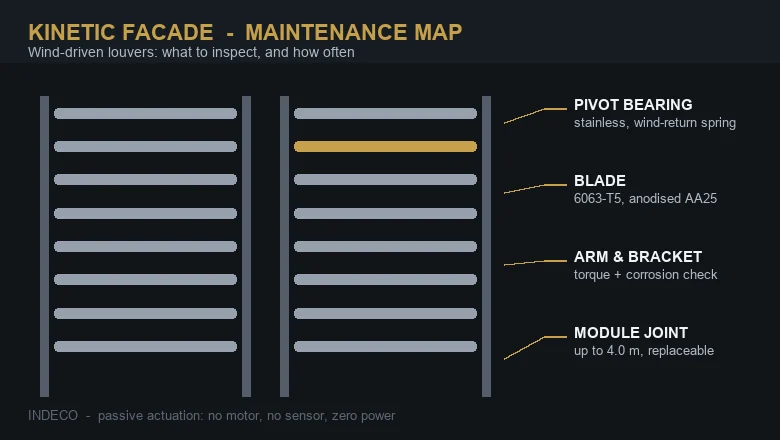
Short answer: A rotating louver facade turns rigid blades on a fixed pivot — a bearing, a return spring and a defined rotation angle. A wind-chime facade (also called a wind or wind-bell curtain wall) hangs hundreds of light panels on cables or a light frame and lets them flutter freely in the breeze. One is a controlled machine; the other is a suspended field of moving panels. Pick by the effect you want and by how much motion you are willing to maintain.
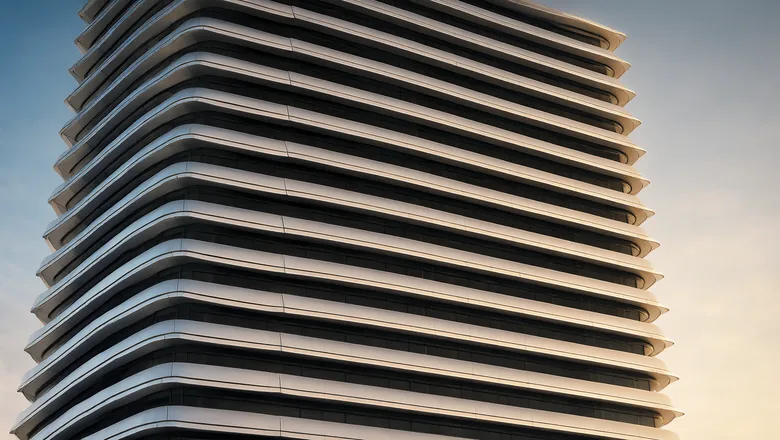
People group both systems under kinetic facade, then assume the engineering is the same. It is not. INDECO builds rotating louver systems — 6063-T5 aluminium blades on stainless pivots, activating below 0.9 m/s and verified to a 45 m/s service wind. Wind-chime screens come from a different supplier family: thin panels suspended so freely that wind alone moves them. This guide sets the two side by side so you can specify the right one.
What is the difference between a wind-chime facade and a rotating louver?
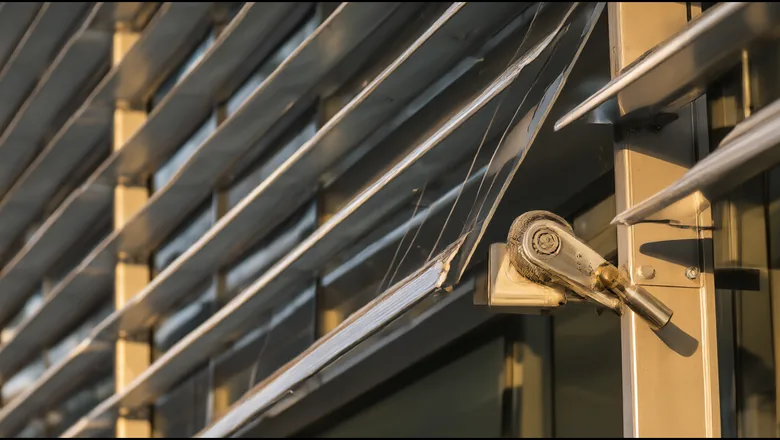
A rotating louver is one rigid blade per pivot. Wind pressure on the blade area overcomes a small spring torque and the blade turns to a stop; when the wind drops, the spring returns it. Motion is measured in degrees and the blade always comes back to the same rest angle.
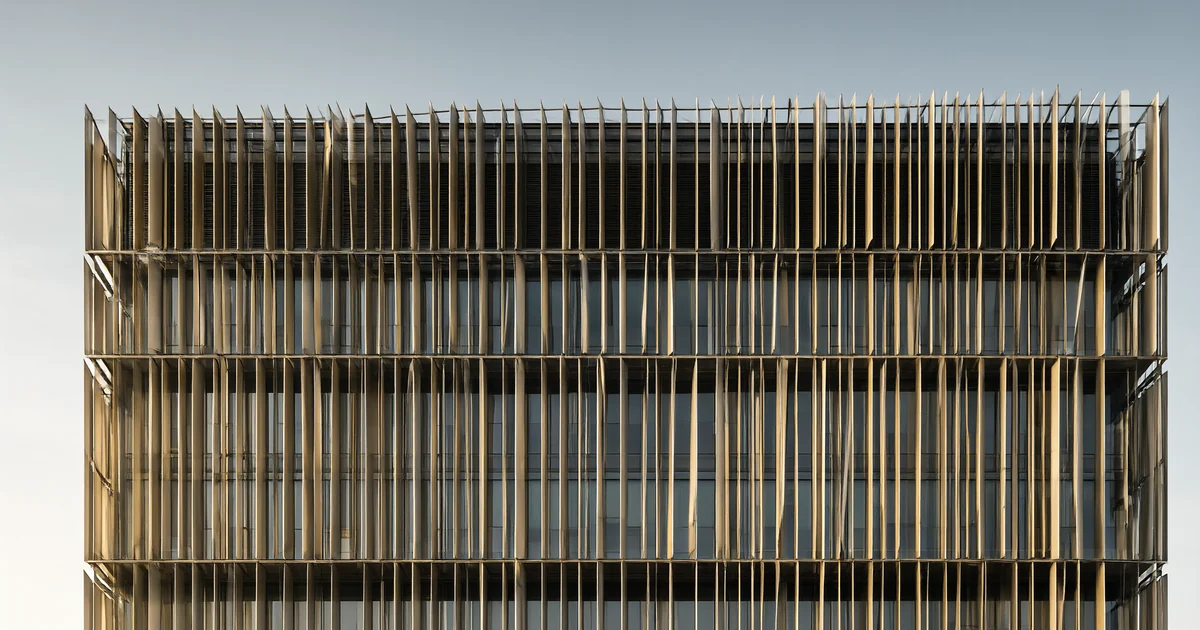
A wind-chime facade has no pivot and no stop. Each light panel hangs from a cable or a slender frame and drifts, twists and ripples with the airflow. Motion is measured as displacement and flutter, not rotation. The visual result is a shimmering, wave-like surface — closer to a hanging mobile than to a louver.
| Aspect | Rotating louver | Wind-chime facade |
|---|---|---|
| Moving part | Rigid blade on a pivot | Light panel hanging on cable/frame |
| Motion | Controlled rotation to a fixed angle | Free flutter and drift |
| Drive | Wind pressure vs return spring | Wind drag on a suspended panel |
| Actuation | Below 0.9 m/s (INDECO blade) | Very light breeze; no threshold setting |
| Units | Dozens to hundreds of blades | Hundreds to thousands of small panels |
| Shading control | Predictable, angle-based | Decorative; shading is diffuse |
How does a wind-chime facade hold its panels?
Three mounting families cover most installations. Cable-hung: panels thread onto vertical stainless cables, the lightest and most transparent option. Framed: panels fix into a slim metal grid, used where a more regular pattern is wanted. Bespoke: non-standard geometry — curved walls, atriums, irregular panel layouts — detailed per project.
Two details decide whether the screen survives a windy decade. The first is a limit device that stops a panel from detaching at a gust; the second is modular fabrication, so a damaged panel can be replaced without dismantling the field. Ask for both by function, not by a supplier's part name.
What panel shapes are available?
The first wind-chime panels were plain rectangles. Current practice adds diamonds, polygons and circles, mixed across one elevation to break up the pattern. Colour and finish vary the effect as much as geometry: a polished metal panel reads as moving light, a coated panel as moving colour.
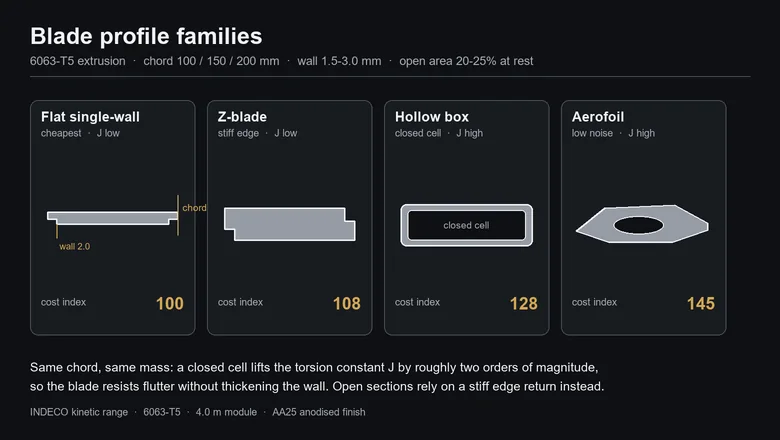
Rotating louvers offer a narrower shape range — typically a 100, 150 or 200 mm aerofoil blade — because the blade section is a structural and aerodynamic part, not just a visual tile. If the brief calls for circles and diamonds, that is a wind-chime conversation, not a louver one.
Which system is right for a hot, windy coastal site?
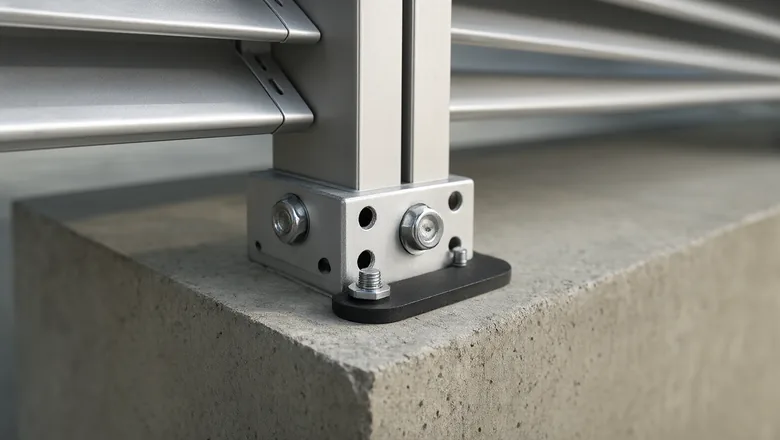
For Gulf and East Africa coastal work the design ambient is 45 °C with ISO 9223 C4–C5 salt exposure. A rotating louver is the safer engineering choice where the screen must survive a defined service wind: it is FEA-verified across 150+ load cases, uses A2/A4 stainless fixings and an anodised or PVDF finish, and has a defined 25+ year duty.
A wind-chime screen is chosen when the priority is a light, shimmering decorative layer in a sheltered or moderate-wind zone — an atrium, a podium, a courtyard. Its many small fixings and free-moving panels mean more inspection. Use it as a feature, not as the primary weather or shading layer.
What should I put in the specification?
Write the brief by behaviour. For a rotating louver: activation wind speed, design service wind, blade width, pivot material, cycle life (10+ million), finish class and anchorage proof load. For a wind-chime screen: panel count and size, suspension type, anti-detachment limit, modular replacement method, corrosion class of every exposed fitting and inspection access.
Keep the two product families in separate specification sections. Mixing them under one performance clause leads to a wind-chime screen being asked to meet a louver's wind-load and cycle-life numbers — which it was never built to do.
Key takeaways
- Rotating louvers are rigid blades on bearings with a defined rotation angle; wind-chime facades are free-hanging panels that flutter — different product families.
- INDECO rotating louvers activate below 0.9 m/s and are verified to a 45 m/s service wind over 150+ load cases.
- Wind-chime panels hang by cable, frame or bespoke structure; demand an anti-detachment limit and modular replacement.
- Panel shapes run from rectangles to diamonds, polygons and circles — a visual freedom a structural louver blade does not offer.
- Use rotating louvers for defined wind duty; use wind-chime screens as decorative layers in sheltered or moderate-wind zones.
Frequently asked questions
Is a wind-chime facade the same as a kinetic louver?
No. A kinetic louver is a rigid blade that rotates on a bearing to a fixed angle and returns on a spring. A wind-chime facade hangs light panels so freely that they flutter and drift. Both move with wind, but only the louver gives controlled, repeatable shading.
How many panels does a wind-chime screen use?
Typically hundreds to thousands of small panels, depending on the area and the target density. That count is why suspension type, anti-detachment detailing and modular replacement matter more than the panel itself.
Do wind-chime facades need maintenance?
Yes. Free-moving panels and many small fixings need periodic inspection, especially on coastal sites at C4–C5 corrosivity. A rotating louver has one sealed bearing per blade and is fatigue-checked beyond 10 million cycles, so its maintenance interval is longer.
Can a wind-chime facade resist a storm?
It is a decorative layer, not a rated wind barrier. Specify the anti-detachment limit and the suspension for the site's design wind, and do not count on it for weather or shading performance. For a rated screen, choose a rotating louver system.
Can I combine both on one building?
Yes. Use rotating louvers where a defined wind duty or shading control is required and a wind-chime screen as a feature in a sheltered atrium or podium. Specify them in separate sections so each is judged against its own performance brief.
Sources
Choosing between a wind-chime screen and a rotating louver?
Send the elevation, the site wind speed and the effect you want. We return a side-by-side brief — motion type, wind duty, fixing detail, finish and maintenance interval — for each system. See the Kinetic Facade range, browse the facade FAQ, or talk to our engineering team.
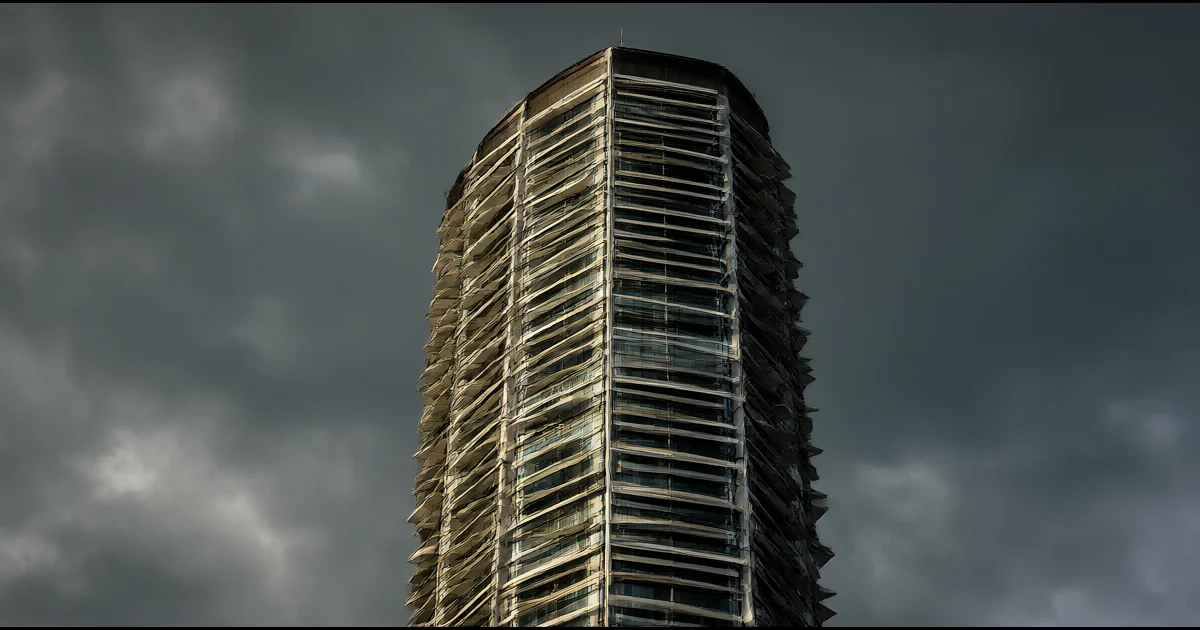
Kinetic Facade Wind Load: Activation to 45 m/s Design
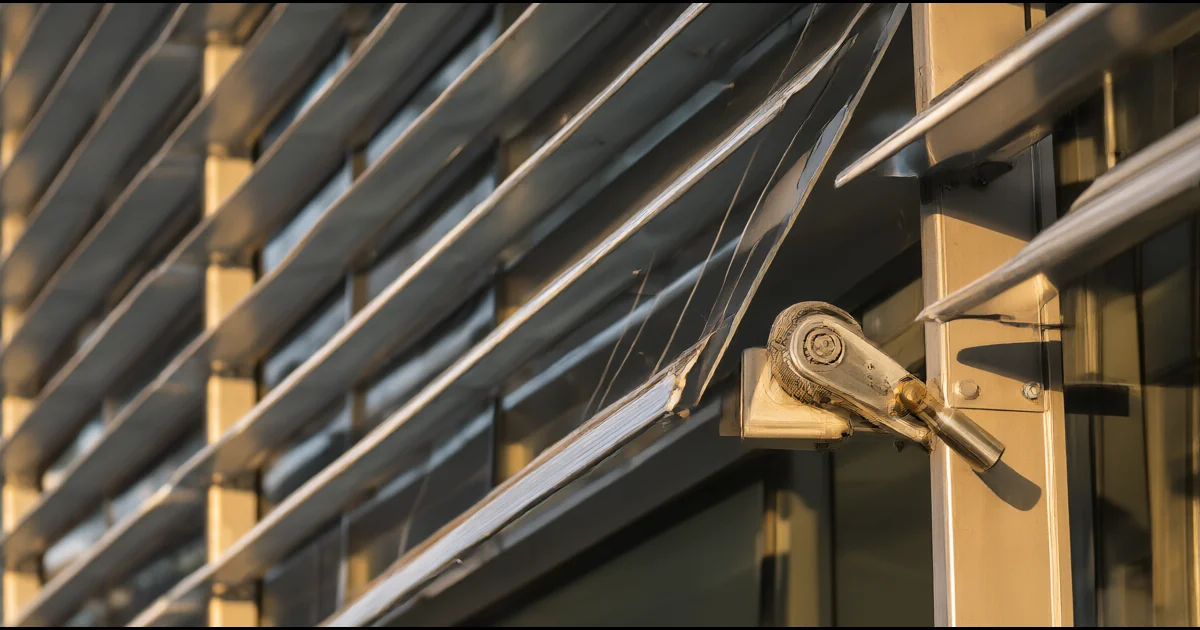
Kinetic Facade Actuation: Passive vs Motorised Louvers
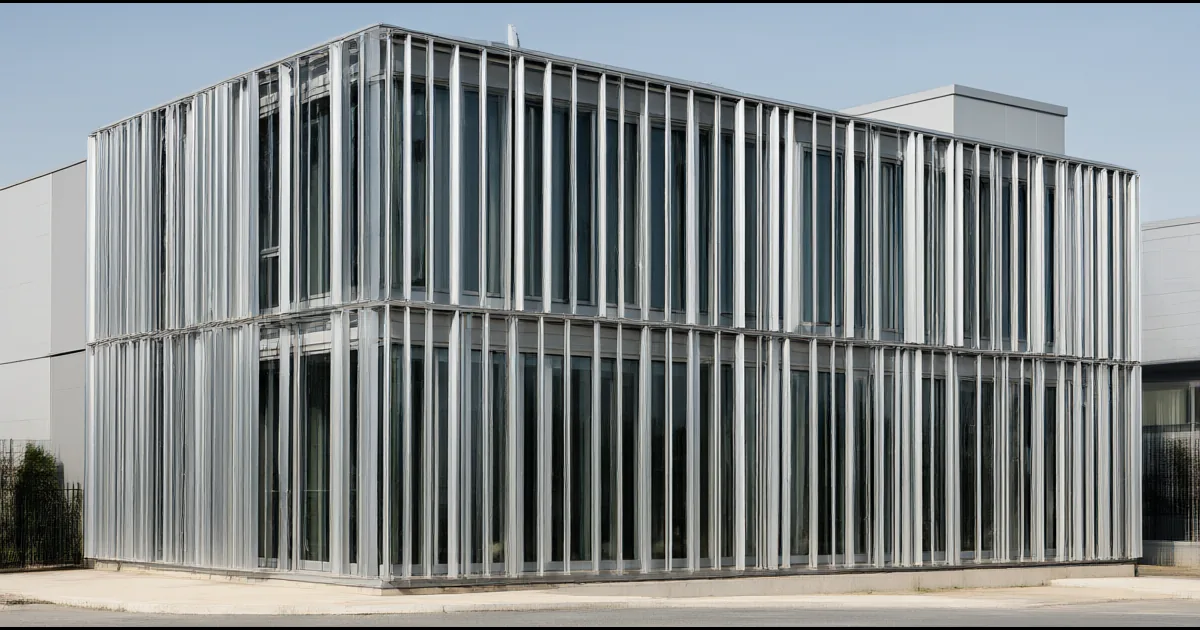
Kinetic Facade Testing: Cycling, Water and Wind Verification
Kinetic Facade Fire Safety: Fire Rating & Smoke Control
Kinetic Facade · Nov 10, 2026

Kinetic Facades on Glazing Curtain Wall: Hybrid Facade Design