Short answer: A kinetic facade needs component inspection, not motor servicing. INDECO louvers are fully passive — no motors, sensors or wiring, zero actuation energy — so maintenance means checking the stainless pivot bearings and wind-return springs, torque-checking brackets, rinsing anodized blades and surveying after a 45 m/s wind event. Design life: 25+ years.
A kinetic facade moves for a living, so the first question every owner asks is what that movement costs to keep running. The honest answer: far less than a motorised dynamic facade, because there is no motor to service. This guide sets out what a wind-driven kinetic louver system actually needs — which parts wear, how often to inspect, how to clean the blades, and what 25-year ownership looks like in hot, coastal Gulf exposure.
What does a kinetic facade actually need maintained?
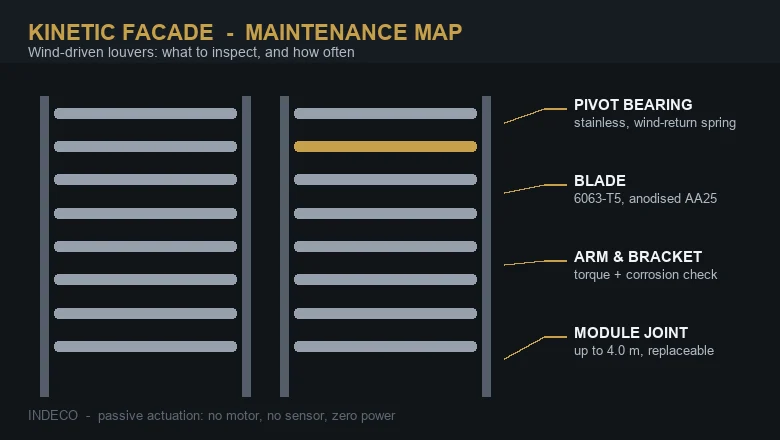
A wind-driven louver has exactly one moving assembly per blade: a stainless pivot bearing with a wind-return spring. There is no gearbox, no actuator arm and no control cabinet. Maintenance therefore concentrates on four component groups:
| Component | What it does | What maintenance means |
|---|---|---|
| Pivot bearing + return spring | Converts wind into blade rotation and returns the blade to rest | Annual function check; sealed unit — no lubrication regime |
| Blade | Marine-grade 6063-T5 aluminium; anodised AA25 or 2-coat PVDF 25 µm | Rinse; inspect edges, end caps and blade fixings |
| Arm & bracket | Transfers wind load into the sub-frame | Torque check every 24 months; confirm A4/316 stainless and isolation washers |
| Module joint & drainage | Modules up to 4.0 m high; the cavity must drain | Clear weep paths; check gaskets at the interface |
How often should a kinetic facade be inspected?
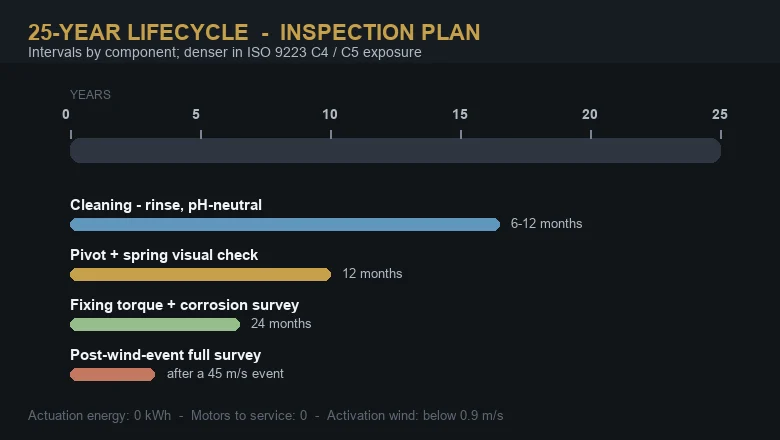
Intervals scale with the exposure class, not with a fixed calendar. On the ISO 9223 scale an inland site sits around C3, while a coastal Gulf tower — salt deposition plus abrasive dust at a 45°C design temperature — works at C4–C5 and needs the shorter intervals below.
| Task | Typical interval (C3) | Coastal C4–C5 |
|---|---|---|
| Visual survey (ground or access equipment) | 6–12 months | 6 months |
| Pivot + spring function check | 12 months | 12 months |
| Fixing torque + corrosion survey | 24 months | 12–24 months |
| Full elevation survey | After any design-level wind event (service wind up to 45 m/s, project-verified by FEA) | |
| Cleaning, pH-neutral water | 6–12 months | 3–6 months |
Why does a passive kinetic facade cost less to own than a motorised one?
A motorised dynamic facade carries a second building system on the front of the glass: actuators, sensors, wiring, software and the contracts that keep them alive. A wind-driven kinetic skin deletes that entire layer, which is where most of the lifecycle difference comes from:
| Attribute | Wind-driven (INDECO) | Motorised dynamic facade |
|---|---|---|
| Actuators per elevation | 0 | One or more per zone |
| Actuation energy | 0 kWh | Standby load + motion load, continuously |
| Controls, sensors, wiring | None | BMS integration, commissioning, updates |
| Servicing the motion system | Bearing inspection only | Actuator service, calibration, firmware |
| Failure mode | Blades rest — shading continues | Shading stops where power or an actuator fails |
| System reliability | 99.8% | Vendor-specific |
| Design life | 25+ years | Actuators replaced several times within the facade life |
Which finish keeps cleaning and refurbishment costs down?
The blade finish decides how much the cleaning invoice weighs and whether the elevation ever needs recoating. INDECO blades are finished with anodized aluminium from our anodizing partner in Guangdong, an architectural line licensed under the QUALANOD quality scheme; a 2-coat PVDF 25 µm system is the alternative where colour-matching to adjacent aluminum cladding calls for it.
| Property | Anodized architectural aluminium |
|---|---|
| Oxide film thickness | 5–20 µm (AA5–AA25) |
| Surface hardness | 200–500 HV — resists abrasive dust |
| Colour consistency | ΔE 1.0–2.0 within a batch; 2.0–2.5 across batches |
| Neutral salt spray | 500–4,000 h depending on series |
| Fire reaction | A2 (GB 8624-2012) |
| Service life / end of life | 25 years+; 100% recyclable, ~96% recovery |
Because the oxide is grown out of the metal, there is no film to chalk or peel under Gulf UV — cleaning stays a rinse, not a restoration.
What drives the 25-year lifecycle cost?
- Access strategy — a building maintenance unit (BMU) or rope access; roof-carried access designed in from day one is cheaper than 25 years of hired plant.
- Module standardisation — blade widths of 100/150/200 mm and modules up to 4.0 m mean identical spares across the elevation.
- Finish class — anodised AA25 never needs recoating; painted systems budget for refurbishment.
- Wind-event surveys — a full elevation survey after any design-level storm; systems are rated across 150+ wind-load conditions.
- Envelope interfaces — joints to the unitised glazing and cladding are inspected with the facade, not separately.
Reference points: the East Africa CBD Tower in Nairobi was engineered for a design wind of about 26.9 m/s, the Gulf Cultural Landmark Pavilion in Doha for up to 45 m/s — both verified by finite-element analysis.
How is maintenance carried out on an occupied tower?
Blades and complete modules are replaced from access equipment without closing the building, and because the system is passive there is nothing to switch off: the rest of the elevation keeps shading and ventilating while one module is swapped. A module exchange is a crane-and-torque exercise measured in hours, not a facade refit.
Where is this maintenance model already specified?
- Gulf Waterfront Commercial Tower (Dubai) — unitised glazing with an adaptive shading strategy for extreme solar gain.
- Gulf Cultural Landmark Pavilion (Doha) — a wind-driven kinetic installation rated for 45 m/s design winds.
- East Africa CBD Tower (Nairobi) — a wind-responsive kinetic skin tuned to East African wind profiles.
Go deeper in the kinetic curtain wall specification guide, the Gulf climate design guide and the kinetic facade primer.
Key takeaways
- The only moving part per blade is a stainless pivot bearing with a wind-return spring — no motors, sensors or wiring anywhere in the system.
- Inspection scales with exposure: 6-monthly visual surveys and 3–6-monthly cleaning on ISO 9223 C4–C5 coastal sites; annual pivot checks everywhere.
- Zero actuation energy and 99.8% system reliability remove the standby, controls and actuator-replacement costs a motorised dynamic facade carries.
- Anodized blades (5–20 µm, 200–500 HV, A2) clean with pH-neutral water and never need recoating.
- Design life is 25+ years, with full surveys after design-level wind events up to 45 m/s.
Frequently asked questions
How often does a kinetic facade need maintenance?
Plan a visual survey every 6–12 months, an annual pivot and spring check, and a fixing-torque survey every two years. On coastal C4–C5 sites tighten cleaning to every 3–6 months, and always book a full elevation survey after a design-level wind event.
Do kinetic louver pivots need lubrication?
No. Each blade turns on a sealed stainless bearing with a wind-return spring, designed to run dry for decades. Maintenance is an annual function check; if a bearing ever shows wear, the blade or the whole module — up to 4.0 m — is exchanged rather than rebuilt in place.
What is the design life of a kinetic facade?
INDECO kinetic systems are engineered for 25+ years with periodic inspection. Blades in marine-grade 6063-T5 aluminium carry an anodised AA25 finish or 2-coat PVDF 25 µm, and every installation is verified by finite-element analysis for service winds up to 45 m/s.
How do you clean anodized kinetic louvers?
With pH-neutral water and a soft cloth or brush — no abrasives, no strong alkali. The anodized surface is hard (200–500 HV), anti-fingerprint and non-charging, so dust releases easily and the ΔE-controlled colour stays uniform after years of washings.
What happens to the louvers during a 45 m/s storm?
Nothing needs switching off. The bearings and wind-return springs are engineered for service winds up to 45 m/s and verified by finite-element analysis, so the blades simply ride out the storm and return to rest. A full elevation survey is scheduled afterwards as a precaution.
Planning kinetic facade maintenance or a new elevation?
Send us the exposure class, elevation areas and access strategy. We return an inspection schedule matched to ISO 9223, a blade and finish specification, and wind-load documentation for the governing code. See the Kinetic Louver Facade range, browse the facade FAQ, or talk to our engineering team.