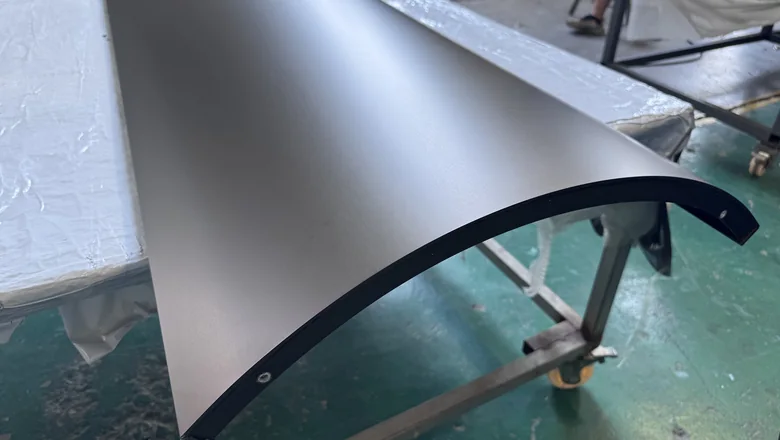
Two aluminium cladding panels can weigh the same, cost the same and carry the same finish, and behave completely differently on the wall — because of what is inside them. A honeycomb panel and a corrugated-core panel are both sandwiches: two thin aluminium skins bonded either side of a much thicker core. The core does almost nothing in tension or compression, and everything in shear. Move the skins apart and the panel stops bending.
That single idea explains most of the specification decisions that follow: why a 20 mm panel can be stiffer than a 3 mm solid sheet at lower weight, why a large flat panel ripples where a thin solid sheet would not, and why a panel that is excellent in one direction of span can be poor in the other. This guide covers the four build-ups you will be asked to choose between, and the details — edges, fixings and drainage — that decide whether that choice survives ten years of weather. The finishes referred to throughout are set out in our finishes and colours guide, and the fire-class background in the fire safety comparison.
Why put a core in a panel at all
Bending stiffness in a flat plate rises with the cube of its depth. A solid sheet therefore has to be thick to be stiff, and thickness costs weight in direct proportion: aluminium runs at about 2,700 kg/m³, so a 3 mm solid sheet is roughly 8.1 kg/m² before any finish.
Bond two 0.5 mm skins either side of a 20 mm core and the arithmetic changes. The same 1 mm of aluminium is now spread over a 21 mm depth, and the theoretical bending stiffness of the section rises by more than two orders of magnitude at a fraction of the mass. In practice the core also deflects in shear, so the real gain is smaller — which is exactly why a sandwich panel’s span has to be calculated rather than assumed, and why the core type matters as much as the core thickness.
The four build-ups you will be asked to choose between
The table below is the shortlist. Everything else — colour, module, fixing type — follows from which row the project lands in.
| Build-up | Total thickness | Construction | Order of weight | Where it wins | Main limitation |
|---|---|---|---|---|---|
| Solid single skin | 2.0–4.0 mm | Solid aluminium, folded or curved | 5.4–10.8 kg/m² | Small modules, folded returns, edges on show, curved profiles | Stiffness falls away with span; poor stiffness per kilogram |
| Corrugated-core composite | 4–10 mm | 0.4–0.6 mm skins over a corrugated aluminium core | 4–6 kg/m² | Long flat runs in one direction; cost-sensitive facades | Stiffness is strongly directional; weak under point loads |
| Honeycomb-core composite | 6–25 mm | 0.5–1.2 mm skins over aluminium honeycomb (0.05–0.07 mm foil, 6–19 mm cells) | 5–10 kg/m² | Large flat panels, high flatness, two-way span | Highest cost of the four; edge closure must be detailed |
| A2 fire-rated composite | 4–6 mm | Mineral core between aluminium skins | 7–11 kg/m² | Any facade where an A2 class is mandated | Heavier and less stiff than an aluminium core of the same thickness |
Read the first and last columns together, because they usually decide the project. A solid sheet is the right answer when the panel has to be folded into a three-dimensional shape, when its edges are visible, or when the module is small enough that stiffness never governs. A composite panel is the right answer when the panel is large and flat, when weight matters, and when the span cannot be shortened.
Corrugated core: cheap stiffness in one direction
A corrugated panel has a trapezoidal, sinusoidal or linear core of aluminium foil, typically 0.3–0.5 mm thick, bonded between two thin skins. It is the fastest and cheapest way to separate the skins, and for a long flat band of cladding it is frequently the correct engineering answer.
The catch is direction. The corrugations carry load along their length and do almost nothing across their width, so the panel is stiff one way and soft the other. Three consequences follow:
- The core must run across the span. Set the corrugation direction perpendicular to the supports, and do not let the same panel be rotated on site without checking the design.
- Supports run one way. Long horizontal bands, fascia runs and soffit strips suit a corrugated core. A large square panel spanning in two directions does not.
- Point loads need packing. A fixing that lands between corrugations has nothing behind it to resist pull-through. Either the fixing lands on a rib or on a carrier, or the core is packed solid locally.
Specify the core direction on the panel drawing, not only in a general note, and mark it on the back of the panel. It is the sort of thing that is obvious in the design office and invisible on a scaffold.
Honeycomb core: flatness, and load in any direction
Aluminium honeycomb is a hexagonal cell structure made from foil 0.05–0.07 mm thick, with cells commonly 6, 10 or 19 mm across. Because the cells support one another in every direction, the panel’s bending stiffness is close to uniform in plane, which is what allows a large square panel to span two ways without a visible weak axis.
Honeycomb is usually bought for one of two reasons. The first is flatness: a large panel with a dense core resists the local buckling that makes a thin solid sheet look wavy. The second is local load: with a potted insert, a honeycomb panel can take a fixing or a concentrated load almost anywhere, which no corrugated core can promise. The insert spreads the load into the core; the panel is not stronger at the bolt in the way a 6 mm plate is, but it behaves predictably.
The price is cost and edge treatment. Honeycomb costs more than corrugated core at the same thickness, and the open cells at the panel edge must be closed — a folded return, a U-channel or a solid insert. An open honeycomb edge is a row of small tubes pointing at the weather.
Flatness, thermal bow and the oil-canning question
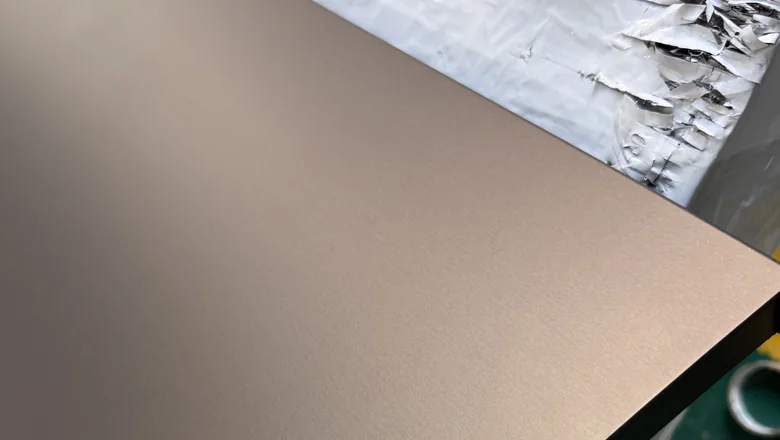
When a large flat panel ripples in the sun, it is not usually a manufacturing fault. It is differential movement. Aluminium expands by about 23 × 10-6 per °C, so a face sheet 1.5 m long grows roughly 0.9 mm over a 25 °C rise. If the face heats faster than the core, or if the fixings restrain the panel too tightly, that millimetre has to go somewhere — and the only direction available is out of plane.
Four things keep a large panel flat in service:
- A core that resists local buckling — honeycomb, or a denser corrugated core, rather than an empty cavity.
- A module that suits the thickness. Doubling a panel’s plan size while keeping its thickness is the most common cause of visible waviness.
- Floating fixings. One fixed point per panel and the rest slotted or oversized, so the panel can move instead of being bowed by its own fixings.
- An even surface temperature. A ventilated or back-ventilated cavity takes heat out of the section, and a lighter colour lowers the peak the face ever sees.
Flatness is normally written as a tolerance per metre, measured on the installed panel in its installed orientation. Whatever figure is written, agree how and when it will be measured — a panel assessed lying flat in the afternoon sun will fail a tolerance that it meets comfortably once it is on the wall.
Fire: what an A2 panel actually is
In a composite cladding panel the core decides the fire class, not the skin. A polyethylene core is combustible and contributes fuel to a facade fire; an aluminium honeycomb or corrugated core is metal and cannot; a mineral core is filled with material that releases water when heated and suppresses the reaction.
On most high-rise and public facades the requirement written into the specification is A2-s1,d0 to EN 13501-1, or A2 under GB 8624-2012. Two things about that class are worth stating plainly, because they are frequently misunderstood on site:
- A2 does not mean “no organic content”. The adhesive and the coating are organic, and the class limits how much heat the whole assembly may contribute — it does not eliminate it.
- Non-combustible does not mean fire-resistant. Aluminium melts at about 660 °C and loses most of its strength well before that. An A2 panel is a facade that will not feed a fire; it is not a structural fire barrier.
The classification must be stated on the panel and on the certificate, not only in a brochure, and it applies to the panel as supplied — same core, same skins, same thickness.
Edges, fixings and drainage
Composite panels do not fail in the middle of a sheet. They fail at the edge, at the fixing and at the bottom of the wall. Five details carry most of the risk.
- Close every edge. A folded return or a solid U-channel closes the core to the weather. An open edge wicks water and chloride into the core and corrodes the panel from the inside, where nobody looks until it is too late.
- Isolate dissimilar metals. Stainless fixings in an aluminium panel form a galvanic couple. Use A2 stainless inland and A4 stainless within reach of salt, with an isolating washer under every head, and never let the panel touch galvanized or bare carbon steel.
- Let the panel move. One fixed point per panel and slotted holes elsewhere. On a 6 m run at a 45 °C design temperature the swing from a cool night is roughly 4 mm, and a panel pinned hard at both ends has nowhere to put it.
- Drain and ventilate the cavity. Water reaches the back of any rainscreen. Give it a path down and out: a drained horizontal joint, a drip edge at the base, and no sealant closing the cavity.
- Protect cut edges and site holes. Every cut through the panel exposes aluminium or core. Edges go behind a return; drilled holes get a coated or stainless sleeve; on anodized work a cut edge cannot be touched up, so it should not be visible.
Composite panels in coastal and humid climates
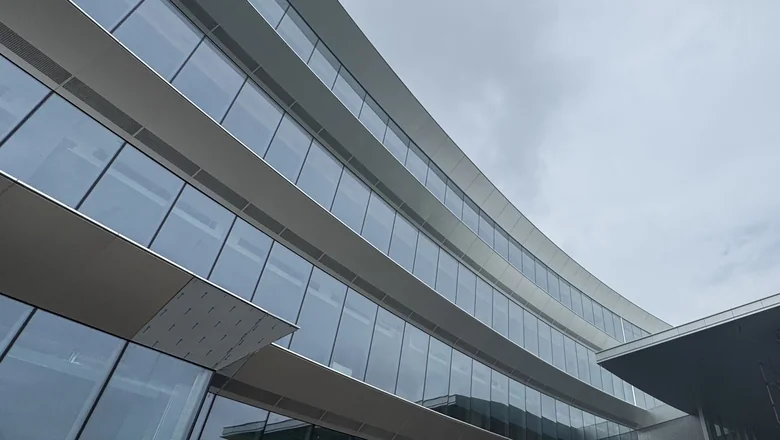
In a coastal project the panel build-up and the finish are one decision, not two. Chloride deposits break down the passive oxide film on aluminium and cause pitting where water sits; the panel that survives is the one whose finish resists the chloride and whose details do not hold water. An anodized skin keeps metal at the cut edge, which matters wherever panels are perforated or handled; a high-performance PVDF coating gives a wider colour range with a longer salt-spray performance. Both work, provided the edges are closed, the fixings are A4 stainless and isolated, and the cavity drains. Our guide to coastal projects in West and East Africa sets out exposure classes and maintenance cycles in detail.
What to write in the specification
Paste this list into the panel schedule and most of the arguments are settled before they start:
- Build-up per location: solid skin, corrugated core, honeycomb core or A2 mineral core.
- Total thickness, skin thickness, alloy and temper, plus the core specification — foil thickness and cell size for honeycomb, core direction for corrugated.
- Panel module and the span it was calculated for, with the design wind pressure and the uplift pressure where the panel is a soffit.
- Deflection limit, stated explicitly and checked against that pressure.
- Flatness tolerance, with the method, orientation and timing of measurement agreed in advance.
- Fire class on the panel and on the certificate, for the panel as supplied.
- Finish system — anodized film class, or coating system and dry film thickness — with the colour reference as a physical sample.
- Edge closure and drainage detail, drawn, including head and base conditions.
- Fixing material, isolating washers and movement provision.
- Cleaning and inspection regime matched to the exposure class of the site.
Frequently asked
Is a honeycomb panel stronger than a solid aluminium sheet? In bending, at equal mass, yes — by a wide margin. At a fixing it is not: local bearing and pull-through govern there, and a honeycomb panel needs a potted insert so the load is spread into the core. Compare panels on the span they can actually achieve at the design pressure, not on a single strength figure.
Can a corrugated-core panel be used in any orientation? It can be installed in any orientation, but it must be designed for the one it is in. Stiffness is directional, so the corrugation direction has to run across the supports and the panel must not be rotated on site. Where two-way span is required, honeycomb is the safer build-up.
What is the difference between an A2 panel and a PE-core panel? The core. A polyethylene core burns and contributes fuel to a facade fire; an A2 panel has a mineral or metal core that limits the calorific contribution of the assembly. Where a facade fire class applies — which is most high-rise and public work — the A2 panel is the compliant choice.
Why do large flat panels show waviness? Usually differential thermal movement and restrained fixings, not a defect in the sheet. The face expands faster than the core, and if the panel is pinned too tightly the movement goes out of plane. A stiffer core, a smaller module, floating fixings and an agreed flatness tolerance measured in place all reduce it.
Which build-up suits a coastal site? A honeycomb or corrugated composite with anodized or high-performance coated skins, A4 stainless fixings with isolating washers, closed edges and a drained, ventilated cavity. The core type changes the structural behaviour; the finish and the detailing decide whether the panel is still there in twenty years.
Key takeaways
- A composite panel is a stiffness machine, not a strength machine: separating the skins is what stops it bending.
- Corrugated core is cheap stiffness in one direction — correct for long bands and fascia runs, wrong for large two-way panels.
- Honeycomb core buys flatness and load in any direction, at higher cost and with an edge that must be closed.
- An A2 fire-rated panel is defined by its core. A2 limits the calorific contribution; it does not mean the assembly contains no organic material.
- Waviness in large flat panels is differential thermal movement. Fix it with the core, the module, floating fixings and a flatness tolerance agreed in advance.
- Edges, fixings and drainage decide service life. Close every edge, isolate every fixing and give the cavity a way to drain.
Choosing a panel build-up?
Send us the elevations, the module and the design wind pressure. We return a panel schedule with the build-up, alloy, thickness, core, span and deflection check, the finish system and the edge and fixing details — plus a sample panel in the specified finish. See the Aluminum Cladding range, read the complete aluminum cladding guide and the coastal cladding guide for West and East Africa, or talk to our team.