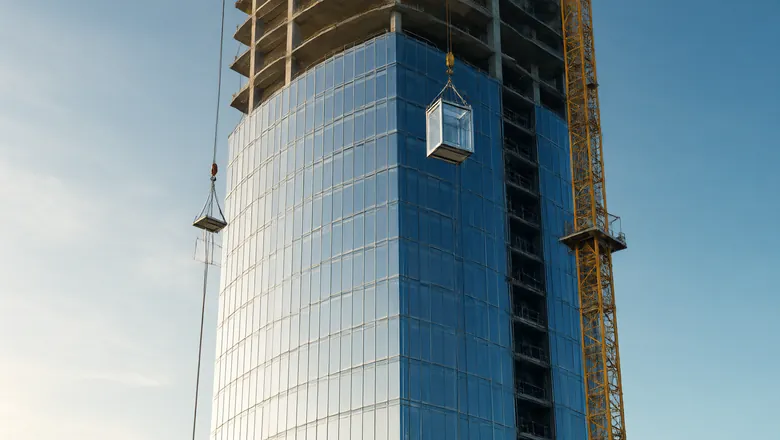
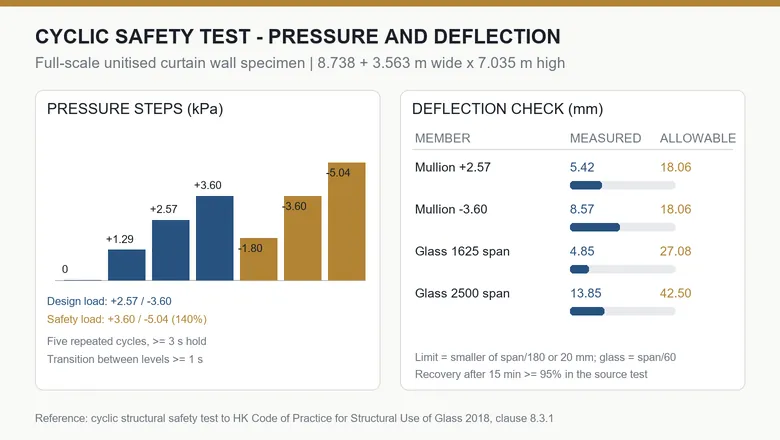
Short answer: A cyclic structural safety test proves that a curtain wall survives repeated wind pressure without permanent movement. A full-scale unitised specimen was loaded to +2.57/−3.60 kPa at design wind and +3.60/−5.04 kPa at 140% of design. Mullion deflection reached 5.42 mm against an 18.06 mm limit, and recovery after unloading exceeded 95%.
A curtain wall passes a paperwork review and still moves too far in a storm. The curtain wall performance testing set answers air, water and wind questions; the cyclic structural safety test answers a narrower one: does the assembly return to its original geometry after repeated pressure reversal? Below we use a documented pressure-chamber test on a full-size unitised specimen to show the numbers a specifier should demand.
What does a curtain wall cyclic safety test actually prove?
The test applies five repeated pressure cycles to a full-size specimen: +2.57/−3.60 kPa at design load, then +3.60/−5.04 kPa at 140% of design. The specimen measured (5.175 + 3.563) m wide by 7.035 m high — two joined bays, glazed and fixed as on site. The method referenced the Hong Kong Buildings Department Code of Practice for Structural Use of Glass 2018, clause 8.3.1.
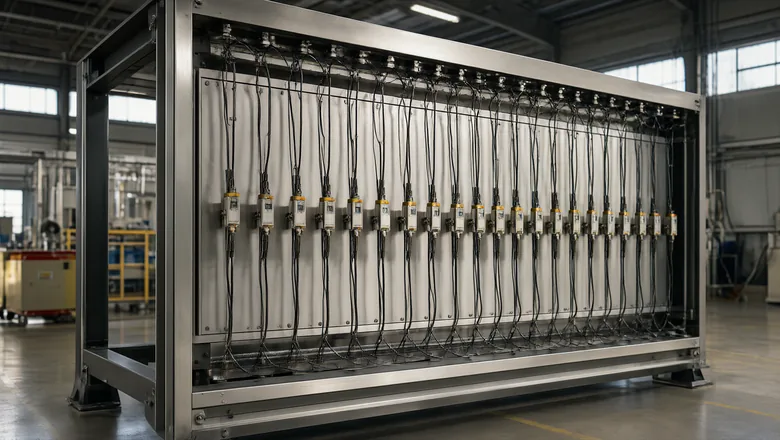
Transition between pressure levels took at least one second; each peak was held for at least three seconds. Electronic displacement transducers tracked 30 points across mullions, transoms and glass panels. Our facade test laboratory in Hong Kong treats this as a system verdict, not a glass-only verdict: the frame, connectors, seals and panels must all survive the same sequence.
How is the deflection limit set for mullions, transoms and glass?
The acceptance rule is numeric: min(span/180, 20 mm) for structural members and span/60 for glass panels. A cantilever member is judged at span/90 or 20 mm, whichever is smaller. Glass gets a looser ratio because it is checked for panel bending, not for supporting the frame.
| Member / span | Allowable | Reported deflection | Basis |
|---|---|---|---|
| Mullion, 3,250 mm | 18.06 mm | 5.42 mm at +2.57 kPa | span/180 or 20 mm |
| Mullion, 3,250 mm | 18.06 mm | 8.57 mm at −3.60 kPa | span/180 or 20 mm |
| Transom, 1,625 mm | 9.03 mm | 0.45 mm | span/180 or 20 mm |
| Glass panel, 1,625 mm | 27.08 mm | 4.85 mm | span/60 |
| Glass panel, 2,500 mm | 42.50 mm | 13.85 mm | span/60 |
| Glass panel, 1,237.5 mm | 20.63 mm | 8.55 mm | span/60 |
Read the table as a ratio, not as raw millimetres. A 13.85 mm movement on a 2,500 mm panel is only one third of its limit; the same number on a 1,000 mm panel would fail. Ask the supplier for the span alongside every deflection figure — a number without its span is marketing.
What do recovery and post-breakage checks prove?
Recovery must be at least 95% 15 minutes after unloading; the reported specimen recovered 98.9–100%. No glass broke under +3.60/−5.04 kPa, and the specimen showed no separation, plastic deformation or other deleterious effect. The glazing curtain wall range uses the same pass logic: strength, shape retention and visible condition are three separate checks.
- Strength check: no breakage at the 140% safety pressure.
- Serviceability check: member deflection below min(span/180, 20 mm); glass below span/60.
- Recovery check: at least 95% rebound 15 minutes after unloading.
- Condition check: no seal separation, connector slip or permanent set.
This test does not replace the drift compatibility test or a coastal water test. Wind cycling asks whether the frame returns; seismic cycling asks whether joints survive storey movement; a water chamber asks whether the pressure-equalised drainage works. For a 45 °C Gulf site under SBC and Mostadam, request all three plus ISO 9223 C4–C5 corrosion detailing for exposed fixings.
Key takeaways
- Cyclic structural safety testing repeats positive and negative pressure on a full-size facade assembly, not on loose glass samples.
- Structural members are limited to the smaller of span/180 or 20 mm; glass panels to span/60; cantilevers to span/90 or 20 mm.
- A 140% safety step (+3.60/−5.04 kPa in the quoted test) is what exposes permanent set and connection slip.
- At least 95% deflection recovery 15 minutes after unloading, plus no breakage or separation, is the pass condition.
- Deflection numbers are meaningless without the span; ask for both in every test dossier.
Frequently asked questions
What is a cyclic safety test for a curtain wall?
It is a full-scale test that repeats positive and negative wind pressure on a mounted facade specimen. The source test used five repeated cycles, held each peak for at least three seconds, and checked displacement after every step. It proves the system returns to shape under wind reversal.
What is the structural deflection limit for a unitised curtain wall?
For structural members the common acceptance rule is the smaller of span/180 or 20 mm. Cantilever members use span/90 or 20 mm. Glass panels are checked at span/60. On a 3,250 mm mullion span the limit is 18.06 mm; on a 1,625 mm glass span it is 27.08 mm.
Why is the safety load higher than the design wind load?
Design load represents the expected wind case. The cyclic safety step applies 140% of that load to expose brittle failure, permanent set and connection slip. In the quoted specimen, +2.57/−3.60 kPa became +3.60/−5.04 kPa. Passing at design load alone does not cover that margin.
Does a wind tunnel test replace a cyclic safety test?
No. A wind tunnel study refines surface pressure coefficients for the building shape. The cyclic test then applies the resulting design pressures to an actual facade assembly and measures movement. Use both: tunnel data defines the load, the test chamber proves the system survives it.
What does 95% recovery mean in a curtain wall test?
After the test load is removed, the specimen is measured again 15 minutes later. At least 95% of the deflection must disappear; the rest is accepted as elastic settling. The reported test reached 98.9 to 100%, with no glass breakage, seal separation or visible plastic deformation.
Sources
Need a cyclic test dossier for your facade schedule?
Send the design wind pressure, panel spans and IGU build-up. We return the limit calculation, the test sequence and the climate add-ons for your site. See the Glazing Curtain Wall range, browse the facade FAQ, or talk to our engineering team.
Curtain Wall Performance Testing: Air, Water, Wind & Cyclic Movement

Glass Curtain Wall CE Marking: LG, IGU and Tempered Glass Declarations
Glazing Curtain Wall Seismic Movement: Drift Compatibility and Rack Testing

Structural Glazing for Unitised Curtain Walls: Silicone Bite and 45 °C Durability
Glazing Curtain Wall IGU Selection: SHGC, U-Value & Acoustics