Short answer: CE marking for a glass curtain wall is not one certificate for the whole facade — it is a set of declarations, one per glass type. Tempered glass is declared to EN 12150, heat-strengthened glass to EN 1863, and insulating glass units (IGU) to EN 1279. Laminated glass brings its own interlayer and safety-glass declaration. A compliant unitised facade keeps each declaration traceable to the exact glass build-up in the project schedule.

A specifier asks for a CE-marked curtain wall and receives a folder of certificates with different numbers, dates and standards. The confusion is normal: the frame, the glass and the IGU are declared separately. This guide maps each glass type to the standard that governs it, and shows how to check that the declarations actually match the unit you are buying.
Which CE standards apply to curtain wall glass?
Start with the glass, not the frame. Thermally toughened soda-lime silicate safety glass — the usual 'tempered' panel — is declared under EN 12150. Heat-strengthened glass, which is not a safety glass but has higher strength than annealed, falls under EN 1863. An insulating glass unit, the sealed two- or three-pane build-up used in almost every unitised facade, is declared under EN 1279.
Laminated glass adds another layer: the safety-glass performance to EN 14449 and the interlayer behaviour. Each standard answers a different question — strength, post-breakage behaviour, seal durability — so a single 'CE certificate' cannot cover all of them.
| Glass type | Governing standard | What it declares |
|---|---|---|
| Tempered (thermally toughened) | EN 12150 | Strength, fragmentation, safety-glass class |
| Heat-strengthened | EN 1863 | Enhanced strength; not a safety glass |
| Insulating glass unit (IGU) | EN 1279 | Seal durability, gas retention, condensation behaviour |
| Laminated safety glass | EN 14449 | Post-breakage retention and interlayer performance |
Why does the IGU declaration matter most?
The IGU is the part of a unitised facade that fails quietly. A broken seal does not show as a visible crack; it shows as fogging between the panes, lost gas fill and a U-value that drifts away from the calculated value. EN 1279 exists to test exactly that: edge-seal durability, gas leakage and the formation of condensation over an accelerated ageing programme.
Ask for the declaration to match the actual build-up — pane thicknesses, cavity width, gas and spacer. A certificate for a 6+12A+6 unit does not automatically cover an 8+16A+8 unit used on a higher-load elevation. Our glazing curtain wallrange starts from the tested build-up, not from a generic label.
How do I verify a CE declaration on real glass?
Check four things on every document. First, the standard number — it must be the one that governs that glass type. Second, the product description — it must match the build-up in your schedule. Third, the issuing body and date. Fourth, traceability: can the batch be followed back from the delivered panel to the declaration? A declaration that cannot be tied to a batch is a marketing sheet, not a compliance record.
Keep the documents as part of the facade O&M file. When a panel is replaced in year twelve, the replacement must carry the same declarations as the original — otherwise the facade quietly stops being compliant one panel at a time.
Does CE marking cover the whole curtain wall system?
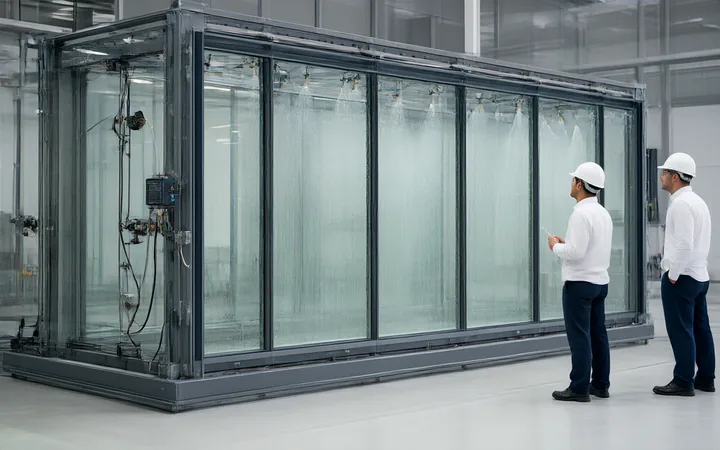
No. CE declarations cover products — glass, and in some cases the framing system — but the facade as installed also depends on design and workmanship: anchors, brackets, seals, drainage and the interface with the slab. That is why performance testing sits alongside the paper trail. A curtain wall is verified by laboratory tests for air permeability, water tightness, wind resistance and, where required, impact and seismic drift.
In practice you need both sets of evidence: component declarations for the materials and a system test report for the assembled facade. Neither replaces the other. See the curtain wall performance testing guide for the test side.
What should a Gulf or East Africa specifier add?
CE is a baseline, not a climate answer. For a 45 °C coastal site under the Saudi Building Code with Mostadam requirements, add solar-control performance (SHGC), a corrosion grade for exposed fixings to ISO 9223 C4–C5, and a water-management strategy verified by a laboratory water test. Ask how the IGU edge seal behaves under high sustained temperature — that is where a nominally compliant unit fails early.
Write the requirement as a schedule: glass build-up, governing standard, declaration reference, performance target and replacement traceability. That single table does more for compliance than a stack of unrelated certificates.
Key takeaways
- CE marking for curtain wall glass is a set of declarations by glass type, not one certificate for the facade.
- Tempered glass → EN 12150; heat-strengthened → EN 1863; insulating glass units → EN 1279; laminated safety glass → EN 14449.
- The IGU declaration matters most because seal failure is invisible until fogging and U-value drift appear.
- A declaration must match the exact build-up and be traceable to the delivered batch — otherwise it is not a compliance record.
- For Gulf and East Africa, pair CE with SHGC, ISO 9223 C4–C5 corrosion grade and verified water management.
Frequently asked questions
What CE standard applies to tempered curtain wall glass?
Tempered (thermally toughened) soda-lime silicate safety glass is declared under EN 12150. It covers strength and fragmentation behaviour. Heat-strengthened glass is a different product, declared under EN 1863, and is not classified as a safety glass.
What does EN 1279 cover for insulating glass?
EN 1279 covers the insulating glass unit: edge-seal durability, gas leakage and resistance to condensation under accelerated ageing. It is the declaration that matters for long-term U-value and for avoiding fogging between the panes.
Does a CE certificate cover the entire curtain wall?
No. CE declarations apply to products such as glass and, in some cases, framing. The installed facade also needs system performance tests for air, water, wind and, where required, impact or drift. Component papers and system test reports are both required.
How do I check a glass CE declaration is genuine?
Verify four things: the standard number matches the glass type, the product description matches your build-up, the issuing body and date are stated, and the batch can be traced from the delivered panel back to the declaration.
Why does glass certification matter more in a hot climate?
High sustained temperature accelerates IGU edge-seal ageing and drives solar gain. In a 45 °C coastal site, a nominally compliant unit can fail early if the seal is not rated for that duty, so pair CE with SHGC targets and a corrosion grade for exposed fixings.
Sources
Need the declarations behind a glazing schedule?
Send the glass build-up, the elevation and the governing code. We return the declaration map by glass type, the matching system test evidence and the climate add-ons for your site. See the Glazing Curtain Wall range, browse the facade FAQ, or talk to our engineering team.
Glazing Curtain Wall Fire Safety: Perimeter Barriers and Seals
Unitised Glazing · Oct 23, 2026
Glazing Curtain Wall IGU Selection: SHGC, U-Value and Acoustics
Unitised Glazing · Oct 13, 2026

Unitised Curtain Wall Condensation: Dew Point and Warm Edge
Glazing Curtain Wall Quality Control: Tolerances & Inspection
Curtain Wall Drainage & Pressure Equalisation | INDECO
Unitised Curtain Wall vs Stick-Built: Cost & Programme
Unitised Glazing · Oct 30, 2026