Short answer: A complete aluminum cladding specification fixes four numbers before tender — alloy and temper (3003-H14, 5005-H34 or 5052-H32), panel thickness (2.5–4.0 mm), finish system (70% PVDF at 25–40 µm, or AA15–AA25 anodizing), and tolerances with a deflection limit of span/180. State all four and low-value substitutions lose their hiding places.
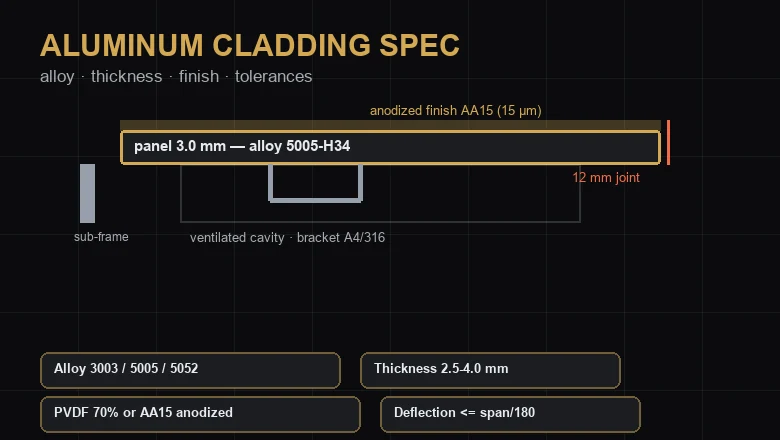
Most disputes on cladding projects do not start on site — they start in the specification. When a tender says only “aluminum cladding panels, coated”, every bidder prices a different product: a different alloy, a different film build, a different fixing system. A specification that states the four key variables turns pricing into a like-for-like comparison and keeps every substitution visible on one page.
This checklist is the one INDECO engineers apply to solid-panel facades in the Gulf and East Africa, where 45°C design heat, dust and C4/C5 coastal exposure punish underspecified cladding within a few seasons. For the material itself, start with our complete aluminum cladding guide.
What Does an Aluminum Cladding Specification Cover?
A tender-ready specification for solid aluminum cladding rests on four pillars. Everything else — colours, samples, warranties — hangs off one of them:
- Alloy and temper — the mechanical grade of the sheet (3003, 5005, 5052) and its hardness condition (H14, H32, H34).
- Panel geometry — thickness, maximum panel size and the support spacing the panel can span.
- Finish system — PVDF coating or architectural anodizing, with film build, colour control and fire class.
- Engineering limits — tolerances, deflection limits, fixings and the thermal movement allowance.
Which Alloy and Temper Should You Specify?
Three wrought alloys cover nearly every facade case. The differences look small on paper but decide formability, anodized appearance and coastal strength. The figures below are typical yield ranges for these tempers as supplied in facade coil.
| Alloy / temper | Typical yield strength | Best suited to | Why it matters |
|---|---|---|---|
| 3003-H14 | ~110–145 MPa | General wall cladding, cassettes, curved work | Excellent formability, economical, widely stocked |
| 5005-H34 | ~110–150 MPa | Anodized facades | Most uniform oxide appearance across a batch |
| 5052-H32 | ~110–160 MPa | Coastal C4/C5 sites, higher wind loads | Higher magnesium content, stronger welded details |
Specify temper explicitly: the same 3 mm sheet in the annealed condition forms beautifully but sags on the wall, while a full-hard condition cracks at the folding machine. H14/H32/H34 sit in the working sweet spot for panelling — and 5005 is the grade our anodizing partner in Guangdong processes in coil precisely because its oxide film takes colour evenly.
How Thick Should Aluminum Cladding Panels Be?
Stiffness rises with the cube of the section, so small thickness steps have outsized effects. Facade coil is available from 0.15 mm up to 6.0 mm, but external wall cladding concentrates in a narrow band. The support spacings below are indicative starting points — confirm each one against the project wind load calculation.
| Thickness | Typical application | Indicative support spacing |
|---|---|---|
| 2.0 mm | Soffits, column covers, interior walls | up to ~600 mm |
| 2.5 mm | Standard exterior wall cladding | up to ~750 mm |
| 3.0 mm | External facades, medium wind zones | up to ~900 mm |
| 4.0 mm | Large panels, high wind or exposed coastal elevations | up to ~1,100 mm, verify by calculation |
Resist the temptation to solve wind problems with thickness alone. Moving from 2.5 mm to 4.0 mm adds 60% panel weight and cost; adding a stiffener or reducing the support spacing is often cheaper, flatter and easier to fix.
How Do You Write the Finish Clause: PVDF or Anodizing?
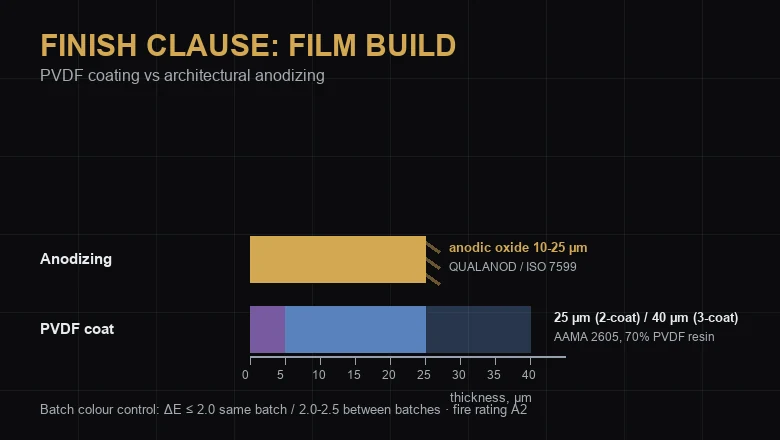
The finish clause is where specification quality shows. A compliant clause names the resin content or oxide class, the film build, the colour-control method and the fire contribution — not just a colour name.
| Parameter | PVDF coating | Architectural anodizing |
|---|---|---|
| Governing standard | AAMA 2605 (70% PVDF resin) | QUALANOD / ISO 7599, classes AA10–AA25 |
| Film build | 25 µm (2-coat) / 40 µm (3-coat) | 10–25 µm oxide, grown into the metal |
| Colour control | ΔE against an approved master panel | ΔE ≤ 2.0 in batch / 2.0–2.5 batch-to-batch |
| Weathering | Chalk-resistant fluoropolymer film | Electrolytic colour inside the oxide, 25+ years outdoors |
| Fire contribution | Organic film on A2 metal | A2 rating (GB 8624); no burning drips at 600°C |
| End of life | Coating must be stripped before recycling | ~96% recovery with no stripping |
INDECO specifies architectural anodizing — produced under the QUALANOD architectural scheme by our anodizing partner in Guangdong — for Gulf and coastal African towers, and PVDF where the design needs a wide colour palette. Both finishes can sit on one elevation; the specification should simply state which panel receives which. Neutral salt-spray performance of the partner’s series ranges from 500 h to 4,000 h depending on the surface family, so the exposure class (ISO 9223 C3–C5) belongs in the same clause.
What Tolerances Should a Tender State?
Tolerances decide whether panels install without rework. State them numerically; “to standard industry practice” is not a tolerance. The values below are the ones INDECO puts on drawings for formed solid panels.
| Parameter | Typical specified value |
|---|---|
| Panel length / width, panel ≤ 2.0 m | ± 1.0 mm |
| Panel length / width, panel > 2.0 m | ± 1.5 mm |
| Squareness (diagonal difference) | ≤ 2 mm |
| Flatness | ≤ 0.5% of panel dimension, max 3 mm |
| Fixing hole positions | ± 0.5 mm |
| Deflection under design wind load | ≤ span/180, max 20 mm |
| Proof load test | 1.5 × design wind pressure, no permanent set |
Aluminium expands about 23 µm per metre per kelvin — roughly 3.5 mm over a 3 m panel between a 45°C Gulf afternoon and a cool night. That movement is why joint widths of 10–15 mm, slotted fixing holes and isolated A4/316 stainless fasteners are standard on INDECO drawings rather than options. The coastal cladding guide covers the fixing and drainage detail in depth.
Which Submittals Should You Require Before Award?
A specification is only as enforceable as its submittal list. Require, as a condition of award:
- Mill certificates linking alloy, temper and batch to the delivered coils.
- Coating or anodizing certificates with film-build readings and batch colour data.
- Sample panels — at least three, spanning the darkest and lightest of the batch range.
- A finished mock-up tested to 1.5 × design wind pressure where the code requires it.
- Fire classification to EN 13501-1 (A2-s1,d0) or the local equivalent — see our fire safety comparison.
- Corrosion strategy matched to the ISO 9223 exposure class, with A2/A4 stainless fixings.
- Panel drawings showing joint widths, bracket layout and drainage paths.
What Are the Most Common Specification Mistakes?
- Naming a colour but not a film build — “PVDF” alone can mean 15 µm or 40 µm.
- Specifying anodizing without an alloy clause; 3003 and 5005 colour differently and banding shows across a facade.
- Letting deflection limits float — without span/180, panels ripple visibly in wind.
- Mixing galvanized or carbon-steel fixings with aluminium; galvanic corrosion follows within seasons in C4/C5 zones.
- Leaving the finish clause silent on colour tolerance, so “slight shade variation” becomes a handover argument instead of a controlled process.
On recent INDECO reference applications — the Gulf Waterfront Commercial Tower (Dubai), the Gulf Cultural Landmark Pavilion (Doha) and the East Africa CBD Tower (Nairobi) — fixing alloy, thickness, finish class and tolerances before pricing produced comparable bids, visible substitutions and installed facades that matched the approved samples without site negotiation.
Key takeaways
- A cladding specification is four numbers: alloy/temper, thickness, finish class, tolerances.
- 3003-H14 for forming, 5005-H34 for anodizing, 5052-H32 for coastal strength.
- 2.5–3.0 mm covers most walls; go to 4.0 mm only with calculation support.
- PVDF: AAMA 2605 at 25–40 µm; anodizing: QUALANOD AA10–AA25 with ΔE ≤ 2.0.
- Deflection ≤ span/180, proof test at 1.5 × design wind load, A4/316 fixings in C4/C5 zones.
Frequently asked questions
What alloy is best for aluminum cladding?
For formed solid panels, 3003-H14 is the economical general-purpose choice, 5005-H34 gives the most uniform anodized appearance, and 5052-H32 adds strength for coastal C4/C5 sites and heavier wind loads. Specify alloy and temper together — a grade without a hardness condition is only half a specification.
How thick should aluminum cladding panels be?
Most exterior wall cladding sits at 2.5–3.0 mm. Use 4.0 mm for large panels or high wind zones, and 2.0 mm only for soffits and interiors. Because stiffness rises with the cube of thickness, reducing the support spacing often beats adding metal.
PVDF or anodized — which finish should I specify?
Specify anodizing when you want a metallic, UV-stable finish that never chalks or peels — 10–25 µm oxide under QUALANOD. Specify 70% PVDF (AAMA 2605, 25–40 µm) when the design needs a wide colour palette. Both are A2 fire class on solid aluminium.
What deflection limit should cladding panels meet?
The common tender value is span/180 with an absolute cap around 20 mm under design wind load, proven at 1.5 times design pressure. Tighter limits such as span/240 are used where panel ripple would be visible close to eye level.
Does a specification need colour tolerance numbers?
Yes. Ask for ΔE ≤ 2.0 within a batch and 2.0–2.5 between batches, measured against an approved master panel. Without a numeric colour clause, “slight shade variation” becomes an argument at handover instead of a documented, controlled process.
Specifying aluminum cladding for a Gulf or East Africa project?
Send us the elevation grid, the design wind load and the exposure class. We return a panel-by-panel specification — alloy, thickness, finish class, tolerances and fixing layout — plus SBC/Mostadam documentation. See the Aluminum Cladding product page, the finishes and colours guide, or talk to our engineering team.