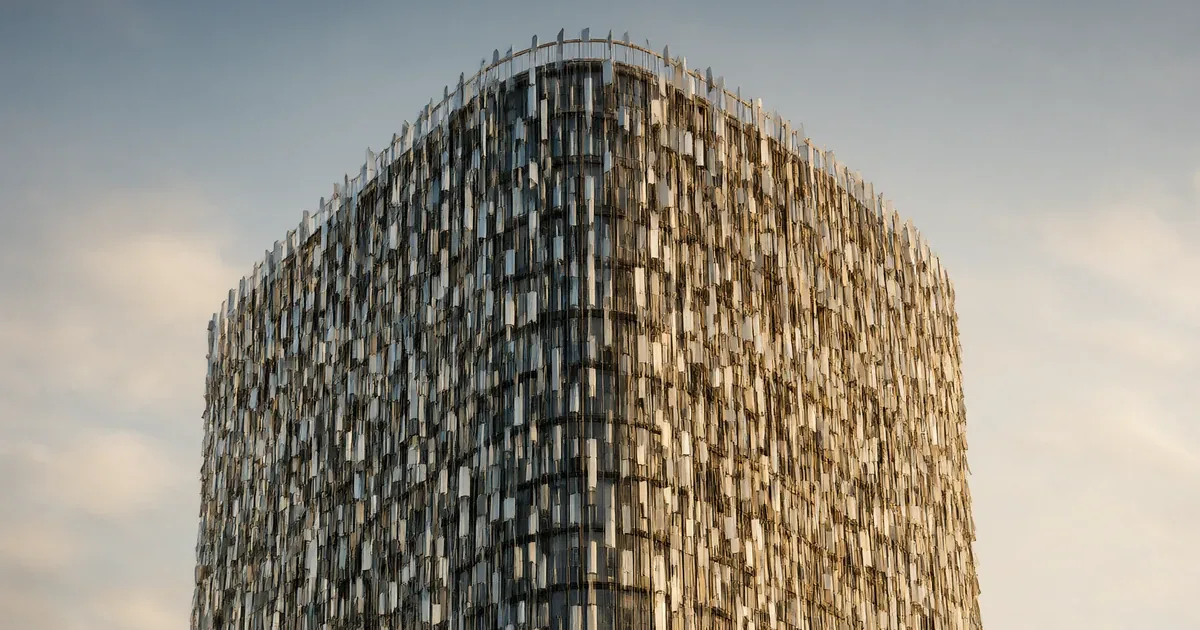
Short answer: A wind-chime kinetic facade hangs light metal panels so they drift in the wind. Three structures carry them: stainless steel cables, a rigid frame, or a bespoke support. Shapes run from rectangles to diamonds, polygons and circles. The part that decides service life is not the outline. It is the anti-detachment stop at every panel and the modular fixing that lets one panel come out without disturbing the rest.
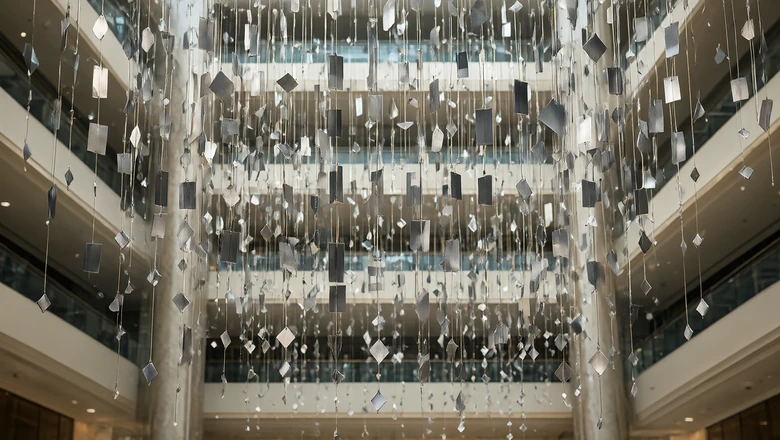
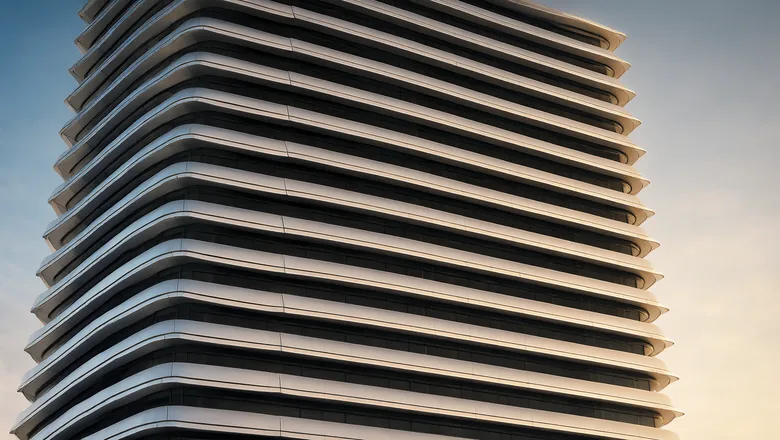
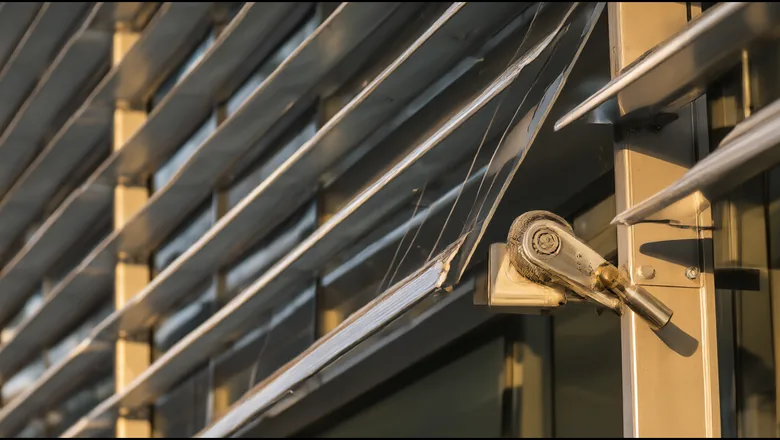
A wind-chime facade is not a rotating louver. A louver is a rigid blade on a bearing, held at an angle and checked for a defined wind duty. A wind-chime panel hangs free. It moves because air pushes on a thin plate. That difference changes the whole specification. You stop specifying a rotation angle and start specifying a shape, a suspension and a stop that keeps the plate on the building. This article covers the two moving families in detail and then goes into shapes and structures. It follows the wind load article and the maintenance schedule.
What shapes can a wind-chime facade panel take?
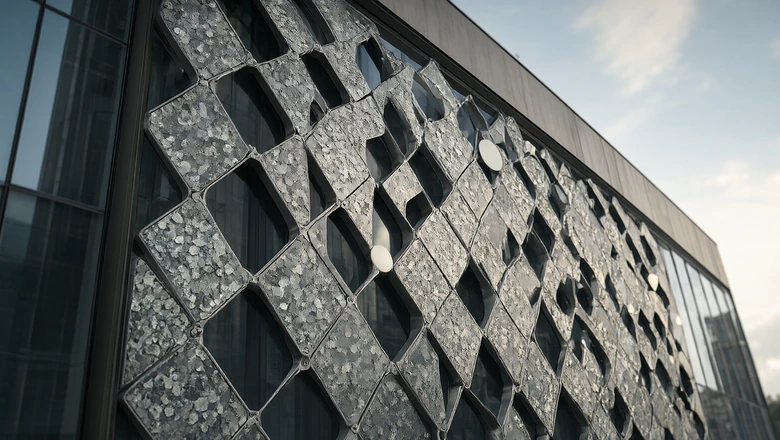
Four shape families cover almost every project: rectangle, diamond, polygon and circle. The rectangle came first and remains the cheapest to cut from coil. The other three are cut from the same sheet. They change the visual rhythm and the way wind loads reach the suspension point, not the panel thickness. Use the shape to set the pattern; use the structure to carry the wind.
| Shape | How it is cut | Visual effect | Where it works |
|---|---|---|---|
| Rectangle | Straight shear, minimal offcut | Regular grid, calm rhythm | Large podium screens, tight budget |
| Diamond | 45° rotation of the rectangle | Diagonal shimmer, denser edges | Atrium feature walls, entrances |
| Polygon | Nested or honeycomb nesting | Faceted, less formal | Cultural buildings, garden-side facades |
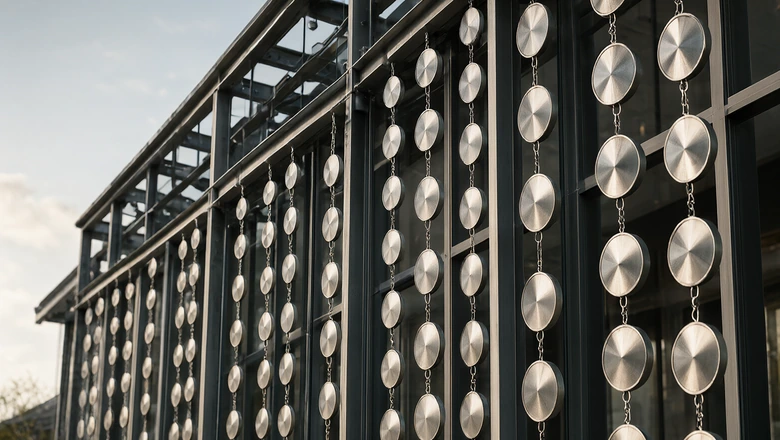
| Circle | Round nesting, higher offcut | Soft, organic movement | Sheltered courts, interior screens |
Panel size is set by the eye, not by strength. A thin plate 150 to 400 mm across moves visibly at a breeze of about 1 m/s. Go much larger and the panel stops fluttering and starts bending. Keep the plate small, keep the suspension simple, and let quantity create the effect. A screen of two thousand small plates reads as one moving surface; a screen of two hundred large plates reads as a set of flapping signs.
How does a cable-hung structure carry the panels?
Two suspension points per panel, usually a stainless steel wire of 3 to 8 mm in A4 grade. The wire runs from a head bracket to a bottom anchor, and each plate is clamped or punched at its top edge. Nothing below is rigid. The plate swings, twists and returns under its own weight. This is the lightest structure and the one we use where the aim is a shimmering veil rather than a solid screen.
| Element | Typical choice | Reason |
|---|---|---|
| Vertical wire | A4 stainless, 3–8 mm | C4/C5 coastal exposure, no rust staining |
| Fixing per panel | Two clamp points or two punched eyes | Restrains rotation without locking the plate |
| Wire pretension | Set on site, rechecked after 30 days | Wires settle; slack panels collide |
| Panel gap | At least 10 mm all round | Stops plate-on-plate impact at 45 m/s |
| Anti-detachment | Closed stop above the clamp | Prevents a panel riding off a slack wire |
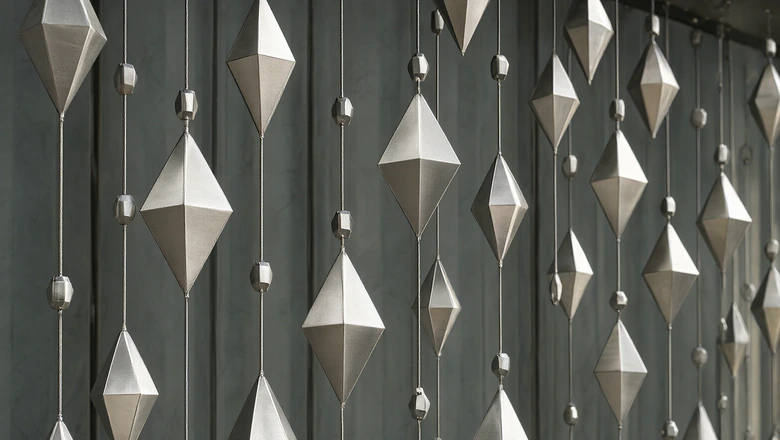
The trade-off is movement you cannot command. A cable-hung panel reacts to the wind it meets, so the screen cannot be told to open, close or hold a fixed angle. If the brief includes a shading target, a fire smoke vent function or a stated wind position, use a rotating louver instead. Cable-hung wins on cost, lightness and the softness of the effect. It loses on control and on the inspection needed to keep hundreds of small clamps tight.
When is a framed structure better than cables?
A framed structure puts the panels on a light metal skeleton, with verticals typically at 1.2 to 1.5 m centres. Each panel hangs from a short link or pin fixed to the frame. The frame takes the load back to the main building at a few clear points. Choose it when the screen is tall, when wires would be too long to tension, or when the facade sits over an entrance where a dropped panel is not acceptable.
| Criterion | Cable-hung | Framed | Bespoke |
|---|---|---|---|
| Structure weight | Lowest | Medium | Highest |
| Free movement | Highest | Controlled by the link | Designed per site |
| Height limit in practice | Limited by wire tension | Good for tall screens | Sets its own limit |
| Replace one panel | Unclip from wire | Unpin from the link | As detailed |
| Cost driver | Panel count | Frame and fixings | Design time and jigs |
Bespoke is the third answer, not an upgrade. Use it when the geometry leaves no repeat: a curved atrium, a folded canopy, a shape that must follow a roof line. It means a new bracket drawing, a new jig and a first-off inspection for each zone. Accept the cost on the features that are seen, and keep the standard field of panels on a repeated cable or framed grid. That split is how a landmark screen stays inside a normal facade budget.
Why does anti-detachment decide the service life?
A panel that leaves its fixing becomes a falling object. Limit stops are therefore not an accessory; they are the part that makes the system safe to put above a public route. At each clamp the plate needs a closed retainer that prevents lift-off when the wind drops suddenly and the wire or link slackens. We detail the retainer as a separate, replaceable piece so a worn stop can be changed without replacing the panel.
Modular fixing does the same job for maintenance. Two thousand panels will lose a handful of clips over twenty-five years. If each swap needs a crane and a cut wire, the facade is unmaintainable. If each panel unclips from the ground or from a simple access platform, the screen stays in service. Ask for the replacement sequence in the tender, not just the installation sequence. Our installation article sets out the tolerance chain that keeps the gaps open.
- Closed stop at every panel: no open hooks on a public elevation.
- A4 stainless wire, links and pins in ISO 9223 C4/C5, isolated from carbon steel.
- Panel gap of at least 10 mm at full movement, checked on the mock-up.
- One-for-one spare panels from the same anodising batch, stored on site.
- Recheck wire tension 30 days after handover and then at the ISO 9223 interval: 12 months in C3, 6 months in C4/C5.
Cable, frame or bespoke: which do I specify?
Three questions settle it. Is there a stated wind duty or a shading target? Then take a rotating louver, not a free panel. Is the screen tall or over a public route? Then take a framed structure with closed stops. Is the geometry unique and the budget driven by appearance? Then take bespoke, but only for that zone. At 45°C and in coastal air, specify A4 stainless, an anodised finish of 5 to 20 µm and a cleaning path that reaches every panel.
| Brief | Pick | Cost of the choice |
|---|---|---|
| Defined shading or wind position | Rotating louver | Bearings, actuators, maintenance |
| Light veil, sheltered, low rise | Cable-hung | No positive control; frequent clamp checks |
| Tall screen over an entrance | Framed | More steel, defined load path |
| Curved or folded feature zone | Bespoke | Design time, jigs, first-off inspection |
Key takeaways
- Four shape families — rectangle, diamond, polygon, circle — change the pattern, not the panel strength.
- Three structures carry the panels: cable-hung, framed and bespoke. Pick by control, height and geometry.
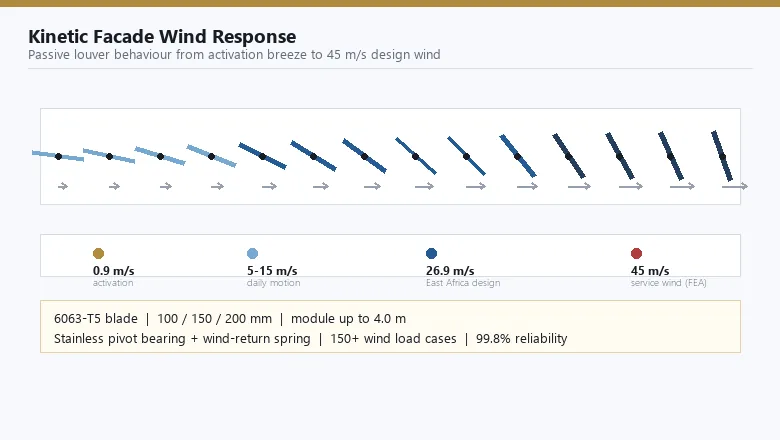
- A free wind-chime panel cannot promise a shading angle. If the brief needs one, specify a rotating louver.
- The anti-detachment stop is the safety part. Require a closed retainer at every clamp and a written replacement sequence.
- In C4/C5 coastal air use A4 stainless and a 5–20 µm anodised finish; recheck tension at 6 months.
Frequently asked questions
Are wind-chime panels the same as rotating louvers?
No. A rotating louver is a rigid blade on a bearing, held at a stated angle and checked for a design wind. A wind-chime panel hangs free on a cable or link and moves with whatever wind arrives. Only the louver can be commanded to a position or used where a shading target must be met.
How many panel shapes are available?
Four families cover most screens: rectangle, diamond, polygon and circle. The rectangle is the cheapest to cut; the others come from the same sheet with more offcut. Shape changes the visual rhythm and where the wind load enters the fixing, but it does not change the panel thickness or the wind duty.
What holds the panels on a cable-hung facade?
Two clamps or punched eyes per panel on A4 stainless wire of 3 to 8 mm. A closed stop above each clamp stops the plate lifting off when the wire slackens. Wires are tensioned on site and rechecked 30 days after handover, then at the corrosion-driven inspection interval, six months in C4/C5 exposure.
Can a wind-chime screen resist a storm?
As a decorative layer, yes, if the stop, the wire and the 10 mm panel gaps are detailed for the site wind. It is not a rated weather barrier and cannot promise a fixed open or closed position. Where a defined 45 m/s duty must be demonstrated, use a rotating louver system with a tested load path.
How do I replace one damaged panel?
Unclip the panel from its wire or unpin it from the frame link, fit a spare from the same anodising batch and reclose the stop. The point is to do this from a simple access platform without touching neighbours. Ask for the replacement method and the spare quantity in the tender, not only the installation method.
Sources
Choosing shapes and a mounting structure?
Send the elevation, the site wind speed and the effect you want. We return a panel-shape option and a cable, frame or bespoke recommendation with the anti-detachment detail and maintenance interval. See the Kinetic Facade range, read the facade FAQ, or talk to our engineering team.
Wind-Chime Facade vs Rotating Louvers
Kinetic Facade · Nov 19, 2026
Kinetic Facade Wind Load: Activation to 45 m/s
Kinetic Facade · Oct 8, 2026
Kinetic Facade Actuation: Passive vs Motorised
Kinetic Facade · Oct 11, 2026
Kinetic Facade Installation: Modules & Tolerances
Kinetic Facade · Oct 25, 2026
Kinetic Facade Fire Safety: Rating & Smoke Control
Kinetic Facade · Nov 10, 2026
Kinetic Facade Maintenance: Inspection & LCC
Kinetic Facade · Oct 5, 2026