Short answer: Aluminum cladding repair begins with a depth test, not a cosmetic fix. Scratches that stay inside the coating can be polished or touched up; anything reaching bare metal, denting the panel face or breaking a sealed joint needs panel replacement — 2–4 hours per hook-on cassette — and full re-anodising is a factory operation, never a site one.
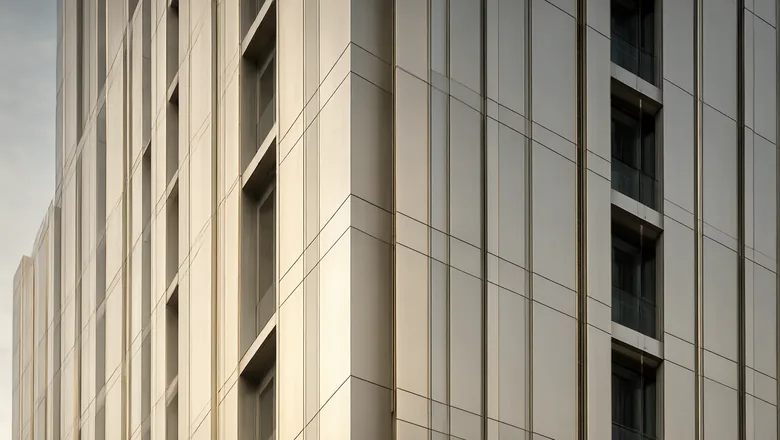
A facade is repaired dozens of times over a 30-year life, and almost every repair is triggered by something small: a scaffold clamp dropped during a window-washer upgrade, a dent from a delivery truck on the podium, a scratch left by a cleaning brush, a sealant bead that failed at one corner. What separates a 300-dollar fix from a 30,000-dollar elevation is the diagnosis made in the first ten minutes. This article sets out the assessment grades we use, the replacement procedure for each fixing family, what can and cannot be re-coated on site, realistic cost and time bands, and the paperwork that keeps a finish warranty alive after a repair. It complements the maintenance schedule article, the anodized finish article and the installation sequence article, and it applies the same 45°C design day and SBC 901 / Mostadam framework used across our aluminum cladding pages.
How Do You Assess Damage to Aluminum Cladding Panels?
Grade the damage before touching it. Three questions decide everything: does the defect penetrate the coating to bare metal, does it deform the panel plastically, and does it compromise a joint, a fixing or a fire stop. A scratch that stops inside the coating is a maintenance item; a scratch that reaches the alloy is a corrosion initiation site, because aluminium does not rust but it does pit under a broken film in a chloride environment.
| Grade | What you see | Standard action | Who can do it |
|---|---|---|---|
| 0 — surface soiling | Deposit, water spotting, no film loss | Clean per approved chemistry | Facade cleaning crew |
| 1 — coating intact | Scratch or scuff inside the film, no metal visible | Polish or touch-up; log the location | Approved applicator |
| 2 — film breached | Bare alloy visible, no deformation, edge intact | Local repair primer plus topcoat, or replace | Approved applicator |
| 3 — panel deformed | Dent, crease, oil-canning that does not spring back | Replace the panel; inspect the sub-frame | Facade contractor |
| 4 — system affected | Cracked panel, loose fixing, failed sealant, displaced fire stop | Make safe, replace, re-certify the zone | Facade contractor plus engineer |
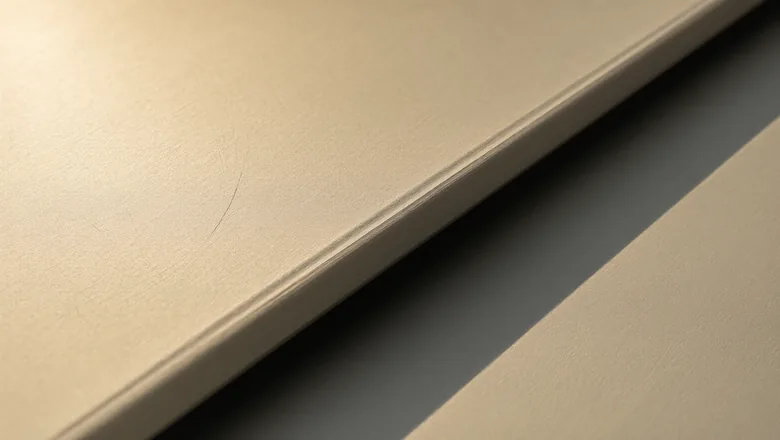
The measurement that settles grade 1 versus grade 2 is film thickness. Anodizing specified as AA15 to AA25 gives a nominal 15–25 µm anodic layer, and a PVDF system gives 23–30 µm in two coats or 35–45 µm in three. A scratch shallower than the film is a cosmetic defect that polishing can close; a scratch deeper than the film exposes alloy that will oxidise white and, in a C4 or C5 coastal site under ISO 9223, start filiform corrosion that creeps under the coating from the damage edge. On a dark bronze or black anodized panel, polishing also changes the sheen, so a grade 1 repair on a highly visible elevation is often a replacement anyway — appearance, not corrosion, becomes the deciding factor.
Two assessment habits pay for themselves. First, photograph every defect with a scale reference and its grid position, because a warranty claim six years later is settled on records, not memory. Second, check the panel behind the damage: a dent that looks cosmetic on the face is often a bracket impact from inside, and a panel that has been pushed against its fixing will show oil-canning that springs back when the fixing is released — the elastic case needs re-torqueing per the flatness article, while the plastic case needs a new panel.
How Is a Damaged Cladding Panel Replaced?
Replacement is a controlled dismantling, not a demolition. Isolate the zone, set up access, remove the damaged unit, inspect what it was hiding, fit a matching spare, then restore the joint geometry and the fire stop. With a hook-on or cassette system the panel comes off in 2–4 hours without touching its neighbours; with face-fixed panels the fixings are behind the joints, so two to four adjacent panels usually come off first, and the job becomes a day or more.
| Fixing family | Time for one panel | Neighbours disturbed | Practical note |
|---|---|---|---|
| Hook-on cassette | 2–4 h | None | Lift, unhook, swap, re-hang |
| Concealed hook-on | 2–4 h | None | Retaining clip access from the joint |
| Back-bolted cassette | 3–6 h | None, but sub-frame access needed | Torque values must be re-set |
| Face-fixed | 6–10 h | 2–4 panels | Joint sealant cut and renewed |
| Unitised or factory strip | 4–8 h | Module only | Requires BMU or crane |
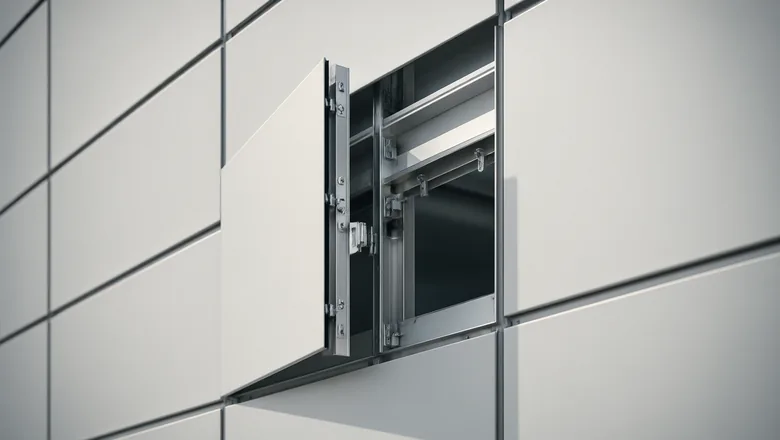
Five steps define a replacement that will not come back as a complaint. One, identify the original batch — alloy, temper, finish and lot — from the project finish schedule, and take the spare from the same lot; a different anodizing bath will not match, whatever the ΔE reading says on a small sample. Two, inspect the cavity before closing it: barrier membrane, bracket condition, insulation, and the floor-edge fire stop, which is the item most often found displaced. Three, fit the panel on the same datum, not on the neighbour’s edge, and re-set the joint to its design width — typically 8–20 mm for a shadow gap, held to ±2 mm. Four, renew the sealant with the same chemistry and the same backer rod, never a hardware-store silicone over a neutral-cure joint, as the joints and sealants article explains. Five, record the repair with photographs, panel ID, date and operative, and add it to the facade log.
Two numbers make the difference between a one-hour job and a three-day one. The thermal one: a 4.0 m panel moves about 4.6 mm across a 45°C design day at α = 23 µm/m·K, so a replacement fitted tight in the morning will be under compression by mid-afternoon — the slotted holes and joint gap must be restored exactly, not “snugged up”. The inventory one: keep 0.5–1% spares from the original order, stored flat and indoors. Projects that skip the spare pool end up buying a new production run for one panel, waiting 6–10 weeks for fabrication plus sea freight, and accepting a visible colour difference on the most scrutinised elevation of the building.
Can Aluminum Cladding Be Re-Coated or Re-Anodised on Site?
Re-anodising on site is impossible, and any contractor offering it should be removed from the tender list. Anodizing is an electrolytic process: the panel is immersed in an acid electrolyte, current is passed at a controlled density, the oxide grows from the substrate, then the film is sealed. It needs a bath, rectifiers, tanks and a factory — a spray bottle cannot grow an anodic film, and the “cold anodizing” pens sold for touch-up are dye, not oxide.
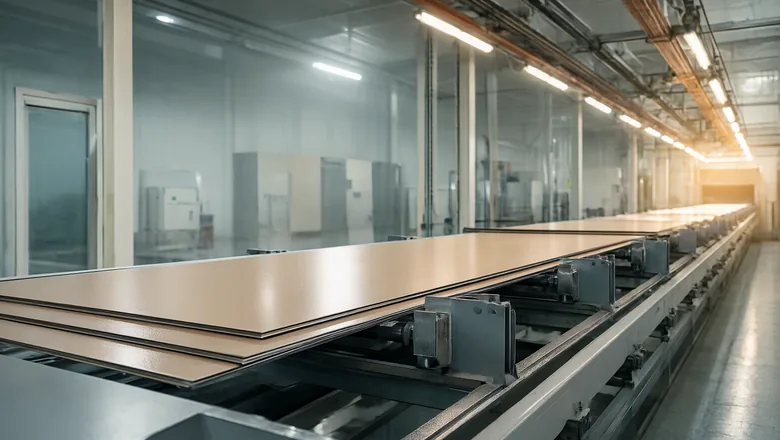
Re-coating is different, but bounded. A 2K repair coating applied by an approved applicator can restore colour and barrier protection over a limited area, typically a few percent of an elevation, and it will hold for years if the substrate is prepared and primed correctly. What it will not do is reproduce a factory PVDF system: the 70% Kynar-grade fluoropolymer used for AAMA 2605 performance is baked at high temperature, and a site-cured repair coat is a different material with a different chalk-and-fade curve. Full re-coating of an elevation means removing the panels, stripping the old finish and returning them to a plant — a 4–6 week cycle plus freight, priced close to new panels on small quantities.
| Finish | Field repair possible? | Method and limit | Warranty effect |
|---|---|---|---|
| Anodized AA15–AA25 | No re-anodising; touch-up only | Dye pen or wax for hidden faces; visible faces replaced | Repaired panel excluded from finish warranty |
| PVDF 70% two-coat | Yes, small areas | 2K repair coat over prepared, primed substrate | Retains warranty if approved applicator and logged |
| PVDF 70% three-coat | Yes, small areas | Repair coat plus clear; colour match harder on metallics | Metallic and mica colours usually excluded |
| Powder coat | Yes, small areas | 2K repair or factory batch re-coat | Field repair carries its own shorter warranty |
| Mill finish | Not applicable | Clean and accept patina, or replace | No finish warranty in the first place |
Site conditions decide whether even a legitimate repair coat will last. The surface must be below 40°C and at least 3°C above dew point, which on a Gulf elevation in August narrows the window to early morning; a repair coat applied to a panel at 55°C will blush, lose adhesion and fail inside two summers. Chloride contamination must be washed off and the substrate abraded and primed to the coating maker’s data sheet, and the repair should be feathered, not blobbed, so the sheen transition is invisible from ground level. Where the damage sits above a sealed joint, replace the panel: coating a compromised joint only hides a water path.
What Does a Cladding Repair Cost and How Long Does It Take?
Access, not material, sets the price. A panel costs what it costs; moving a person to it at 60 m is what generates the invoice. At ground and podium level a hook-on panel swap is a half-day task for two people. At height the same swap needs a MEWP, a mast climber or rope access, and mobilising any of them for a single panel costs more than the panel, the coating and the labour combined.
| Intervention | Duration | Indicative cost band | Dominant cost |
|---|---|---|---|
| Clean and inspect a defect | 0.5–1 h | USD 60–150 | Access |
| Polish or touch-up, grade 1 | 1–2 h | USD 90–220 per location | Applicator time |
| Repair coat on a breached film | 2–4 h | USD 180–450 per panel | Surface prep and cure window |
| Hook-on panel replacement, low level | 2–4 h | USD 250–600 per panel | Panel plus spare-pool draw |
| Panel replacement at height | 1–2 days | USD 600–1,600 per panel | MEWP, mast climber or rope team |
| Face-fixed replacement | 1–2 days | USD 900–2,200 per zone | Adjacent panels and re-sealing |
| Elevation re-coat, factory cycle | 4–6 weeks | USD 55–110 per m² | Stripping, freight, re-finishing |
Programme follows the same logic. A planned repair campaign — 20 to 40 panels across one elevation, mobilised once — is 60–70% cheaper per panel than 20 separate call-outs, because mobilisation is paid once. That is the argument for batching repairs found in the annual inspection rather than fixing them as they are reported, provided none of them is grade 4. Grade 4 items are made safe immediately: a loose panel over a public entrance is a life-safety issue, not a budget line, and should be secured the same day.
Weather compresses the calendar further. Wind stops panel handling at 8–10 m/s and manned platforms at 12.5 m/s, so a coastal site loses days that an inland site keeps; a Gulf site loses afternoons above 45°C for both work and sealant cure. Price a repair campaign with 20–25% weather downtime built in, and sequence the elevation so that sealant work happens in shade — the same rule that governs new installation in the installation article and the cost structure described in the cost article.
How Do You Keep the Finish Warranty Valid After a Repair?
Finish warranties are conditional contracts, not guarantees. A 10-year AAMA 2605 finish warranty typically requires cleaning to a stated schedule with approved products, no abrasive or solvent attack, and repairs carried out by an approved applicator with materials from the original coating system. Break any of those and the warranty is not void for the building — it is void for the panel, which is worse, because nobody discovers it until a claim is refused.
- Keep the batch record. Alloy, temper, finish, colour code, lot number and supplier certificate for every panel, indexed to elevation and grid.
- Keep the cleaning log. Dated entries, product name and dilution, plus photographs before and after. This is the single document most often missing at claim time.
- Use the named system. Repair coatings from the original finish manufacturer, applied to the data sheet, not a generic hardware silicone or an automotive clearcoat.
- Record the repair. Date, panel ID, damage grade, material, operative, photographs and the remaining warranty period for that unit.
- Re-inspect after one year. A repair that has survived a full thermal cycle and a wet season is stable; one that has chalked or lifted indicates a preparation fault and should be redone before the warranty conversation starts.
The certification side matters as much as the cosmetic side. A replacement panel must come from the same certified system — EN 13501-1 A2-s1,d0 for the assembly, not just the substrate — or the fire classification of that zone is no longer supported by test evidence, and neither SBC 901 nor Mostadam will accept a substitution made on site without documentation. Where the building is pursuing a rating, keep the replacement panel’s declaration and recycled-content figure with the repair record; the sustainability article sets out what those numbers look like, and the specification article lists the clauses a repair contractor should be held to.
Key takeaways
- Grade damage before touching it: intact film is a polish job, breached film is a corrosion site, and a deformed panel is a replacement — four grades, four different invoices.
- A hook-on or cassette panel is replaced in 2–4 hours with no neighbours disturbed; face-fixed zones take 6–10 hours and two to four adjacent panels.
- Re-anodising cannot be done on site at all; a 2K repair coat covers a few percent of an elevation, and anything larger goes back to a factory for 4–6 weeks.
- Keep 0.5–1% spares from the original batch: without them, one damaged panel becomes a 6–10 week production run and a visible colour mismatch.
- Warranty survives on paperwork: batch records, cleaning log, approved materials and a dated repair entry per panel, re-inspected after one full year.
References
- Wikipedia: Anodizing
- Wikipedia: Polyvinylidene fluoride (PVDF)
- Wikipedia: Cladding (construction)
- Wikipedia: Corrosion
Frequently asked questions
Can scratched aluminum cladding be repaired without replacing the panel?
Yes, if the scratch stays inside the coating. Anodized films are 15–25 µm and PVDF systems 23–45 µm; a scratch shallower than that can be polished or touched up. Once bare alloy shows, the film is breached and the panel needs a repair coat or replacement, because pitting starts at the damage edge in coastal air.
How long does it take to replace one cladding panel?
A hook-on or cassette panel takes 2–4 hours for a two-person crew and disturbs no neighbours. Face-fixed panels take 6–10 hours because two to four adjacent panels must come off to reach the fixings. At height, add mobilisation of the MEWP, mast climber or rope team, which usually means a full day.
Can aluminum cladding be re-anodised in place?
No. Anodizing is electrolytic: the panel is immersed in an acid bath, current grows the oxide from the substrate and the film is then sealed. No site-applied product reproduces it. Touch-up pens are dye over bare metal, not an anodic film, and they fade within a season on a south or west elevation.
How much does aluminum cladding repair cost?
Indicatively USD 90–220 for a polish or touch-up, USD 180–450 for a repair coat, and USD 250–600 for a low-level hook-on panel swap. At height the same swap runs USD 600–1,600 because access dominates. Batching 20–40 panels into one mobilisation cuts the per-panel cost by 60–70%.
Does repairing a panel void the finish warranty?
Only for the panel repaired, and only if the work departs from the coating system. A repair by an approved applicator using the original manufacturer’s repair materials, logged with date, panel ID and photographs, normally keeps the remaining warranty. Unapproved materials or an unrecorded repair void cover on that unit alone.
Sources
- AAMA 2605 — superior-performance coatings tier, the 10-year South Florida benchmark for PVDF. FGIA (formerly AAMA).
- EN 13501-1 — supplies the A1-to-F reaction-to-fire classes used in CE marking. CEN (CEN/TC 127).
- ISO 9223 — defines the C1-to-CX atmospheric corrosivity categories that drive coating selection. ISO.
Repairing a facade you did not build?
Send photographs with a scale reference, the elevation plan and whatever finish records exist. We return a damage grading for each defect, a replacement schedule with panel IDs and spare-pool draw-down, the repair-versus-replace decision with cost bands, and the warranty documentation set — checked against a 45°C design day and SBC 901 / Mostadam requirements. Talk to the engineering team.
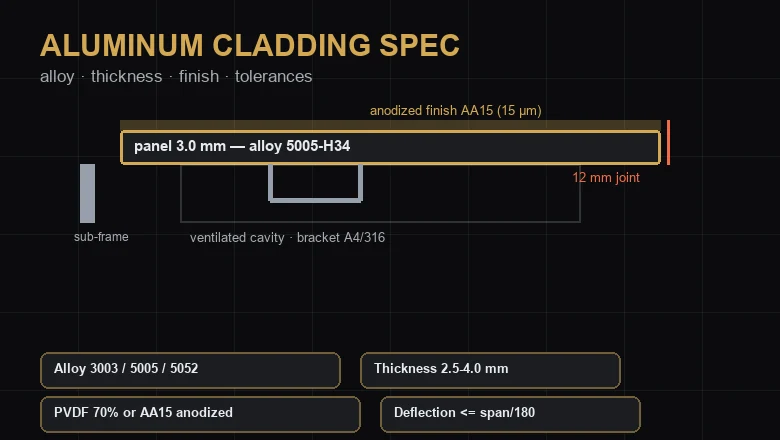
Aluminum Cladding Specification: Alloy, Thickness & Finish
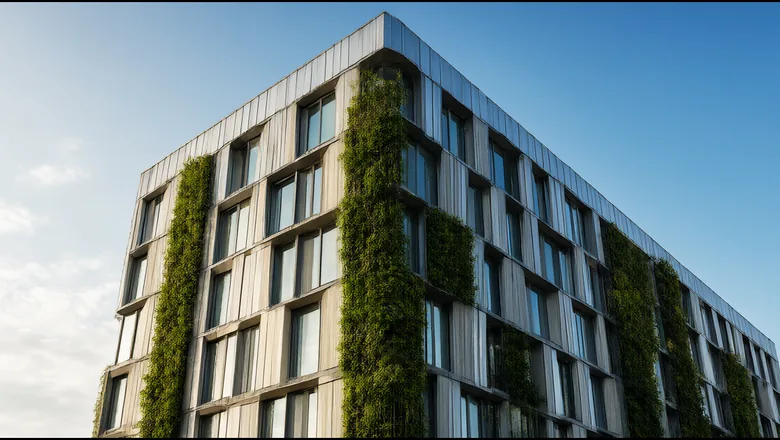
Aluminum Cladding Sustainability: Recycled Content & Carbon
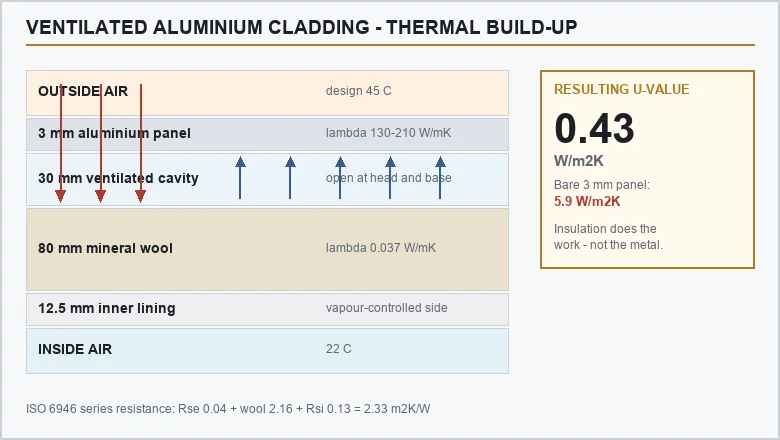
Aluminum Cladding U-Value: Insulation & Thermal Bridging
Aluminum Ceiling and Soffit Systems: Clip-In to Baffle
Aluminum Ceiling · Sep 21, 2026
Honeycomb vs Corrugated Aluminum Panels
Aluminum Cladding · Sep 28, 2026
Aluminum Rainscreen Fixing: Cassette, Hook-On & Sub-Frame
Aluminum Cladding · Oct 07, 2026