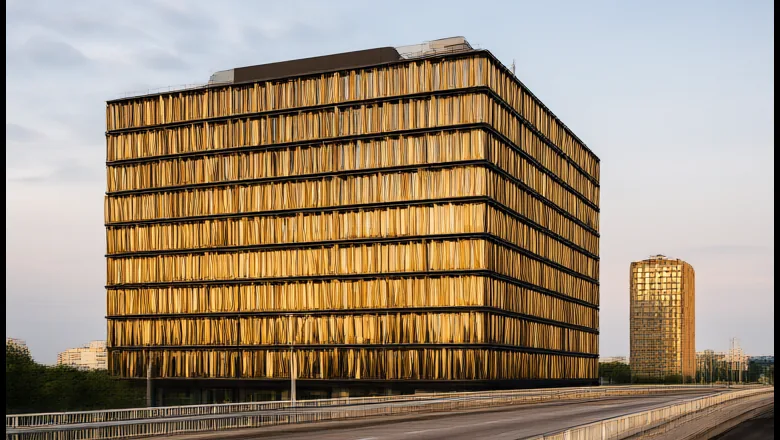
A noisy elevation is normally treated as a glazing problem — and mostly it is. But the moment a moving blade screen is added in front of that glazing, a second question appears: what does the screen itself do to sound? The answer surprises buyers who have been sold a kinetic facade as an acoustic barrier, and it is useful to anyone specifying one. A blade screen is an open-air device, so its acoustic value is set by how much air it lets through, and its real job is to protect the sealed line behind it. New to the product family? Start with the kinetic facade guide.
What is kinetic facade acoustics?
Facade acoustics on a kinetic building splits into two separate problems: the sound insulation of the sealed facade line, and the self-noise of the moving screen. Insulation is rated as Rw from laboratory data on the element to ISO 717-1, adjusted for the low-frequency energy of road traffic by the Ctr spectrum term, then converted into a field value DnT,w measured to ISO 16283-3 in the finished building. Predictions before construction follow EN 12354-3, and outdoor descriptors follow ISO 1996-1. The screen contributes only insertion loss — the difference in the level reaching a point with and without the screen. Nothing about a moving blade changes the underlying physics: the slots between blades are an opening in the facade, and an opening has almost no sound reduction. Every solid zone around the screen is closed with aluminum rainscreen cladding.
| Metric | What it measures | Typical target for a kinetic screen facade |
|---|---|---|
| Rw (ISO 717-1) | Weighted laboratory sound reduction of the sealed element — glazing plus frame | ≥ 40 dB at the glazing line |
| Rw + Ctr | Rw corrected for low-frequency traffic and urban spectra | ≥ 32 dB facing an arterial road |
| DnT,w (ISO 16283-3) | Field level difference across the facade, standardised on reverberation | 30–40 dB offices, 35–45 dB hotels |
| Lden / Lnight (ISO 1996-1) | Outdoor day-evening-night and night traffic level outside the facade | ≤ 53 dB / ≤ 45 dB (WHO guidance) |
| Inward design limit | Design level inside the occupied room | 35–40 dB(A) offices, 30–35 dB(A) bedrooms |
How much noise does an open louver screen actually block?
The governing calculation is the composite transmission of a barrier with a hole in it. If the sealed wall behind the screen has a rating Rw and the blades leave a fraction f of the screen area open, the assembly behaves as:
R = −10 log10 [(1 − f) × 10−Rw/10 + f]
The open slots are an acoustic short circuit: sound passes through them as though the wall were not there, and the composite value collapses towards the open-area ratio. That is why the screen number is so stable and so low.
| Open area at rest | Composite R (45 dB wall behind) | Level inside, from a 75 dB(A) arterial |
|---|---|---|
| 2% | 17.0 dB | ≈ 61 dB(A) |
| 5% | 13.0 dB | ≈ 65 dB(A) |
| 10% | 10.0 dB | ≈ 68 dB(A) |
| 15% | 8.2 dB | ≈ 70 dB(A) |
| 20% | 7.0 dB | ≈ 71 dB(A) |
| 24% — 150 mm blade at rest | 6.2 dB | ≈ 72 dB(A) |
| 30% | 5.2 dB | ≈ 73 dB(A) |
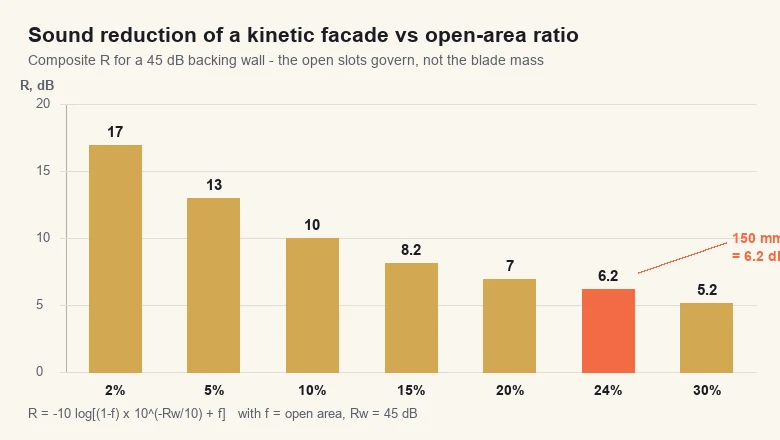
Read that table honestly and the design consequence is clear: a screen alone cannot make a room quiet on a busy road. What it can do, and does well, is protect the element that can. Two comparison facts make the ranking intuitive. Distance is worth more than mass: every doubling of distance from a traffic line takes about 3 dB off the level, while replacing a 2 kg/m² blade with a 20 kg/m² blade moves the composite rating by less than 0.1 dB — the open area is the dominant term by two orders of magnitude. Reducing the rest open area from 24% to 10%, by contrast, buys a full 3.8 dB.
Why is the glazing behind the screen the real acoustic barrier?
Because it is the only continuous, sealed, mass-loaded surface in the assembly. The unitised glazing line behind a kinetic screen — modules from 6 + 12A + 6 to 8 + 16A + 12, verified to STC 42 and U ≈ 1.4 W/m²K on 1.5 × 4.0 m units — is where acoustic performance is won or lost; the full build-up is described in the IGU selection guide. Asymmetric laminated glass with a 0.76 mm PVB interlayer lifts performance exactly in the 63–250 Hz band where road noise energy sits, which is why designers chasing a busy road specify Rw + Ctr rather than Rw alone. The screen outside is not wasted work: it breaks the direct path from the road to the glass, shields the glass from wind and rain-driven noise, and can be finished absorbently where cavity build-up matters.
| Layer | Acoustic function | Value |
|---|---|---|
| Kinetic blade screen | Shading, privacy, breaks the direct sound path | 3–8 dB insertion loss |
| Ventilated cavity, 60–150 mm | Decoupling and drainage; must be sealed at head, sill and jambs | Negligible alone — leaks dominate |
| Sealed unitised IGU | Primary acoustic barrier of the facade | Rw 42 / STC 42 with asymmetric PVB |
| Perimeter and interlock seals | Prevents flanking paths through joints | 1% leak area can cost 5–10 dB |
That last row is the one that fails site tests. A facade can meet its Rw in the laboratory and miss its DnT,w in the building because a fraction of one percent of the joint length was left open. The drainage and compartment detailing that keeps water out, described in the pressure-equalisation and weep path guide, is the same detailing that keeps noise out.
How do you stop a kinetic facade from making its own noise?
Passive blades move continuously from 0.9 m/s, so the acoustic risk is not one loud event but a permanent low-level texture: pivot rattle in the bearing, blade slap where a stop is metallic, and a tonal whistle from vortex shedding across the blade edge between roughly 5 and 15 m/s. All three are designed out rather than tolerated:
- Resilient EPDM or Santoprene bumpers at every stop, so blades land on rubber rather than metal.
- Preloaded stainless return springs, so blades settle on the rest angle instead of hunting around it.
- Stainless pivot bearings rated beyond 10 million cycles, with controlled friction — the wear points mapped in the maintenance guide.
- Radiused blade leading edges, and deliberate pitch variation between adjacent modules so any shedding tone is spread rather than amplified.
- A finish that stays dimensionally stable at the pivot: anodized AA25, 5–20 µm film, 200–500 HV, from our anodizing partner in Guangdong.
The acceptance criterion worth writing into the specification is measured self-noise of 25–30 dB(A) at 1 m in a 10 m/s wind, verified on a single module in a wind tunnel and spot-checked on site to ISO 16283-3. The structural side of the same blade — activation torque, service wind to 45 m/s, and 150+ FEA load cases — is covered in the wind load article.
What noise levels do East African and Gulf city sites actually produce?
Acoustic design starts with the source, not the product. The levels below are the ones that govern most commercial frontages in Nairobi, Addis Ababa, Juba and the Gulf coast, including the plant that usually gets forgotten until commissioning.
| Source at the facade | Typical level | Dominant frequency band |
|---|---|---|
| Light urban traffic, 30 km/h | 60–70 dB(A) | 125–500 Hz |
| Busy arterial (Lden) | 70–80 dB(A) | 63–250 Hz |
| Expressway or elevated road, 80 km/h | 75–85 dB(A) | 63–500 Hz |
| Diesel generator or chiller at 1 m | 75–90 dB(A) | 31.5–125 Hz, tonal |
| Aircraft on approach near a city airport | 80–90 dB(A) | 63–2,000 Hz |
| Construction, piling or concrete works | 85–95 dB(A) | Broad-band with tonal components |
Against WHO guidance of Lden ≤ 53 dB and Lnight ≤ 45 dB outside a dwelling, and an indoor target of 35–40 dB(A) for offices, a 75–85 dB(A) arterial frontage demands an outdoor-to-indoor difference of 35–45 dB. No open screen delivers that; a sealed unitised line does, and the kinetic screen is then specified over it for shading, for the daylight and glare control described in the glare article, and for the reduced noise reflection that a broken-up surface gives. Gulf projects additionally check the indoor environment criteria of SBC and Mostadam, and coastal sites in both regions select fasteners and seals to match the ISO 9223 C4–C5 corrosivity mapped in the Gulf climate guide.
When should you specify an absorptive blade instead of a plain louver?
Whenever the elevation has to ventilate as well as screen — a podium plant room, a car-park rim, a naturally ventilated stair core. Here the blade itself becomes the acoustic element: a perforated blade face (20–30% perforation, 3–5 mm holes) over 50–100 mm of mineral wool gives an NRC of 0.70–0.95 and turns the screen into a short absorptive louver. Insertion loss rises from 3–8 dB to 8–15 dB, paid for with 25–40% more pressure drop across the screen and a lower effective free area for airflow.
| Attribute | Plain anodized blade screen | Absorptive blade screen | Fixed acoustic louver |
|---|---|---|---|
| Insertion loss | 3–8 dB | 8–15 dB | 10–20 dB |
| Free area for airflow | 24% at rest, up to 61% when driven | 15–20% effective | 10–15% |
| Pressure drop for ventilation | Lowest | +25–40% versus plain | Highest |
| Movement | Wind-driven from 0.9 m/s | Wind-driven, heavier section | None |
| Best fit | Shading-led office elevations | Plant rooms, ventilation intakes, mixed elevations | Permanently open plant areas |
What should a facade acoustic specification include?
- Required Rw and Rw + Ctr for the sealed glazing line, with DnT,w verified on site to ISO 16283-3, not only by laboratory certificate.
- Rest open-area ratio stated as a number, with the composite R computed from it — the figure that tells the client what the screen can and cannot do.
- Blade mass and section, thickness of mineral wool and perforation pattern where an absorptive blade is used.
- Self-noise limit of 25–30 dB(A) at 1 m at 10 m/s, with resilient stops, preloaded springs and bearing cycle rating — for the full blade system, not just the anodized aluminium section.
- Seal continuity at head, sill, jambs and interlocks, with a leak criterion, because a 1% open joint can cost 5–10 dB of field performance.
- Finish and durability clauses: anodized AA25 at 5–20 µm, 200–500 HV, ΔE ≤ 2.5, fire class A2, 25+ year design life, A2/A4 stainless fasteners with EPDM isolation in ISO 9223 C4–C5 air.
Key takeaways
- A kinetic facade is a screen, not a barrier: at 24% open area the whole assembly is capped at roughly 6 dB of sound reduction, whatever the wall behind it weighs.
- Insertion loss from a plain blade screen is 3–8 dB; absorptive blades lift that to 8–15 dB where a ventilation path must stay open.
- The sealed unitised glazing line does the real work — Rw 42 / STC 42, with asymmetric laminated glass chosen for Rw + Ctr and 35–45 dB of outdoor-to-indoor difference.
- Blade mass is acoustically irrelevant next to open area: a tenfold heavier blade changes the composite rating by less than 0.1 dB, while closing the rest position from 24% to 10% buys 3.8 dB.
- Self-noise is an engineering deliverable, not an accident: resilient stops, preloaded springs, bearings beyond 10 million cycles, and a written limit of 25–30 dB(A) at 1 m at 10 m/s.
Frequently asked questions
How much noise does a kinetic facade actually block?
Between 3 and 8 dB with plain anodized blades, and 8–15 dB with absorptive blades. The hard limit is open area: 24% open caps any assembly behind it near 6 dB. Expect the sealed glazing line, rated Rw 42, to deliver the 35–45 dB of outdoor-to-indoor difference a noisy street demands.
Does an open blade screen make the noise problem worse?
No, but it cannot solve it alone, and that is the honest answer to write into a specification. The screen adds a small insertion loss and breaks up reflected noise, while the sealed line behind it carries the acoustic duty. Where a ventilation path must remain, absorptive blades recover 8–15 dB.
Can kinetic facade blades rattle or whistle in the wind?
They can if the stops are bare metal and the springs are slack, which is why resilient EPDM bumpers, preloaded stainless springs and bearings rated beyond 10 million cycles are standard on our blade systems. The specification limit is 25–30 dB(A) at 1 m in a 10 m/s wind, checked on a module.
What Rw should we specify on a road-facing elevation?
For the sealed glazing line, Rw + Ctr of at least 32 dB where an arterial road is in view, and 40 dB or more under an expressway or generator plant. Choose asymmetric laminated glass with a 0.76 mm PVB interlayer, and confirm the result as DnT,w on site.
Which standards govern kinetic facade acoustics?
ISO 717-1 rates Rw, C and Ctr; ISO 10140-2 covers laboratory element testing; ISO 16283-3 covers field facade measurements; EN 12354-3 predicts outdoor-to-indoor performance; and ISO 1996-1 defines the outdoor Lden and Lnight descriptors that set the target in the first place.
Need the acoustic numbers for a noisy elevation?
Send us the orientation schedule, the glazing build-up and the noise sources around the site. We return an outdoor-to-indoor assessment for your facade — composite R at your rest open area, blade and blade-finish selection, absorptive options for ventilated zones, and the Rw + Ctr clauses to put into the specification. See the Kinetic Louver Facade range, browse the facade FAQ, or talk to our engineering team.