
Glare is the complaint that turns a beautiful facade into a maintenance liability: blinds come down, lights go on, and the daylighting strategy dies on day one. A wind-driven kinetic facade attacks the problem with moving blades — but not the way most people assume. The blades do not track the sun. Glare control is engineered into the resting geometry you fix at design stage, and the wind-driven motion adds a constantly shifting light texture on top. New to the product class? Start with the kinetic facade primer.
What is kinetic facade glare control?
Glare control means keeping the brightness of the window wall, and of the sky seen through it, below the level that makes screens unreadable and eyes strain. Designers measure it with the daylight glare probability (DGP) index from climate-based daylight modelling, and with simple luminance limits on the window surface. On a kinetic louver screen, three fixed parameters do the work: the blade profile, the pitch between blades, and the resting angle each blade returns to when the wind drops. The dynamic behaviour — blades easing open on a breeze from 0.9 m/s — modulates that baseline rather than replacing it.
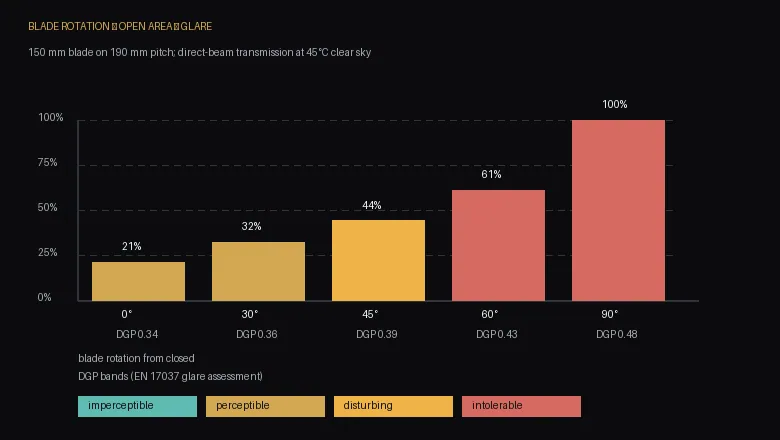
| DGP band | Value | Occupant experience |
|---|---|---|
| Imperceptible | < 0.35 | No restriction on screen work |
| Perceptible | 0.35–0.40 | Noticed, still comfortable — target band |
| Disturbing | 0.40–0.45 | Screen contrast drops, blinds requested |
| Intolerable | > 0.45 | Workstations effectively unusable |
How does blade geometry set daylight glare probability?
DGP responds strongly to vertical eye illuminance — the total light reaching the occupant’s eye from the window. A louver screen controls that illuminance twice. First, it blocks the direct solar disc, the single largest contributor. Second, it drops the apparent luminance of the sky: a 24%-open screen replaces a 6,000 cd/m² sky patch with a mix of gold anodized blade surfaces at roughly 1,000–2,000 cd/m² and darker gaps. Screen geometry that holds window luminance under about 2,000 cd/m² and cuts vertical illuminance by 70–85% typically brings DGP from the 0.45–0.55 range down to 0.35–0.40 — the difference between a workspace people use and one they abandon.
How does the cut-off angle work on a louver screen?
The governing number is the profile angle: tan Ω = tan h / cos γ, where h is the sun altitude and γ the azimuth offset of the sun from the facade normal. A blade rotated by (90° − Ω) from its closed position shades that beam completely. Because INDECO blades rest at 0–15°, they are tuned to cut the high sun that dominates Gulf and equatorial skies — and to open progressively as the sun drops and beam control shifts to the glazing behind. See how the same logic holds in hot, arid Gulf climates.
| Condition (Dubai, west elevation) | Sun altitude | Profile angle Ω | Blade rotation for full cut-off | Open area at that rotation* |
|---|---|---|---|---|
| 21 Jun, 12:00 | 88° | 88° | 2° — resting position | 21% |
| 21 Mar, 15:00 | 35° | 45° | 45° | 44% |
| 21 Dec, 15:00 | 20° | 27° | 63° | 61% |
*150 mm blade on 190 mm pitch. Low-angle winter and late-afternoon sun is the residual risk: where a brief demands seasonal cut-off, hybrid zones with motorised actuation can be added per elevation.
Why do blade width and pitch matter more than colour?
Buyers often argue about finish and forget the section. The table below shows why: because pitch scales with blade width, the resting open-area ratio barely changes — roughly 23–26% across the range. What blade width really buys is shadow depth and view granularity. A 200 mm blade at 15° casts a shadow band deep enough to shield a full workstation depth; a 100 mm blade gives finer light texture and lower module weight but a shallower cut-off. All blades are marine-grade 6063-T5 aluminium with anodized (AA25, 5–20 µm film, 200–500 HV) or PVDF finishes from our anodizing partner in Guangdong; modules run to 4.0 m height on the Kinetic Louver Facade range.
| Blade width | Pitch | Open area at 15° rest | Open area at 60° | Best fit |
|---|---|---|---|---|
| 100 mm | 130 mm | 26% | 62% | Tight glare control, shallow reveals, light structures |
| 150 mm | 190 mm | 24% | 61% | Standard tower elevations |
| 200 mm | 250 mm | 23% | 60% | Deep shadow, 4.0 m modules, landmark scale |
How much daylight survives a kinetic screen?
A 24%-open screen is not a 24%-daylight screen. Blade undersides reflect diffuse sky light into the depth of the room, so effective daylight transmission is typically 30–40% of unshaded glazing — enough to hold workplane illuminance in the 300–500 lux band that EN 17037 sets as the medium and high daylight targets over at least half of daylight hours. In climate-based terms, a typical 3.0 m floor-to-floor office with 2.6 m of glass behind the screen models at sDA 300/50% of roughly 55–65% — above the 55% threshold most rating schemes use — while annual sunlight exposure (ASE 1000,250) drops below the 10% limit that an unshaded west elevation routinely fails.
Why is west-facing glare the worst case at 45°C?
At Gulf latitudes the noon sun sits at up to 88° and is trivially cut off by nearly any horizontal blade. The problem is the west elevation between 15:00 and 18:00, when the sun drops to 20–35°, the profile angle closes, and occupants face the beam head-on — with 45°C outside pushing blinds down and cooling loads up. Near-equatorial East African sites such as Nairobi have the mirror-image problem: the sun crosses low in the east and west all year, so low-angle glare is an every-day event, not a seasonal one. In both climates the screen’s resting geometry — not its motion — is what holds the line through the worst hours.
| Surface seen through the window | Typical luminance | Visual effect |
|---|---|---|
| Sky adjacent to the sun, clear day | 6,000–10,000 cd/m² | Instant discomfort, DGP > 0.45 |
| Clear sky, away from the sun | 3,000–6,000 cd/m² | Disturbing without shading |
| Anodized blade surface, lit | 1,000–2,000 cd/m² | Bright but tolerable texture |
| Comfort guidance for window wall | ≤ 2,000–3,000 cd/m² | Screens stay readable |
How do you verify glare before the facade is built?
Glare is simulated, not guessed. The standard workflow is climate-based daylight modelling: an annual Radiance simulation at hourly steps using a TMY weather file for the site, a five-point illuminance sensor grid per occupied zone, and the glazing VLT and SHGC of the curtain wall behind the screen — typically a unitised system as described in the unitised glazing overview. Output is a DGP and ASE distribution, not a single number. A one-module physical mock-up under a real sky still earns its cost, and a post-handover luminance survey closes the loop.
| Stage | Deliverable | Pass criterion |
|---|---|---|
| Annual CBDM | DGP + sDA/ASE report, occupied floors | DGP ≤ 0.40; ASE 1000,250 ≤ 10% |
| Physical mock-up | 1 blade module × 1 bay, equinox sun path | Shadow band covers workstation depth |
| Post-handover survey | Window luminance mapping, occupied hour | ≤ 2,000–3,000 cd/m² at the window |
How does a kinetic screen compare with fixed louvers and coated glass?
Every shading family can cut glare; they differ in what they give up. Fixed louvers are tuned to one sun position and leak at low angles. Fritted or dark-tinted glazing takes daylight away all day, every day, whether the sun is out or not — typically 20–40% of visible light lost permanently. Electrochromic glass is genuinely dynamic but adds power, controls and 10–20 minute switching. A passive kinetic screen sits in between: its resting geometry does the constant shading work, and the wind-driven motion breaks up the static light pattern that makes occupants feel they are sitting behind a grille — at zero energy cost. The solid zones around the screen are closed with aluminum rainscreen cladding.
| Attribute | Passive kinetic screen | Fixed louver | Fritted glazing | Electrochromic IGU |
|---|---|---|---|---|
| Response to conditions | Wind-driven, from 0.9 m/s | None | None | Programmed, 10–20 min |
| Low-sun west glare | Partial — geometry + glazing | Leaks | Good | Good |
| Daylight penalty when unneeded | None | None | 20–40% constant | None |
| Power and controls | Zero | Zero | Zero | Powered, BMS-linked |
| Relative screen cost | Moderate | Low | Low–moderate | High |
What should a glare-control specification include?
- Blade profile, width (100/150/200 mm) and pitch, with the resulting open-area ratio at the 15° resting angle stated numerically.
- Resting angle tolerance and wind-return behaviour: activation below 0.9 m/s, service wind to 45 m/s verified by FEA over 150+ load cases.
- Finish and reflectance: anodized AA25 (5–20 µm, 200–500 HV, matte gloss to limit specular reflection) or PVDF, ΔE ≤ 2.5 between batches.
- Fire classification A2 and 25+ year design life, matched to the maintenance regime in the kinetic facade maintenance guide.
- Verification deliverables: annual DGP/sDA/ASE simulation, physical mock-up, and post-handover luminance survey.
Key takeaways
- Glare control on a wind-driven kinetic facade comes from fixed geometry — blade profile, pitch and the 15° resting angle — not from sun-tracking motion.
- A 150 mm blade on 190 mm pitch rests at 24% open area, blocking the direct beam and holding DGP in the 0.35–0.40 comfort band.
- Resting open-area ratio is nearly constant (23–26%) across 100/150/200 mm blades; width buys shadow depth and view granularity instead.
- The screen preserves 30–40% daylight transmission — enough for the 300–500 lux EN 17037 targets while cutting ASE below 10%.
- West elevations at 45°C Gulf sites and year-round low sun in East Africa are the governing cases; verify with annual DGP simulation plus a mock-up.
Frequently asked questions
Do kinetic facades block too much daylight?
No. A screen resting at 24% open area still transmits 30–40% of diffuse sky light once blade reflections are counted, enough to hold 300–500 lux on the working plane for most daylight hours. Blade undersides act as reflectors, bouncing light deeper into the plan than clear glazing alone.
What DGP value should a kinetic facade achieve?
Target daylight glare probability at or below 0.40 across occupied hours. Between 0.35 and 0.40 glare is perceptible but comfortable; above 0.40 screen contrast drops and occupants reach for blinds; above 0.45 the space is effectively unusable. Screen and glazing share the duty, so model both together.
Can a wind-driven facade control glare if it does not track the sun?
Yes, because the resting position is engineered for the worst hours. On Gulf elevations blades sit at 0–15°, cutting the near-vertical sun completely; low western sun is handled by glazing selection plus the screen’s residual shading. Where seasonal low-angle cut-off is needed, add hybrid motorised zones per elevation.
Which blade width is best for glare control?
Width matters less than buyers expect: because pitch scales with blade, the resting open-area ratio stays near 23–26% for 100, 150 and 200 mm alike. Use 150 mm as the tower default, 200 mm for deep shadow bands or 4.0 m modules, 100 mm where structure is tight.
How is glare performance verified before installation?
Through climate-based daylight modelling: an annual hourly Radiance simulation with the site weather file, the selected glazing VLT and SHGC, and the measured reflectance of the blade finish. Deliverables are DGP and sDA/ASE distributions per occupied floor, followed by a physical mock-up of one module and a post-handover luminance survey to confirm the window wall stays under 2,000–3,000 cd/m².
Need the glare numbers for your elevation?
Send us the orientation schedule, glazing build-up and site weather context. We return a DGP and daylight assessment for your kinetic screen — blade and pitch selection, resting-angle geometry, cut-off table for your latitude, and the finish specification. See the Kinetic Louver Facade range, browse the facade FAQ, or talk to our engineering team.